49 works in this view — arrow keys or swipe to move between them.
Dance in Art
Africans
Unknown artist
- Collection:
- Prints depicting dance
- Source:
- New York Public Library
- Rights:
- Public domain — free to use, share and adapt.
- Recorded as:
- Public Domain
Dance histories have long centered European theatrical forms while marginalizing or exoticizing non-European traditions. This print, despite its colonial perspective, is primary visual evidence of African communal dance practice and the attention it commanded from European documentation—a record that dancers and historians use to trace how African dance has been represented, misrepresented, and erased in Western collections. The specific gestures, body positions, and social arrangement offer hints about participatory dance aesthetics that differ fundamentally from the trained, vertical body of European classical dance.
What you are looking at
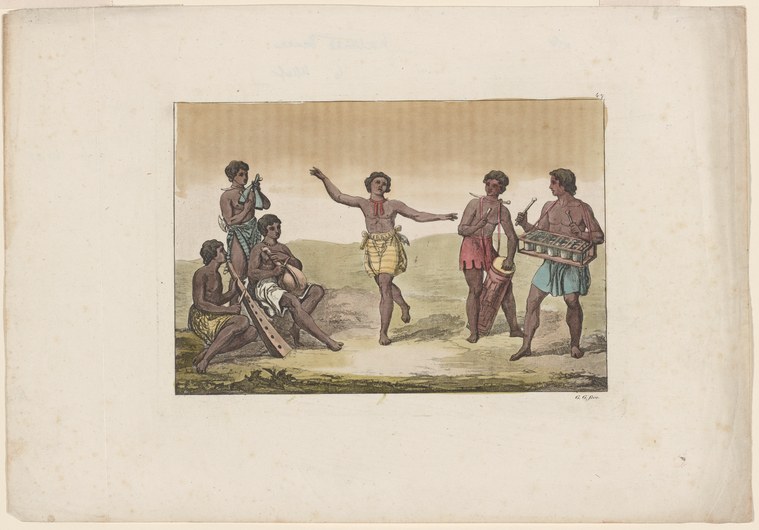
Six figures are arranged in a landscape of warm, sandy tones. On the left, two seated men are shown from behind; one holds what appears to be a long pipe or musical instrument. Standing and moving across the composition are four other figures in animated postures. The central figure, with one arm raised high and the other extended outward, appears to be leading or demonstrating movement. The figures wear minimal clothing—loincloths, wraps, and body ornaments in muted reds, greens, and earth tones. One figure on the right carries what looks like a large basket or woven object. The ground is sparse and open, with minimal vegetation, suggesting a gathering space. The coloring and hand-tinting of the print gives the scene a documentary quality, as if recording an observed moment rather than an imagined or theatrical one.
The dancing
The central dancer stands with weight shifted forward, one arm raised vertically and the other extended horizontally at shoulder height in an open, expansive frame. Two other standing figures nearby maintain upright, engaged postures. The seated figures on the left are passive observers. The bodies show clear weight shifts and directional orientation, suggesting active movement across the ground rather than a closed-partner hold. Arm and leg positions emphasize breadth and extension rather than vertical alignment or turned-out positions from trained ballet technique.
The dance depicted
This image most likely documents social or ceremonial dance from sub-Saharan Africa, given the dress, body adornment, setting, and the presence of what appears to be musical accompaniment (the long pipe). The animated postures and open spatial arrangement are consistent with participatory, community-based dance rather than choreographed theatrical performance. The raised-arm gesture and expansive frame may relate to celebration, greeting, or ceremonial expression. Without more specific iconographic detail or inscription, the exact cultural origin and dance name cannot be determined with certainty, but the visual evidence points to communal African dance practice rather than performance art for external audiences.
How it was made
This is a hand-colored engraving or aquatint, likely from the 18th or early 19th century, based on the technique, paper, coloring method, and overall aesthetic. The use of engraving allowed the image to be printed and circulated widely, and hand-coloring afterward suggests a work intended for educated, affluent collectors rather than mass production. The technique's linear precision is evident in the figures' outlines and the landscape framing, while the watercolor or hand-applied pigment adds naturalism and documentary warmth. This combination of methods was typical of illustrated travel narratives and ethnographic prints of the period.
About this work
This hand-colored engraving documents a moment of social or ceremonial dance from African cultural practice, likely created for circulation among European collectors of ethnographic imagery. The work captures active dancers in open, expansive postures, with musical accompaniment provided by at least one seated observer. The composition and technique position it within a tradition of illustrated travel documentation and cultural record rather than fine art or theatrical performance, yet it constitutes a significant visual document of dance practice outside the European canon. It belongs in a gallery about dance because it testifies to the presence and vitality of African dance traditions in the historical record, even when filtered through the perspective and conventions of European printmaking.
How to look at it
Attend to the raised arm and open frame of the central figure—this is the moment the artist chose to freeze, capturing a gesture of expansion or expression rather than a contained, vertical position. Notice that no two dancers hold the same pose, suggesting spontaneous, social movement rather than synchronized choreography. The presence of seated musicians and observers suggests this is a participatory event, not a performance staged for the print's audience. The artist's choice to show the dancers' full bodies and the ground beneath them emphasizes spatial and social context rather than decorative detail.
The period
The late 18th and early 19th centuries saw an explosion of illustrated travel narratives and ethnographic prints aimed at European readers curious about distant lands and peoples. These prints often combined scientific documentary ambition with aesthetic taste for the exotic, and dance—especially group, non-European dance—was a standard subject for such imagery. The hand-coloring technique and engraving method were expensive and labor-intensive, placing these works within the luxury market of illustrated books and portfolios for collectors. At the same time, European theatrical dance was undergoing its own transformation, with Romantic ballet emerging as a dominant form; the contrast between the improvisational, communal African dance shown here and the codified, individual artistry of European ballet reflects the deep aesthetic hierarchies of the period.
Where it lives
The work is held in the New York Public Library's prints collection, where it is catalogued under the title 'Africans' with minimal additional documentation. It is part of a larger body of hand-colored ethnographic engravings from the period of European expansion and colonial interest in non-European cultures.
Dance in this work
Questions about this work
Who created this print?
The artist is not recorded in the catalogue. The technique and style are consistent with 18th- or early 19th-century European engraving practice, and the work was likely created as part of an illustrated travel narrative or ethnographic portfolio, but without a signature or inscription visible in the image, attribution cannot be determined from the print alone.
What part of Africa does this show?
The catalogue and the print itself do not specify a geographic location or cultural group. The dress, body adornment, and setting are consistent with sub-Saharan African practice, but without text, inscription, or more detailed ethnographic markers, the specific region or people represented cannot be identified from the image.
Is this a 'real' dance or an invention by the artist?
The postures, social arrangement, and presence of musical accompaniment all suggest the artist was documenting observed or reported practice rather than inventing a fantasy. However, the work was created for a European audience, through the filter of European artistic convention and perspective, so it is a mediated representation rather than an unmediated record.
Why is the title just 'Africans'?
The simple title reflects both the generic framing common in 18th- and 19th-century ethnographic prints—where entire regions or continents were treated as undifferentiated subjects—and the likely loss of more specific documentation over time. This generalization is itself a record of how European collectors categorized and understood African cultures.
More dance artwork





