49 works in this view — arrow keys or swipe to move between them.
Dance in Art
Theatrical portraits
Unknown artist
- Collection:
- Prints depicting dance
- Source:
- New York Public Library
- Rights:
- Public domain — free to use, share and adapt.
- Recorded as:
- Public Domain
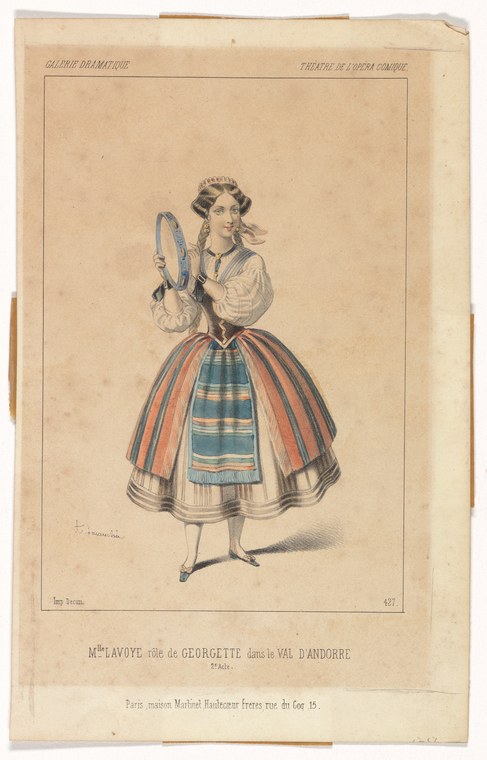
This work is a direct record of how a specific character was dressed and presented on stage in the mid-19th century—the costume, hairstyle, and accessories are fixed evidence of theatrical practice and taste in that period. For historians of operetta, comic theatre, and the connections between theatrical and dance practice, such portraits are primary documents showing how character types were visually constructed and communicated to audiences.
What you are looking at
A young woman in theatrical costume stands alone against a neutral background, presented in three-quarter view facing left. She wears a striped skirt in red, white, and blue—the stripes running vertically down the full length of the garment, with deeper blue-grey bands creating rhythm across the hem. Over this is a fitted bodice in pale cream or tan, with white puffy sleeves. A dark jacket or overdress with horizontal stripes in red and blue sits open over the bodice, draped to show the costume's constructed layers. She holds a mirror or round reflective object in her right hand, raised at shoulder height. Her hair is styled in the fashion of the mid-19th century, parted and gathered back, crowned with what appears to be a decorative bonnet or headpiece. Her left arm hangs naturally at her side. The setting is plain and theatrical—a studio presentation rather than a scene with narrative or landscape. The execution is a hand-colored engraving or lithograph, with fine line work and careful cross-hatching to define form and fabric texture.
The dancing
The single figure stands in a relaxed but poised posture, with weight evenly distributed and a slight forward lean. Her body is presented frontally enough to display the costume's construction, though her head turns slightly in profile. The raised arm holding the mirror is a deliberate theatrical gesture, perhaps indicating vanity, self-regard, or costume display—a pose that would read clearly from a distance. There is no evidence of active dance movement: the body is still, the legs straight, the feet positioned close together.
The dance depicted
This is not a depiction of dance in progress. The figure appears to be a theatrical or operatic character in costume, shown as a formal portrait study rather than captured mid-movement. The striped skirt, fitted bodice, and puffed sleeves suggest mid-19th-century theatrical dress, possibly from a comic operetta or vaudeville piece—the bright primary colors and stripes suggest a character role rather than classical ballet. The mirror held as a prop might indicate a character of vanity or coquetry. The work belongs to the tradition of theatrical portraiture, documenting costume and character type rather than choreography or dance technique.
How it was made
This is a hand-colored engraving or lithograph, executed with fine line work defining folds, seams, and surface texture. The technique allows precise rendering of costume detail, making this valuable as a record of theatrical dress construction. The hand coloring—applied after printing—gives the image immediacy and helps the textile patterns read clearly. This is a commercial theatrical portrait, likely published as a sheet for sale to audiences or collectors, which explains the numbered printing at the bottom and the credit line. The technique and finish suggest a Parisian or other European theatrical print house of the mid-1800s.
About this work
This is a theatrical portrait of a female character in comic operatic costume, rendered as a hand-colored engraving. The image documents mid-19th-century stage dress and character type rather than dance movement, but belongs in a dance history collection because theatrical portraiture of this era is inseparable from dance history: the same actresses often performed in both spoken theatre and ballet or operetta, and costume conventions crossed between forms. The figure is shown frontally in the formal studio manner, emphasizing the costume's construction and the character's identity.
How to look at it
Look at the way the costume is presented: frontally and in stillness, as if for a tailor's record rather than a moment of performance. The artist has taken care to show how the separate pieces—the striped underskirt, the fitted bodice, the open jacket—are layered and constructed. The mirror held in the raised hand is a theatrical prop and gesture, not a dance movement; it anchors the figure as a character with an identity and intention, not as a generic dancer. The hand coloring emphasizes the vivid primary colors of the stripes, which would have read strongly from the theatre gallery.
The artist
The artist is unrecorded in the catalogue. The credit line references a Parisian publisher (Michel Éditeur, Rue de la Bourse, no. 15) and identifies the figure as Mme Ayvoé in the role of Georgette in the Vaudeville (a Paris theatre). This is a commercial theatrical print from a publisher's series, suggesting a workshop practice in which artists produced costume portraits for popular actors and roles of the day, sold as sheet prints to collectors and theatre-goers.
The period
Mid-19th-century Paris saw a flourishing market in theatrical portraiture, fed by the popularity of opera, operetta, and vaudeville. Lithography and engraving made it possible to reproduce and hand-color images quickly, allowing publishers to capitalize on celebrity and fashion. The costume shown here—with its bright stripes, fitted bodice, and puffed sleeves—reflects the tastes of the 1840s–1860s, when operetta and comic theatre drew on contemporary women's fashion while exaggerating it for stage effect. This was also the period when ballet was shifting from Romantic ballet toward more elaborate scenic production, and when the boundaries between dance, operetta, and spoken theatre were fluid.
Where it lives
This is a commercial theatrical print from the New York Public Library's collection of prints depicting dance. It is identified in the catalogue as a theatrical portrait, but with minimal detail about date, artist, or medium.
Questions about this work
Is this a record of an actual performance or costume?
Almost certainly yes. The credit line identifies the actress (Mme Ayvoé) and the role (Georgette in the Vaudeville, a Parisian theatre), and gives the publisher's address. This is a commercial theatrical portrait, probably sold shortly after or during the run of the play. It is a record of how the character was costumed, though the pose is a studio convention, not a captured moment from the stage.
What is the mirror for?
It is a theatrical prop that identifies the character's type: a woman of vanity, charm, or coquetry. Holding it raised in the hand is a posed, deliberately readable gesture that tells the audience or print-buyer who the character is meant to be.
Is there any dancing in this image?
No. The figure stands still in a formal, posed manner typical of theatrical portraiture. This is costume documentation rather than a depiction of dance in progress. It belongs in dance history because theatrical dress, character types, and the operetta/ballet boundary are all part of how dance was made and seen in the 19th century.
More dance artwork





