49 works in this view — arrow keys or swipe to move between them.
Dance in Art
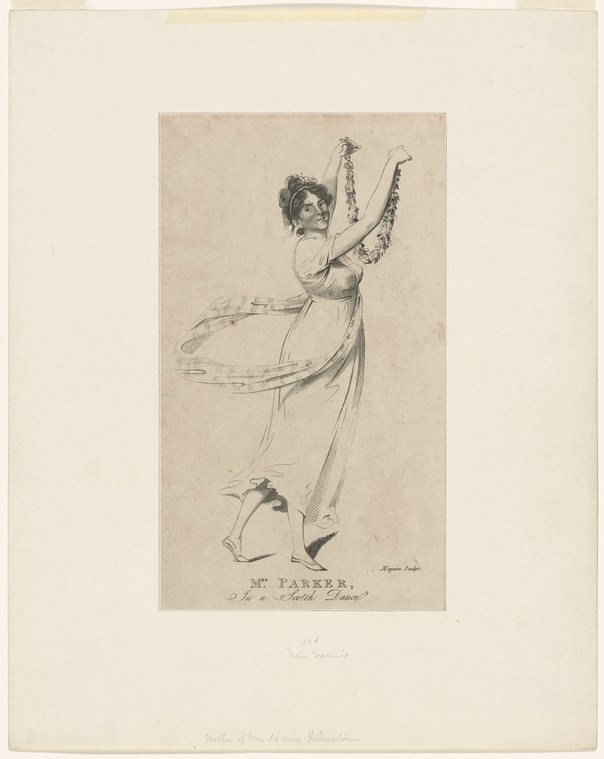
Mrs. Parker in a Scotch dance
Unknown artist
- Collection:
- Prints depicting dance
- Source:
- New York Public Library
- Rights:
- Public domain — free to use, share and adapt.
- Recorded as:
- Public Domain
This print documents a named female performer in motion—Mrs. Parker—and makes her the subject worthy of visual record and circulation. It demonstrates that Scottish country dance was not only a social or vernacular practice but was formalized enough, and fashionable enough, to be performed by named professionals and documented through fine-art prints. The care lavished on the rendering of her body in motion and the formal presentation of the print suggest that dance was considered a subject of cultural value and aesthetic interest.
What you are looking at
A woman in a high-waisted, neoclassical gown executes an energetic leap or bound in the center of the composition. Her body is caught mid-motion, arms raised above her head with hands holding what appears to be ribbons or streamers that arc upward; her legs are extended in a dynamic scissor-like position. The skirt of her dress billows around her, caught in the moment of suspension. A smaller figure of a man appears below her, dressed in dark clothing, seeming to look upward at the leaping woman. The drawing is executed in pen or pencil on a cream ground with delicate cross-hatching for shadow and volume. The composition is vertical and elongated, emphasizing the upward thrust of the dancer's movement.
The dancing
The primary dancer demonstrates a vertical spring or jump with an emphatic upward reach of both arms, creating a line from the extended legs through the torso to the raised hands. The pose suggests explosive elevation and control—the legs are in a wide open position rather than a tight or balletic line, and the arm carriage is expressive rather than formally placed. The secondary figure is passively witnessing rather than partnering. The overall frame and gestural vocabulary suggests a performer trained in theatrical movement rather than ballroom technique.
The dance depicted
The title identifies this as a 'Scotch dance' performed by a named performer, Mrs. Parker. The image shows characteristics consistent with the energetic, often jumping style of Scottish country dances as they were performed in theatrical or social contexts of the late 18th or early 19th century—particularly the use of elevation and the somewhat exaggerated, outward-turned leg position. The ribbons or props held aloft suggest either a theatrical elaboration of a folk form or a stylized social dance performance intended for an educated audience. Without a date on the print itself, the costume and artistic technique suggest performance contexts where Scottish identity was being commodified or celebrated within fashionable circles.
How it was made
This is a finely executed engraving or etching on paper, likely hand-colored or printed in a warm tone. The artist demonstrates considerable skill in rendering drapery and the human figure in motion—the skirt's voluminous folds and the delicate articulation of the limbs show anatomical understanding and an ability to suggest movement through line. The technique permits the kind of fine detail that would make this suitable for publication as a print or for inclusion in a bound collection of theatrical or social dance illustrations. The quality and care of execution suggest this was made for a discerning audience with access to prints—likely performers themselves, dance instructors, or members of polite society interested in dance.
About this work
This engraving depicts a theatrical performance of a Scottish country dance by Mrs. Parker, a performer whose name was considered worth recording on the print. The work preserves a moment of energetic, elevated movement captured in a medium that permits both the documentation of a specific performer and the circulation of dance imagery to a broader audience. It belongs to an important 18th–19th-century tradition of printing theatrical and social dance scenes, which were collected, shared, and studied both by professionals and amateurs. The image demonstrates how folk and national dance forms were adopted and elaborated within theatrical and fashionable contexts, and it stands as a record of a named woman dancer executing a recognizable and valued form.
How to look at it
Notice how the artist has frozen a moment of maximum elevation and extension—the dancer is fully airborne, her body elongated vertically. The ribbons or streamers add a visual flourish that would be invisible in an ordinary hop or jump, suggesting the theatrical context and the performer's intention to create a memorable image. The secondary figure of the man looking upward helps orient the viewer to the perspective and emphasizes the woman's dominance of the composition. The fineness of the line work and the delicate shading demonstrate the printmaker's commitment to rendering the figure with both accuracy and elegance.
The artist
The artist's signature or name does not appear clearly legible in the visible portion of the print, or remains unattributed in the catalogue record. The print shows the hand of a trained printmaker comfortable with figure drawing, drapery, and the representation of action—suggesting professional training and likely work producing theatrical, social, or instructional imagery.
The period
This print emerges from a period (likely late 18th or early 19th century, based on the neoclassical silhouette and engraving technique) when Scottish identity and culture were becoming fashionable in Britain following the Union, and when dance—both social and theatrical—was an established subject for visual documentation and study. The theatrical performance of national or folk dances was increasingly common among fashionable performers, and prints served as both records of specific performers and as instructional or inspirational images for audiences who might themselves dance. The high-waisted, flowing gown shown here reflects regency-era fashion, placing the image in the early 19th century or its immediate aftermath.
Where it lives
The print is held as part of the New York Public Library's collection of prints depicting dance. Such collections typically preserve theatrical records, instructional materials, and popular entertainment imagery, indicating that this work was considered significant enough for preservation and was part of a broader documentary effort to record dance practice and performers.
Dance in this work
Questions about this work
Who was Mrs. Parker?
Mrs. Parker is identified in the print's title as a performer of Scottish dance, but further biographical information is not available from this image alone. She was evidently well-known enough to be named on a distributed print, suggesting a professional or semi-professional performance career in the late 18th or early 19th century.
Is this a real Scottish dance?
The print is titled a 'Scotch dance,' and the dynamic, jumping movement is consistent with Scottish country dances as performed in that era. However, the theatrical elaboration—the ribbons, the maximal height of the leap, the formal presentation—suggests this is a performance adaptation or stylization of a traditional form rather than documentation of how it would have been danced in vernacular contexts.
Why would someone keep a print of a dancer?
Prints of performers served multiple purposes: they were souvenirs of a performance, instructional aids for people learning dance, inspiration for home performances, and records of famous performers. They circulated in polite and theatrical society and could be collected, framed, or bound into albums.
What are the ribbons in her hands?
The objects held aloft appear to be ribbons or streamers, a common prop in theatrical dance of this period. They would have enhanced the visual effect of the movement and may have been part of the costume or deliberately incorporated as a theatrical element.
More dance artwork





