49 works in this view — arrow keys or swipe to move between them.
Dance in Art
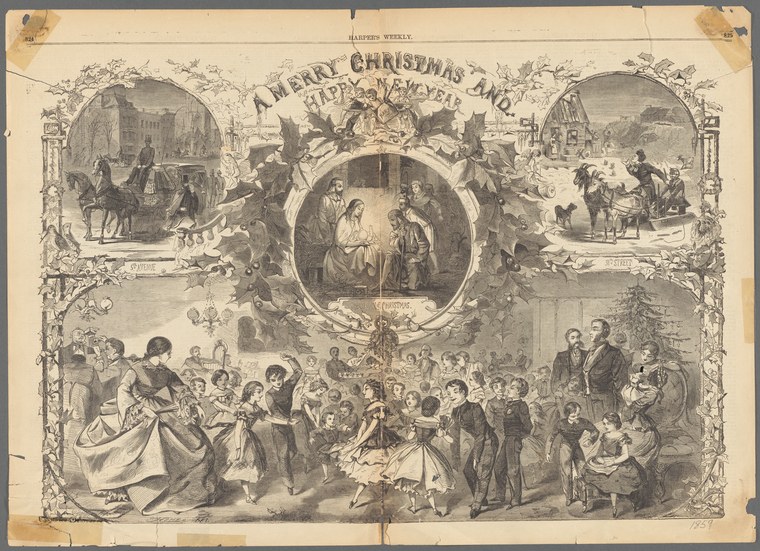
A merry Christmas and happy New Year
Unknown artist
- Collection:
- Prints depicting dance
- Source:
- New York Public Library
- Rights:
- Public domain — free to use, share and adapt.
- Recorded as:
- Public Domain
This print documents the waltz and polka at the moment when they had become the dominant social dances of the English-speaking world, yet were still sufficiently novel and morally contested that they were worthy of artistic attention. For dance historians, it offers concrete evidence of ballroom posture, hold, and spacing in the mid-Victorian period. For art historians and cultural historians, it exemplifies how dance functioned as a marker of modern, urban, middle-class identity—and how that identity was marketed and celebrated through popular print media.
What you are looking at
A Victorian-era engraving presents Christmas festivity organized around a central nativity scene. The composition is densely populated with overlapping vignettes: at top left, a formal indoor gathering with figures in evening dress; top right, an outdoor winter street scene with horse-drawn sleighs and carolers; center, the holy family in a glowing circular frame surrounded by cherubs and garlands; and below, a large crowded ballroom or assembly room where dozens of figures in formal Victorian dress engage in social dancing and celebration. The architectural framing—ornamental columns, flourishing botanical borders, and decorative scrollwork—creates a theatrical stage effect. Gas lamps and candlelight suggest evening entertainment. The overall impression is of Christmas as a season encompassing sacred reverence, domestic intimacy, outdoor merriment, and urban social dancing in equal measure.
The dancing
The lower ballroom scene, which dominates the composition, shows multiple couples in closed ballroom holds characteristic of mid-19th-century dance: men in dark tailcoats with one arm raised to frame the woman, women in full-skirted gowns with corseted waists. The couples stand in loose formation rather than the rigid lines of earlier quadrilles—suggesting the more fluid choreography of Romantic-era waltzes and polkas. Arms frame the bodies with the formality expected of Victorian social dance. The crush of figures and the variety of pose suggests the spontaneous sociability of a ball in progress rather than the strict geometry of a formal figure.
The dance depicted
The work depicts the waltz and polka as they were danced in fashionable Victorian ballrooms during the mid-to-late 19th century. These were the dominant social dances of the period, performed at Christmas celebrations among the urban middle and upper classes. The multiple couples, the closed hold with the man's right hand on the woman's waist, and the upright carriage are consistent with ballroom social dance of this era. The engraving captures not a specific choreographic innovation but rather the normative, recreational dancing of the season—the waltz in particular was still relatively new to Britain and America and remained a focus of holiday entertainment and, for some, moral controversy.
How it was made
This is a wood engraving or steel engraving, identifiable from the fine line-work, the tonal gradation achieved through cross-hatching, and the capacity to render detail across a large composition without loss of clarity. The technique allowed for mass reproduction and circulation; such prints were commonly bound into periodicals or sold separately as broadsheets, reaching middle-class and working-class households far beyond the reach of oil paintings. The ornamental border and the allegorical framing (nativity scene, cherubs, seasonal symbols) are typical of the commercial engraved Christmas cards and holiday prints that were a major publishing category from the 1840s onward.
About this work
This is a festive engraving celebrating Christmas in the Victorian era, with the ballroom scene as its primary secular expression. The work belongs to the tradition of Christmas prints that merged sacred imagery (the nativity) with scenes of contemporary social life—in this case, the waltz and polka as practiced in urban ballrooms. It documents not a special or staged performance but the ordinary social dance of the holiday season, the kind of evening entertainment that defined middle-class celebration in the 19th century.
The engraving is valuable as evidence of how widely the waltz had penetrated English and American culture by mid-century, and how completely it had displaced earlier quadrille-based formations in popular imagination. The composition also reveals the artist's understanding of the ballroom as a space where dance was continuous, informal, and woven into the fabric of seasonal conviviality rather than reserved for formal display.
How to look at it
Attend first to the ballroom at the base of the composition: note the formal but relaxed spacing of the couples, the consistency of the closed hold, and the way the artist has arranged bodies to suggest the rotating motion of the waltz without freezing a single moment in the turn. The engraver has chosen to show the ball in mid-swing—not at its opening (when the mood would be more formal) nor at the moment of a specific figure, but rather in the continuous, convivial state that ballroom dancing occupied in Victorian life. Compare the ballroom figures to the skating couples and carolers in the upper scenes: the engraver is making a point about the varieties of Christmas pleasure, but also about the formality and social hierarchy that ballroom dance maintained even as it became 'democratic' in its reach.
The period
The waltz emerged from Austrian and German court dance in the early 19th century and spread rapidly to Britain and America, where it provoked both enthusiasm and moral anxiety—it was danced in closed hold, brought bodies into proximity, and introduced rotational movement that some clergy and social conservatives condemned as immodest. By the 1860s–1880s, when this print was likely made, the waltz had become fully naturalized as respectable entertainment for the middle class. The polka, introduced in the 1840s, quickly became its equal in popularity. Christmas celebrations had by this period become heavily commercialized and sentimentalized in Victorian culture, with printed imagery playing a central role in defining and disseminating the holiday ideal. Wood and steel engraving were the dominant technologies for color and black-and-white reproduction, allowing publishers to flood the market with seasonal imagery.
Where it lives
The work is held in the New York Public Library's collection of prints depicting dance. No artist attribution is recorded. The print is consistent with the commercial Christmas gift-print tradition of the mid-to-late 19th century, the kind of item that would have been sold in urban print shops or included in holiday gift albums.
Dance in this work
Questions about this work
When did the waltz become acceptable in Britain and America?
The waltz emerged in Vienna and Prague around 1800 and began appearing in London ballrooms in the 1810s, where it was initially greeted with moral suspicion—the closed hold and rapid turning were considered improper. By the 1840s it had become standard in fashionable society; by the 1860s–1880s it was the dominant social dance across the middle class. This print, likely from the 1870s–1880s, shows the waltz as fully normalized holiday entertainment.
What is the hold and frame shown here?
The closed ballroom hold shown throughout the lower scene is standard for 19th-century waltz and polka: the man's right hand rests on the woman's waist (or her lower back), his left hand holds her right hand at shoulder height. The couple faces the same direction and rotates as a unit. This hold, while normal to modern ballroom dancers, was still controversial in the early 1800s and was central to arguments about the waltz's morality.
Why is a nativity scene at the center of a Christmas dance print?
Victorian Christmas imagery often merged sacred and secular: the holy nativity (the birth of Christ, the reason for the season) was surrounded by scenes of contemporary celebration and consumption. This engraver is saying that Christmas encompasses spiritual reverence, family warmth, outdoor mirth, and fashionable social dancing—all equally part of the season as it was lived and imagined in urban Victorian culture.
How do I know this is an engraving and not a painting or drawing?
The technique is visible in the fine parallel lines (hatching) used to create shadow and tone, the crispness of the line-work, the way fine detail is maintained across the entire composition, and the absence of brushwork or tonal wash. This is characteristic of wood or steel engraving, a reproductive technique that allowed prints to be made in quantity.
More dance artwork





