49 works in this view — arrow keys or swipe to move between them.
Dance in Art
Portraits of women
Unknown artist
- Collection:
- Prints depicting dance
- Source:
- New York Public Library
- Rights:
- Public domain — free to use, share and adapt.
- Recorded as:
- Public Domain
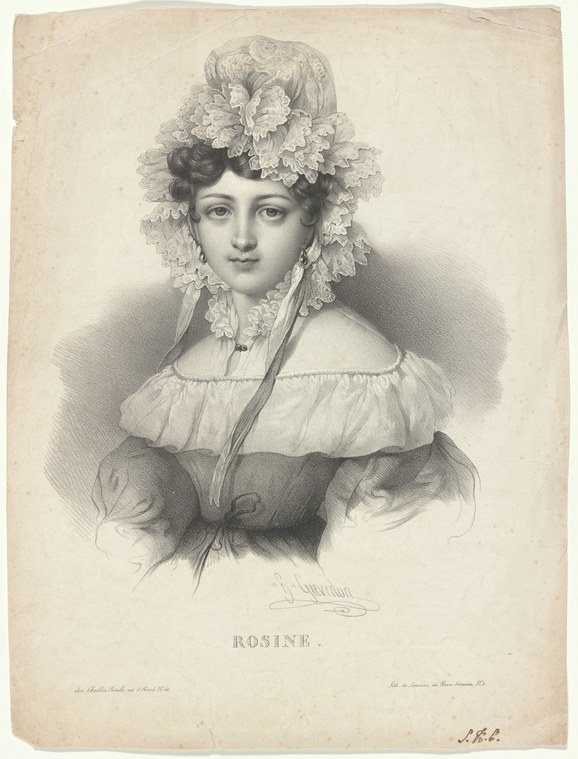
Regency-era fashion prints are crucial documents of early 19th-century theatrical and social presentation. If 'Rosine' is indeed a stage performer, this engraving shows how dancers and actors were marketed and consumed by the public—as fashion icons and objects of visual desire as much as practitioners of their art. The elaborate headdress and studied composure reflect conventions of Romantic-era beauty and stagecraft.
What you are looking at
A three-quarter-length portrait of a young woman in early 19th-century dress, shown from roughly the waist up against a plain background. She wears a white off-shoulder chemise or blouse with voluminous puffed sleeves, beneath which a darker-colored dress (possibly black or deep brown) is visible. Her shoulders are bare or nearly so, following the fashion of the Regency period. Most striking is her elaborate headdress: white lace or muslin arranged in wide, sculptural wings or ruffles that frame her face and rise well above her head, creating a theatrical silhouette. The headdress suggests formal evening wear or stage costume. Her dark hair is gathered beneath the lace. Her expression is serene and direct, her gaze meeting the viewer. The engraving technique renders her skin with fine cross-hatching to suggest volume and shadow, while her costume is rendered in crisp, precise lines. The composition is symmetrical and frontal, emphasizing the architectural quality of the headdress as much as the figure herself.
The dancing
The figure is static and posed rather than captured mid-movement. The body is held upright and still, with arms not visible or only barely suggested at the composition's edge. The shoulders are drawn back in a posture of formal presentation. There is no suggestion of active dance movement—no caught moment of balance, turn, or leap. The figure reads as a portrait or fashion plate rather than a choreographic study.
The dance depicted
This image does not depict a dance or active dancing. It is a portrait of a woman in fashionable dress of the Regency era (approximately 1810–1820). While the elaborate costume and formal presentation might suggest theatrical or ballroom contexts, the static pose and direct frontal composition are those of portraiture, not dance documentation. The label 'ROSINE' (visible at the bottom of the print) may indicate the sitter's name or a theatrical stage name, but the image itself shows only a posed figure, not a performer in motion.
How it was made
This is a steel or copper engraving, a reproductive print technique of the early 19th century. Engraving allowed for fine detail and wide circulation—this would have been an affordable way to disseminate fashionable images to the middle classes. The signature visible in the image (possibly 'Devéria' or similar) indicates the engraver rather than necessarily the original artist. The technique's precision and the care lavished on rendering lace, fabric texture, and facial features suggest this was made for publication, likely as a fashion or theatrical print, and would have circulated among subscribers to illustrated periodicals or as individual folios.
About this work
This is a Regency-era portrait engraving of a woman in formal evening or theatrical dress, notable for its elaborate lace headdress and the high standard of reproductive printmaking. The work sits at the intersection of fashion documentation and portraiture—it records both a moment of sartorial elegance and, possibly, a performer known by the name Rosine. The image belongs in a dance gallery not because it shows dancing, but because it documents the costume and presentation conventions of the early 19th-century stage and ballroom, and because the name 'Rosine' may refer to a known dancer or character of the period. Such prints were often collected by theater enthusiasts and dance patrons, and they provide evidence of how performers and fashionable women were publicly represented.
How to look at it
View this as a document of presentation rather than action. Attend to the headdress—its scale, its sculptural quality, and the way it frames and enlarges the head in a manner both flattering and theatrical. Notice the contrast between the solid black dress and the white gauze or lace of the blouse and headdress; this tonal balance was central to Regency fashion aesthetics. The direct gaze and frontal pose are conventions of portraiture, designed to make the viewer an imagined acquaintance of the sitter. If this is indeed a stage portrait, the stillness is itself a stage convention—the captured 'likeness' rather than the captured movement.
The artist
The engraver's signature is present but not clearly legible in reproduction. The style and quality of execution are consistent with the major reproductive engravers of Paris in the 1810s–1820s, a period when illustrated fashion prints and theatrical portraits were in high demand. Without clearer attribution, it is not possible to specify the artist's individual practice, but the work is representative of a thriving commercial print industry that served both fashion enthusiasts and theater patrons.
The period
The 1810s–1820s saw the height of the Regency period in England and the parallel Restoration period in France, eras of neoclassical and Romantic artistic and social sensibility. In dance, this was the age of Romantic ballet's emergence—the elevation of ethereal, otherworldly femininity as an ideal, though this print precedes the full flowering of Romantic ballet (which would dominate from the 1830s onward). In fashion, the high-waisted empire silhouette and bare shoulders represented the height of neoclassical elegance. Theatrical prints and fashion engravings circulated widely and shaped public taste; they were as important to the dissemination of performance culture as playbills and reviews.
Where it lives
The work is held in the New York Public Library's collection of prints depicting dance (or related theatrical and fashion subjects). The presence of a signature and inscription suggests this was a published print, likely circulated as part of a series or in periodicals; individual impressions would have been collectible items for those interested in fashion, theater, or portraiture.
Questions about this work
Is this a dancer?
Possibly. The name 'Rosine' inscribed on the print may refer to a performer, but the image itself is a static portrait, not a depiction of dancing. The elaborate costume and theatrical presentation suggest a connection to performance, but the print documents dress and appearance rather than choreography or movement.
What is that extraordinary headdress?
It is a lace or muslin cap arranged in large, sculpted wings or ruffles—a formal evening headdress of the Regency era. Such headdresses were worn at balls, in the theater, and in formal society. The scale and elaboration here suggest either high fashion or stage costume; the exaggerated height and width would have been striking in person and would have made the wearer conspicuous in a ballroom or on stage.
When was this made?
Based on the fashion and engraving style, likely between 1810 and 1825. The empire silhouette, bare shoulders, and precision of the engraving technique are consistent with the Regency and Restoration periods. Without a dated publication line visible on this impression, a more precise date cannot be established from the image alone.
What does the signature at the bottom mean?
It identifies the engraver—the artist who cut the plate and pulled the prints. It does not necessarily tell us who designed the original image, who the sitter was, or who published the print. In 19th-century reproductive prints, the engraver's name was the mark of quality and circulation.
More dance artwork





