49 works in this view — arrow keys or swipe to move between them.
Dance in Art
Carolina Galetti
Unknown artist
- Collection:
- Prints depicting dance
- Source:
- New York Public Library
- Rights:
- Public domain — free to use, share and adapt.
- Recorded as:
- Public Domain
This portrait is a primary source for the social and professional identity of an early 19th-century performer, and for how theatrical portraiture functioned as a vehicle for self-promotion and celebrity. The skill of the printmaker and the formal presentation of Galetti suggest she was a significant figure on the stage of her time, yet her name appears in no standard dance histories—a silence the image itself contradicts. For historians of dance and theater, such portraits are archives of otherwise lost performance cultures.
What you are looking at
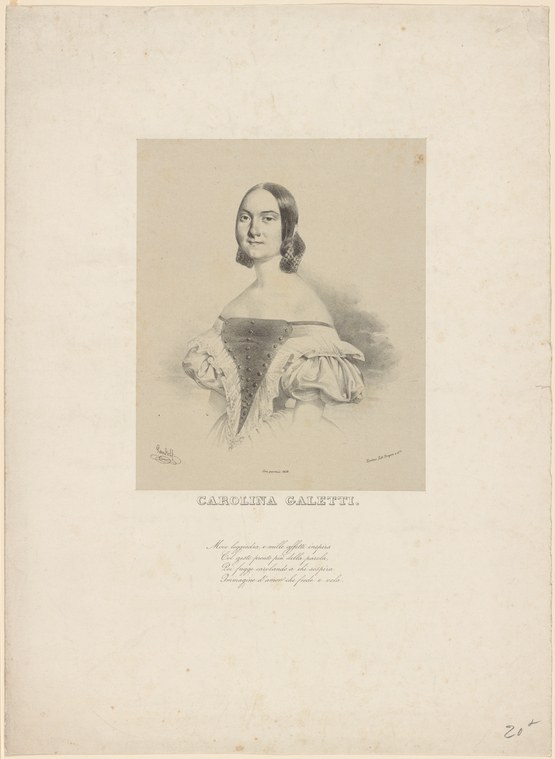
A three-quarter-length portrait of a young woman, rendered in fine pencil or lithographic crayon on a light ground. She faces slightly to the left, her body angled and relaxed, wearing a dark off-the-shoulder dress or bodice with voluminous white puffed sleeves gathered at the wrists. Her hair is parted in the center and falls in waves to shoulder length. The background is empty and neutral, allowing the figure to occupy the full compositional weight. The artist has used subtle shading to model the face and shoulders, creating a soft, intimate quality. Below the portrait, her name is inscribed: CAROLINA GALETTI.
The dancing
A single standing figure, her pose languid and informal—weight shifted slightly, shoulders relaxed, gaze directed toward the viewer with a gentle, knowing expression. The dress is cut to reveal the shoulders and décolletage in a style characteristic of theatrical costume or fashionable evening wear of the early 19th century. The sleeves are the visual focus: gathered and billowing, they emphasize the upper arm and create volume through gathered cotton or silk. There is no suggestion of movement or dynamic pose; she is presented as though paused during a performance or at rest.
The dance depicted
The identity of Carolina Galetti as a professional performer is supported by the formal presentation of this portrait and the theatrical cut of her dress. Without additional documentation in the catalogue, her specific role—whether dancer, singer, or actress—cannot be determined from the image alone. The style of the dress and the period conventions of theatrical portraiture suggest a performer active in the early 19th century, likely in an operatic or balletic context. The voluminous sleeves and off-shoulder cut are consistent with the Romantic era costume for stage performance, and the refined technique of the portrait suggests a work of some artistic standing commissioned to promote or commemorate her professional standing.
How it was made
This is a lithograph or engraving, created using a tonal technique to achieve fine gradation and soft modeling. The work demonstrates considerable technical skill: the artist has used fine parallel lines and subtle shading to render the fabric, especially the luminous puffed sleeves, and to create dimension in the face and neck. The signature in the lower left corner (partially visible) suggests the artist's professional hand. Lithography or engraving of this kind was the standard medium for theatrical portraiture in the early 19th century, allowing for multiple impressions and wide circulation among audiences and the theater-going public. The light, even printing ground and the careful registration of tone indicate a professional print workshop.
About this work
This is a formal theatrical portrait of a professional performer named Carolina Galetti, rendered as a fine-art print in the early 19th century. It belongs in a gallery of dance in art as evidence of how dancers and theatrical performers were memorialized and marketed to the public during the Romantic era. The print captures not a moment of performance, but rather the professional identity and social standing of an individual artist—a convention fundamental to how the public knew and followed dancers of the period. Although the image does not depict her dancing, it is inseparable from the culture of dance and performance it commemorates.
How to look at it
The portrait is not a document of Galetti dancing; it is a document of her as a public figure. Attend to the dress, which marks her as a stage performer: the theatrical cut, the expensive fabric, the fashionable styling all signal professional standing. The pose—relaxed, informal, gazing outward—is designed to convey confidence and star quality rather than virtuosity. The artist chose not to depict her in action or in dramatic gesture, but rather in repose: a choice that emphasizes her individuality and presence rather than the technical feats of her art.
The artist
The signature is not clearly legible in reproduction. The work is a professional lithograph or engraving, created by a skilled hand trained in the conventions of theatrical portraiture. The technique and presentation suggest a commercial print workshop of the early 19th century, likely in a major European theatrical center such as Paris, London, or Milan.
The period
The early 19th century was the age of Romantic ballet and grand opera, when dancers achieved celebrity status and their likenesses were widely circulated in print form. The costume and styling of this portrait are consistent with the 1820s–1840s, when the off-shoulder ball gown and theatrical bodice became standard dress for female performers on the lyric stage. Lithography and engraving had recently become efficient enough to support a mass market in theatrical portraiture, democratizing access to images of famous performers. Carolina Galetti's portrait belongs to this commercial tradition of performance ephemera.
Where it lives
The work is held in the New York Public Library as part of a collection of prints depicting dance. It is catalogued as an artwork of unknown date and unknown artist, with no medium specified in the record, though the image itself clearly identifies it as a lithograph or engraving produced and circulated as a commercial print.
Questions about this work
Was Carolina Galetti a famous dancer?
The print format and formal presentation suggest she was a professional performer of some standing in the early 19th century. However, her name does not appear prominently in standard histories of dance or theater, making her an example of how many historical performers have been obscured by time despite having achieved public recognition in their own era.
Why is she not dancing?
This is a portrait, not a performance image. Its function was to circulate her likeness and reinforce her professional identity and star status among theatergoers. Portraits of performers in the 19th century often presented them in costume or theatrical dress, but posed and still, to emphasize their glamour and individuality rather than their technique.
What does the dress tell us?
The off-the-shoulder bodice, voluminous sleeves, and refined fabric are typical of stage costume for female operatic and ballet dancers in the 1820s–1840s. The style signals both her era and her professional status, as such garments were expensive and associated with the lyric stage rather than everyday wear.
More dance artwork





