49 works in this view — arrow keys or swipe to move between them.
Dance in Art
Rosita Mauri
Unknown artist
- Collection:
- Prints depicting dance
- Source:
- New York Public Library
- Rights:
- Public domain — free to use, share and adapt.
- Recorded as:
- Public Domain
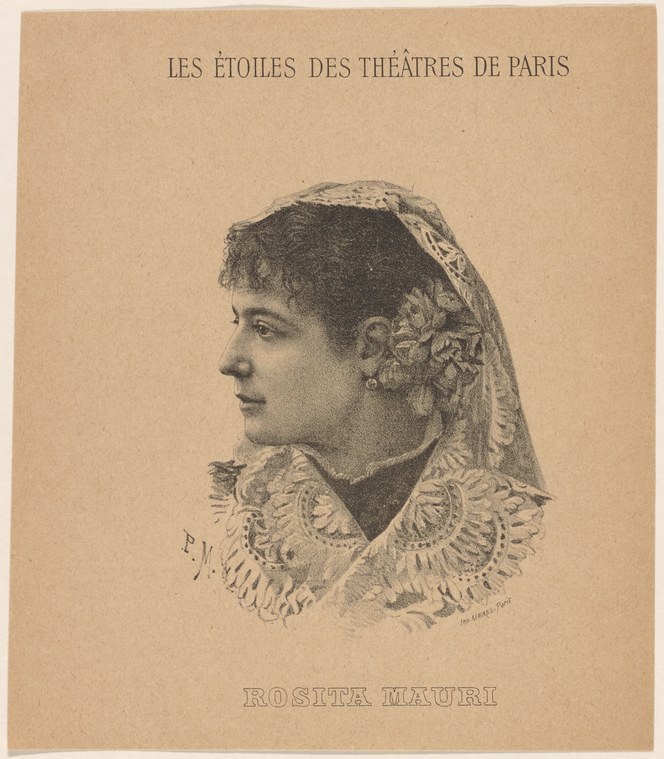
Rosita Mauri was a significant figure in late 19th-century European ballet and Spanish dance; this portrait is evidence of her celebrity and the commercial apparatus that sustained it. The series to which this belongs documents the pantheon of Paris theatrical dance during a formative period in the medium's history, making it valuable for understanding how dancers were branded, circulated, and remembered in the public imagination.
What you are looking at
A woman's profile portrait, shown from the shoulders up against a plain buff background. She wears an elaborate lace collar or fichu of striking delicacy, with deep scalloped edges and intricate geometric patterning typical of Valenciennes or Brussels lace. Over this sits a decorative lace head covering or snood, fastened at the back of her dark upswept hair. The woman's features are refined and her gaze directed downward in a contemplative pose. The work is rendered in a grayscale medium with careful attention to the tonal subtleties of the lace, which reads almost luminous against the darker tones of her hair and costume. The inscription "ROSITA MAURI" appears in capital letters below the portrait.
The dancing
A single figure shown in a three-quarter profile view. The posture is upright and poised, with the head tilted slightly downward in a pose of dignified repose rather than active movement. The shoulders are squared and relaxed. There is no active dance movement or gesture captured here; this is a formal portrait study rather than an action image.
The dance depicted
This is a portrait of the dancer Rosita Mauri, a celebrated Spanish dancer of the late 19th century, but the image itself does not depict dance or dancing. It is a commemorative portrait, likely created for theatrical publicity or documentation purposes. The inscription confirms the subject's identity. No dance style or technique can be identified from the image, as it shows only the dancer's face and upper body in repose.
How it was made
This is a lithograph or engraved portrait, executed in grayscale. The technique allows for the fine rendering of delicate surfaces—particularly visible in the intricate detail of the lace collar and headdress, where cross-hatching and careful tonal work create depth and translucence. The medium suggests this was a mass-produced print, likely part of a series titled "Les Étoiles des Théâtres de Paris" (The Stars of Paris Theatres), designed for circulation among theatre patrons and collectors of theatrical memorabilia.
About this work
This is a commemorative portrait print of Rosita Mauri, a prominent dancer on the Paris stage in the late 19th century. It belongs to a series documenting the leading theatrical performers of the era. While the image shows the dancer herself rather than depicting her in performance, it is a valuable document of how dancers of this period were presented and celebrated, and of the sartorial refinement and elegance associated with the theatrical world. The work captures not dance itself but the cultural status and personal presentation of a major performer.
How to look at it
Attend to the rendering of the lace: the artist has used careful tonal variation and pattern work to create the illusion of transparent, three-dimensional fabric draping against the figure's neck and head. The downward tilt of the gaze and the refined, composed expression present the dancer not in a moment of performance but in a state of dignified repose—the portrait projects classical elegance rather than theatrical dynamism. This is the visual language of respectability: the lace and careful grooming signal a performer of high social standing, not a disreputable theatre figure.
The artist
The artist is not recorded in the catalogue. The work is part of a published series, "Les Étoiles des Théâtres de Paris," which suggests the portraits were either commissioned work or documentation produced by a commercial print house serving the theatre industry. The refined lithographic technique indicates a professional atelier with considerable skill in portraiture.
The period
The late 19th century saw the rise of celebrity culture around theatrical performers, particularly dancers, who became subjects of widespread commercial portraiture and collection. This series exemplifies the market for theatrical memorabilia and the way dancers—especially international stars like the Spanish-born Mauri working in Paris—were packaged for public consumption. The careful attention to costume detail reflects the period's fascination with exotic and refined dress, particularly the elaborate lacework and headdresses worn by female performers of social standing.
Where it lives
This print is held by the New York Public Library in its collection of prints depicting dance. It is part of a series documenting the celebrated performers of Parisian theatres in the late 19th century, suggesting it was created as commercial theatrical publicity and collected as documentary material.
Questions about this work
Who was Rosita Mauri?
Rosita Mauri (1850–1923) was a Spanish dancer renowned for her roles in Romantic and classical ballet on the European stage, particularly in Paris, where she performed at the Opéra. She was celebrated for her technical skill and stage presence and became a major star of the late 19th-century ballet world.
What is the lace she is wearing?
The portrait shows an elaborate lace collar and decorative lace headdress typical of fashionable theatrical costume of the period. These were expensive accessories signaling the wearer's status and refinement—crucial for dancers performing dramatic or classical roles who needed to project elegance and social respectability.
Why is this a portrait and not a dance scene?
This print is part of a promotional or documentary series celebrating theatrical stars by name. Rather than depicting them in performance, the series presents them as individuals worthy of recognition, using the formal language of portraiture to grant them dignity and celebrity status.
What is 'Les Étoiles des Théâtres de Paris'?
This was a published series of portrait prints of leading performers at Paris theatres. The title translates as "The Stars of Paris Theatres" and documents the pantheon of theatrical talent—dancers, singers, and actors—who dominated the Parisian stage during the late 19th century.
More dance artwork





