49 works in this view — arrow keys or swipe to move between them.
Dance in Art
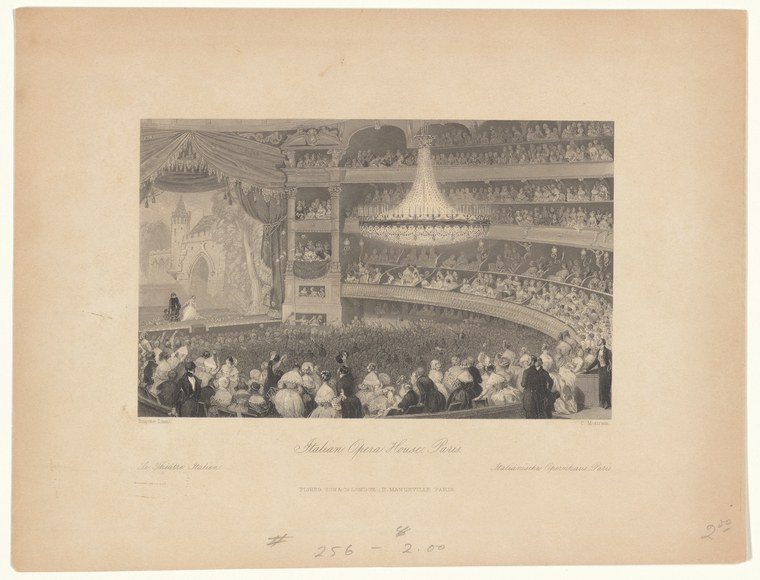
Italian Opera House, Paris
Unknown artist
- Collection:
- Prints depicting dance
- Source:
- New York Public Library
- Rights:
- Public domain — free to use, share and adapt.
- Recorded as:
- Public Domain
This print preserves the interior appearance of a major European opera house during the era when ballet was flourishing as a component of opera. For historians of dance and theater, it is material evidence of the physical space, capacity, and social composition of the audience that supported the art form. The image shows us where dance happened and for whom, which is as important as knowing what steps were performed.
What you are looking at
A vast theater auditorium packed with spectators fills the lower two-thirds of this engraved composition. The crowd occupies the orchestra level and rises in tiered galleries toward the back, their forms rendered in dense clusters of figures in evening dress. At center stage stands a monumental chandelier of crystalline form, emanating light. The stage itself is shallow and theatrical, framed by ornate architectural detail—decorated columns, arched ceiling with coffers, and draped curtains. A distant cityscape or palatial interior is visible in the backdrop, suggesting the opera's grand setting. The scale of the audience dominates the image, emphasizing the occasion's importance and the theater's capacity. The engraving technique creates a uniform tonal treatment across the scene, with careful linework defining the architecture and the massed crowd.
The dancing
The dancers themselves are not the focus of this composition—they are absent or too distant to read clearly. The image is an architectural and social record of the theater space and its audience rather than a dance study. The crowd of spectators, rendered in outline and shadow, fills the entire lower section; they sit passively in their places, not participating. The composition inverts typical theatrical imagery by privileging the audience's presence over the performers' bodies.
The dance depicted
This is a documentary image of a theatrical occasion—the interior of the Italian Opera House in Paris—rather than a depiction of dance or dancers in action. Opera houses of this period included dance in their programs, particularly in ballet and divertissements between acts, but the engraving makes no attempt to show dancers performing. Instead it records the architecture, the audience composition, and the event itself as a social spectacle. The work is historical testimony to the scale and prestige of Parisian opera culture in the era indicated by its style.
How it was made
This is a line engraving, likely a reproductive print made from a drawing or painting of the theater interior. The technique allows precise rendering of architectural detail and crowd composition through careful hatching and parallel lines. The fineness of the engraving and its scale suggest this was a professional publication—a commemorative or documentary print intended for a literate, urban audience. The discipline of the medium—every figure must be individually suggested through line rather than tone—lends the crowd a formal, almost ritualistic quality. Such prints were common vehicles for recording important civic spaces and social events in nineteenth-century France.
About this work
This engraving documents the interior of the Italian Opera House in Paris, a major venue for operatic performance and ballet. The composition privileges the theater's architecture and the assembled audience over any depiction of the stage action, recording the social importance of the occasion and the scale of the modern theatrical apparatus. The image belongs in a gallery of dance in art not because it shows dance in progress, but because it is evidence of the institution and the audience that shaped how dance was created, presented, and consumed in the nineteenth century. It testifies to the theater as a social and architectural achievement, and to the audience as an essential part of the theatrical event.
How to look at it
The viewer should note the vast scale of the audience relative to the stage, which emphasizes the social importance of attending the opera rather than the action on stage itself. The almost architectural quality of the composition—the emphasis on the theater's structure, the box seats, the galleries—shows how the building itself frames and contains the performance. The lack of visible dancers or action on stage is striking and intentional; this is a print about the institution of opera, not about what happens within it. The formal, orderly rendering of the crowd suggests the decorum and social ritual surrounding operatic attendance.
The period
This engraving dates stylistically to the mid-nineteenth century, a period of expansion in European opera house construction and the consolidation of ballet as a prestigious theatrical art. Paris was the capital of ballet innovation, home to the Opéra and a center of operatic culture. The formal, hierarchical arrangement of the Parisian audience—with boxes for the wealthy and galleries for the less affluent—reflects the social stratification of the period and the theater's role as a venue for public display of rank and taste. Operatic ballet of the 1840s-1860s was dominated by the aesthetics of Romantic ballet, emphasizing ethereal grace and exotic narrative; this grand auditorium was the setting for such spectacles.
Where it lives
This engraving is part of the New York Public Library's collection of prints depicting dance. The holding reflects the library's interest in documenting the material culture and institutions of performance.
Questions about this work
Where is the Italian Opera House in Paris?
The exact theater intended by this title is unclear, as Paris had multiple opera venues during the nineteenth century. The most prominent was the Palais Garnier, built for the Opéra (opened 1875), but this print may depict an earlier house, the Salle Le Peletier, or another theater. The catalogue record does not specify, and the engraving's style suggests a date before Garnier's completion.
Why is the audience so prominent?
Prints like this one celebrated the theater as a civic institution and social event. The size and composition of the audience testified to the prestige of the occasion and the drawing power of opera. The audience's presence was part of what made the event noteworthy and marketable.
What dances would have been performed at an opera house like this?
The primary dances would have been ballet—both as a standalone performance and as divertissements incorporated into operas. Nineteenth-century Parisian ballet featured pointe work, romantic narrative, and exotic or fantastical themes. Ballets such as *La Sylphide* and *Giselle* were staples of the operatic stage.
Can you see the dancers or stage action?
No. The distant stage is rendered too small to show dancing figures in detail. The engraving is a view of the theater as a whole—its volume, its population, its architectural grandeur—rather than a record of specific performers or choreography.
More dance artwork





