49 works in this view — arrow keys or swipe to move between them.
Dance in Art
Bellerophon
Unknown artist
- Collection:
- Prints depicting dance
- Source:
- New York Public Library
- Rights:
- Public domain — free to use, share and adapt.
- Recorded as:
- Public Domain
For dance historians, this work illuminates how the Renaissance and Baroque understood the human body as a site of expression and allegory, and how gestural intensity and formal composure were deployed to represent heroic virtue versus chaotic nature. The satyr's convulsed posture offers evidence of how artists of this period visualized and valued extreme bodily attitudes, a vocabulary that would inform the emerging aesthetics of theatrical movement.
What you are looking at
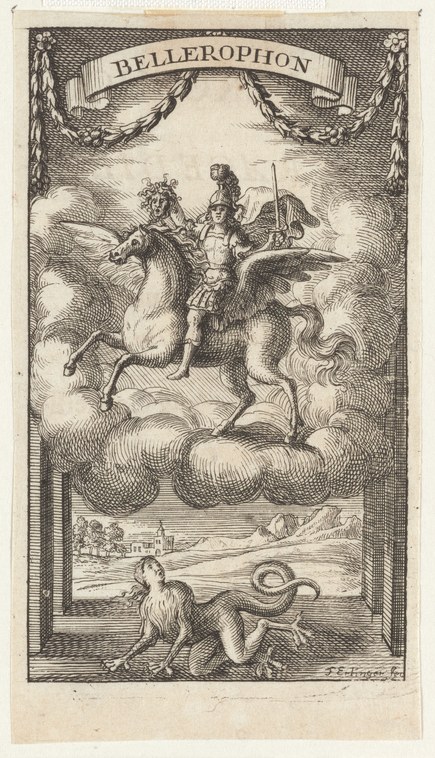
A mythological scene rendered as an engraving in which a winged horse (Pegasus) rears dramatically above clouds, carrying two figures: a warrior in classical armor and dress who gestures heroically forward, and a crowned woman (likely Athena or a muse) who steadies him. Below, in a lower register of the composition, a satyr or faun sprawls earthward, his body contorted in a pose suggesting either ecstatic movement or supplication. The entire scene is framed by an ornamental banner bearing the title 'BELLEROPHON' and by draped festoons at the top. The background shows distant landscape with buildings and sea. The engraving technique creates fine cross-hatching to model the forms and create atmospheric depth.
The dancing
The warrior seated on Pegasus holds an upright posture, one arm extended forward in a commanding gesture, the other gripping the horse's form—a pose of controlled mastery rather than dynamic movement. The crowned female figure leans inward, both hands engaged with the rider and horse, her body angled to support or guide. The earthbound satyr below displays the most marked bodily movement: his limbs are splayed and twisted in a serpentine, asymmetrical posture suggesting either ecstatic abandon or a fall. None of these figures engage in what would be recognized as balletic or courtly dancing, though the satyr's contorted pose invokes gestural vocabulary of classical movement practice.
The dance depicted
This is not a depiction of dance in any conventional sense, but rather a mythological narrative in which bodily gesture carries dramatic weight. Bellerophon, the legendary hero, is shown conquering the chimera through his mastery of Pegasus—a feat presented as a triumph of heroic will and divine favor rather than choreography. The satyr's convulsed posture may allude to Bacchic ecstasy or the chaos of the natural world subdued by civilization and heroism, visual tropes available to Renaissance and Baroque artists to convey extremes of human bodily expression. The image belongs to the allegorical and mythological idiom in which exaggerated bodily attitudes communicated virtue, vice, passion, and transcendence.
How it was made
This is a line engraving, identifiable by the fine parallel hatching used to create tonal gradation and the characteristic sharp, precise lines. Engraving required a metal plate (copper) incised with a burin, and the technique allowed for fine detail and wide circulation through the printing press—this work would have been disseminated as a print, affordable to educated households and collectors. The decorative frame and title banner suggest this is a formally conceived emblem or allegorical print, likely serving as an illustration in a larger work or as a standalone moralizing image.
About this work
This is an allegorical engraving of Bellerophon's legendary triumph over the chimera, presented as a dynastic or courtly emblem. The mythological narrative and heroic triumph align it with Renaissance and Baroque printmaking traditions in which classical subjects were rendered as moral exemplars for aristocratic patrons. The print's formal composition, ornamental frame, and refined technique place it among the learned visual culture of the early modern court.
While not a direct representation of dance, the work exhibits the exaggerated bodily attitudes and gestural expressiveness that characterize allegorical and mythological art of the period, in which the human body was a primary vehicle for communicating affect and virtue. The satyr's writhing posture in particular demonstrates how engravers of this era deployed bodily contortion and asymmetry to convey states of emotion, ecstasy, or disorder.
How to look at it
Attend first to the satyr's posture in the lower register: his splayed limbs and twisted torso embody a bodily vocabulary entirely unlike the controlled, upright bearing of the hero above. The contrast between heroic restraint and natural abandon was a central allegorical trope. Notice also how the engraver uses line direction and cross-hatching to animate the horses' musculature and the figures' drapery, creating a sense of motion and energy even in this static moment. The composition captures not an action but a hierarchy: divine will and human heroism (the warrior and his guides) triumphing over the unruly forces of nature (the satyr and, implicitly, the chimera it references).
The artist
The artist is not recorded in the catalogue, but the engraving's formal qualities—refined technique, allegorical subject, decorative framing—suggest a trained printmaker working within the Northern European or Italian tradition of the sixteenth or seventeenth century. The work belongs to a robust tradition of mythological and emblematic prints that circulated among educated patrons.
The period
This engraving dates from an era in which classical mythology was being revived and reinterpreted across Europe as a vehicle for courtly ideals and humanist philosophy. The Bellerophon legend, in particular, was popular in Renaissance court culture as an emblem of heroic virtue and the triumph of civilization over chaos. During this period, movement and gesture in art were becoming increasingly refined and codified: courtly dance was emerging as a formal art, and painters and printmakers studied classical statuary and the treatises of humanist writers to render the body with anatomical precision and expressive power. The allegorical mode allowed artists to present bodily attitudes as carriers of moral and political meaning.
Where it lives
The print is held in the New York Public Library's collection of prints depicting dance, where it has been catalogued as related to dance imagery. The collection itself suggests that librarians and curators have recognized in early modern allegorical and mythological prints a visual language of bodily expression germane to the history of movement.
Questions about this work
Is this actually a dance image?
Not in the sense of depicting choreography or social dancing. However, it belongs to the visual culture in which bodily gesture, posture, and movement conveyed meaning—a context that shaped how dance was conceived and performed in the Renaissance and Baroque. The satyr's contorted pose is particularly relevant to dance history, as it demonstrates how artists of this era visualized and valued extreme bodily expression.
Why would a dance collection include a mythological engraving?
Early modern dance and visual art shared a common language of bodily expressiveness and allegory. Mythological subjects like Bellerophon's triumph were performed as court ballets and were celebrated in visual culture; prints like this circulated in the same courts and among the same patrons who commissioned and danced in these spectacles. Studying such prints reveals the ideals of movement, virtue, and bodily control that animated Renaissance and Baroque dance.
What does the satyr represent?
In classical and Renaissance allegory, satyrs embodied nature, unbridled appetite, and chaos—forces opposed to civilized order and heroic virtue. His writhing, contorted posture contrasts with the composed bearing of the hero above, encoding a moral hierarchy through bodily attitude. This visual rhetoric of bodily excess and restraint was central to how Renaissance thinkers understood dance and gesture.
More dance artwork





