49 works in this view — arrow keys or swipe to move between them.
Dance in Art
Grand Masonic ball at the Rotundo [sic], Dublin, in honour of the marriage of the Prince of Wales
Unknown artist
- Collection:
- Prints depicting dance
- Source:
- New York Public Library
- Rights:
- Public domain — free to use, share and adapt.
- Recorded as:
- Public Domain
This page documents a historically significant social dance event in Dublin and shows how major balls were reported in the press. It is evidence of the cultural weight of formal ballroom dancing in 19th-century Irish society and the role of masonic institutions in organizing civic spectacle.
What you are looking at
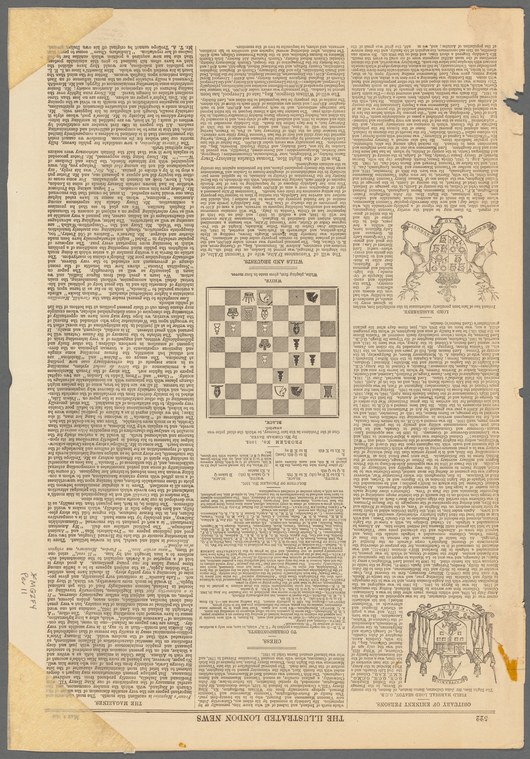
This is a densely printed page from a Dublin newspaper or periodical, dominated by three columns of closely set text in what appears to be Irish or English, with two inserted images: a chess position diagram in the upper center, and an ornamental coat of arms or emblem in the lower right. The page is aged, with foxing and creasing, and appears to be from the 19th century. The title and layout suggest this is a historical document reporting on a significant social event—a Grand Masonic Ball held at the Rotundo in Dublin in honor of the Prince of Wales's marriage. The text is primarily documentary: newspaper copy describing the event, the attendees, the proceedings, and likely the dance itself. No illustration of dancers or the ball itself appears on this page; instead, the visual content is supplementary to the written account.
The dancing
No figures engaged in dance are depicted on this page. The chess diagram and heraldic emblem are the only pictorial elements, and neither represents human movement or dance.
The dance depicted
The page is a historical record of a masonic ball rather than a visual depiction of dance. The title promises an account of the Grand Masonic Ball at the Rotundo, Dublin, held in honor of the Prince of Wales's marriage—an event that would have included formal dancing as part of the proceedings. However, no scene of dancers is illustrated. The dance content must be reconstructed from the text, which the layout and typography suggest contains a full account of the event, including descriptions of the attendees, the program, and likely the dances performed. This was a state occasion in Dublin society, and the ball itself would have been a notable cultural moment, but the page does not show the dancing.
How it was made
This is a printed page, likely from a newspaper or broadside, set in relief letterpress with intaglio or relief illustrations integrated into the layout. The dense, small type and multi-column format are characteristic of 19th-century newspaper typography. The quality of the impression and the age of the paper suggest this was circulated widely in Dublin at the time, possibly as a special edition or as part of a regular periodical reporting on major social events. The integration of text, diagram, and emblem shows professional composition and printing. The condition—foxing, creasing, edge wear—is consistent with a document that circulated in readers' hands and was kept as a keepsake or historical record.
About this work
This is a printed news report of a Grand Masonic Ball held at the Rotundo in Dublin to celebrate the marriage of the Prince of Wales. It is not a visual depiction of the ball or the dancing, but rather a textual account published in a newspaper or periodical. The page belongs in a dance collection because it documents an historically significant social dance event and captures how such occasions were reported to the public. It is valuable as evidence of the cultural importance of formal balls in 19th-century Dublin society and of the role of Masonic institutions in organizing major civic celebrations.
The work is a primary historical document: it records not only that the ball took place, but how contemporaries understood it, what they thought worth reporting, and how they represented it in print. For dancers and historians, it offers insight into the social context of ballroom dancing in the period and the ceremonial role that formal dances played in marking state occasions and elite gatherings.
How to look at it
Read this page as a historical record rather than a visual artwork. Attend to the typography and layout: the choice to lead with the ball's title, the use of multiple columns to convey detail, the integration of the heraldic emblem as a marker of official importance. The chess diagram may seem out of place but reflects the miscellaneous content of 19th-century newspapers. The page is a document of how significant events were circulated and archived in print—a record of what the Dublin press thought worth reporting and how the public received news of civic celebrations.
The period
The Prince of Wales whose marriage is commemorated is almost certainly Edward, Prince of Wales (later King Edward VII), whose marriage to Princess Alexandra took place on 10 March 1863. The ball would have been held in the months following the wedding, as a delayed celebration in Dublin. This places the document in the early 1860s. The mid-Victorian period saw the flourishing of elaborate formal balls as markers of social status and civic pride. Dublin's Rotundo (Rotunda) was one of the city's major public assembly rooms and a traditional venue for balls and public entertainments. The Masonic Order was deeply embedded in Dublin's civic and social life, and organizing a ball in honor of a royal event was within the Order's sphere of activity. This was an era when formal ballroom dancing—quadrilles, waltzes, cotillions, and country dances—was the dominant form of social dance among the middle and upper classes.
Where it lives
This page is held in the New York Public Library's collection of prints depicting dance. It is a newspaper or periodical page, printed in Dublin in the early 1860s, and was preserved as a historical record of a significant social event. The holding suggests the library has recognized its value as documentation of dance in its historical and social context.
Dance in this work
Questions about this work
Is there a picture of the ball on this page?
No. The page is a text-based newspaper account of the Grand Masonic Ball. The only illustrations are a chess diagram and a coat of arms, neither of which depicts the dancing. The ball itself is documented in print, not in pictures.
What was the Rotundo in Dublin?
The Rotunda (often spelled Rotundo) was one of Dublin's major public assembly rooms, built in the 18th century and used for balls, concerts, and civic events throughout the 19th century. It was a prestigious venue for formal social occasions.
When did this ball take place?
The ball was held to celebrate the marriage of the Prince of Wales (later King Edward VII) to Princess Alexandra in March 1863. The ball likely took place in the months following the wedding, placing this page in the early 1860s.
What kind of dances would have been performed at this ball?
Formal Victorian-era ballroom dances would have dominated: waltzes, quadrilles, cotillions, and country dances. The text of this page would contain details about the specific dances and the order in which they were performed.
More dance artwork





