49 works in this view — arrow keys or swipe to move between them.
Dance in Art
Native American dancing in prints
Unknown artist
- Collection:
- Prints depicting dance
- Source:
- New York Public Library
- Rights:
- Public domain — free to use, share and adapt.
- Recorded as:
- Public Domain
This print documents how European artists and audiences in the Renaissance understood non-European dance, through a medium designed for wide circulation and influence. It represents an early encounter between European visual culture and Native American ceremony, capturing a moment when such dances were exotic, documented curiosities in the emerging global consciousness of Europe.
What you are looking at
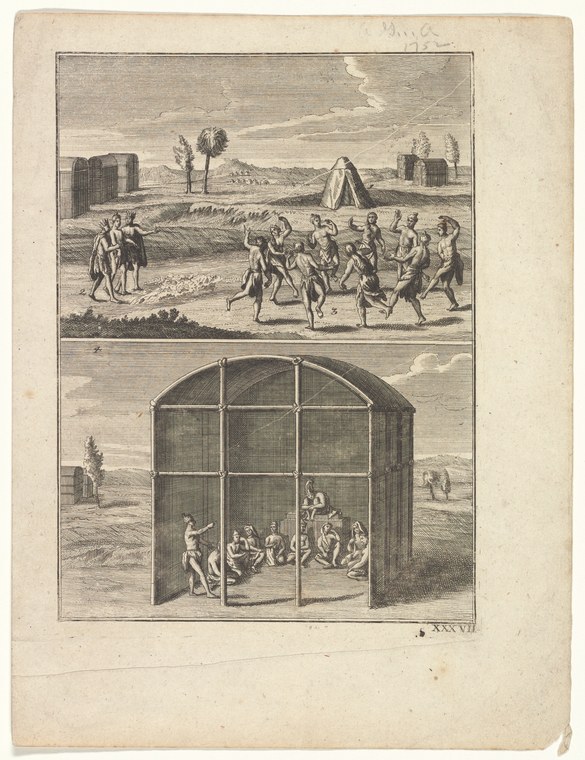
Two engraved scenes of Native American figures, stacked vertically. The upper scene depicts a group of Indigenous people in an open landscape with distant structures (possibly dwellings or fortifications) and sparse vegetation including palm trees. The figures are mostly unclothed or minimally clothed, arranged in a loose group with some in animated postures. The lower scene shows the same or similar group sheltered within a large wooden structure with an arched roof and latticed window panels. The figures are gathered inside, some seated, in what appears to be a communal gathering space. Both scenes employ the linear perspective and cross-hatching technique typical of 16th or 17th-century European prints, with figures rendered in fine detail despite the small scale.
The dancing
The figures in both scenes are depicted with raised arms, twisted torsos, and what appears to be dynamic, celebratory posture. In the upper scene, several individuals stand with arms elevated or extended, suggesting active movement and participation in a collective activity. The lower scene shows figures in similarly animated positions within the enclosed structure, with some appearing to leap or spring upward while others remain grounded. The bodies are slender and unadorned, with minimal clothing depicted, and the artist has attempted to convey motion through asymmetrical stance and limb placement, though the engraving's conventions may not capture the actual mechanics of the dance.
The dance depicted
The image appears to document or interpret Native American ceremonial or social dancing as observed or recorded by European witnesses, likely from a 16th or 17th-century account of exploration or encounter. The distinction between the outdoor and indoor scenes may suggest different contexts or times of day for the same gathering, or two separate occasions. The energetic, upward-reaching postures and the communal nature of the assembly suggest a celebratory or ceremonial dance, but without textual context the specific dance form cannot be identified. The European engraver's interpretation of Indigenous movement may reflect both what was witnessed and European artistic convention of the period, making it difficult to assess how faithfully the choreography is represented.
How it was made
This is a copper engraving, identifiable from the fine parallel lines (cross-hatching) used to create tone and shadow, the precise linear framework establishing perspective, and the small denomination marks ('b', 'XXXVI' at bottom) typical of print series catalogues. The engraving technique allowed for mass reproduction and circulation throughout Europe, making this a document of knowledge exchange and ethnographic curiosity. The two-scene composition within a single plate suggests this comes from a larger series documenting non-European peoples, possibly derived from travel narratives or Kunstkammer collections. The controlled, precise nature of engraving—requiring the artist to plan the image in reverse before cutting—indicates this was created for a educated, wealthy audience.
About this work
This engraving records European knowledge of Native American social or ceremonial dancing in the 16th or 17th century, presented in two contexts: outdoors and within a communal structure. The work belongs to a tradition of ethnographic prints created to document and display the customs of the non-European world to a European audience, combining witness testimony or hearsay with the conventions of European Renaissance figure drawing. As a record of how Indigenous dance was understood, interpreted, and circulated in European visual culture, it reveals as much about Renaissance attitudes toward difference as it does about actual Native American practice. The energetic postures and emphasis on communal participation suggest the artist recognized the collective, performative, and joyful nature of the gathering, even if the specific cultural meaning remains opaque to us.
How to look at it
Note the deliberate contrast between the outdoor and sheltered settings, suggesting the documentation of the same activity in different circumstances or the documentation of a ritual's full scope. Observe how the artist conveys motion through asymmetrical poses, raised limbs, and forward-leaning weight distribution—these are Renaissance conventions for depicting energetic action, applied to an unfamiliar subject. Look at the precision of the engraved line and the careful rendering of the architectural spaces, which anchors the figures in a believable place even though the artist's firsthand knowledge may have been limited. The composition emphasizes numbers and collective participation, suggesting the artist understood the social rather than individual nature of the dance.
The period
This print dates to the period of European exploration and early colonial encounter with the Americas, when ethnographic prints and illustrated travel narratives were creating a European imaginary of non-European peoples. The engraving tradition itself was at its height in the 16th and 17th centuries as a tool for disseminating knowledge, satire, and curiosity. Such prints often appeared in compilations like those of Jean de Léry, Hans Burgkmair, or the workshops of Theodore de Bry, who specialized in dramatizing encounters between Europeans and Indigenous peoples. The artistic tradition of depicting the human figure in dynamic poses drew on Renaissance humanism and anatomical study, applied here to an exotic subject.
Where it lives
The work is catalogued in the New York Public Library's prints collection. The notation 'XXXVI' suggests this is plate 36 in a numbered series, and the 'b' mark indicates a variant or issue state, typical of Renaissance print series documentation.
Dance in this work
Questions about this work
Is this showing a real Native American dance or a European invention?
Almost certainly a mixture. The artist likely worked from travel accounts, interviews, or sketches rather than firsthand observation, interpreted through the conventions of Renaissance figure drawing. The energetic postures and communal gathering reflect something real about Indigenous ceremonial life, but the precise anatomical rendering and spatial logic are European. The engraving tells us what a Renaissance audience understood dance to be, as much as what it actually was.
Why are there two scenes on one plate?
The outdoor and indoor settings may document the same gathering in different contexts, show the dance at different times, or present two separate occasions. This compositional choice emphasizes the importance of the gathering and allows the artist to display multiple aspects of the community's life—public ritual and communal shelter.
How was this print made and who saw it?
It is a copper engraving, created by cutting lines into a metal plate with a burrin tool, which was then inked and printed on paper. This technique allowed hundreds or thousands of impressions to be made and distributed. Such prints were sold to educated, wealthy collectors interested in exploration, geography, and the exotic—likely merchants, scholars, and nobles who read travel narratives and collected Kunstkammer prints.
More dance artwork





