49 works in this view — arrow keys or swipe to move between them.
Dance in Art
Salvatore Viganò
Unknown artist
- Collection:
- Prints depicting dance
- Source:
- New York Public Library
- Rights:
- Public domain — free to use, share and adapt.
- Recorded as:
- Public Domain
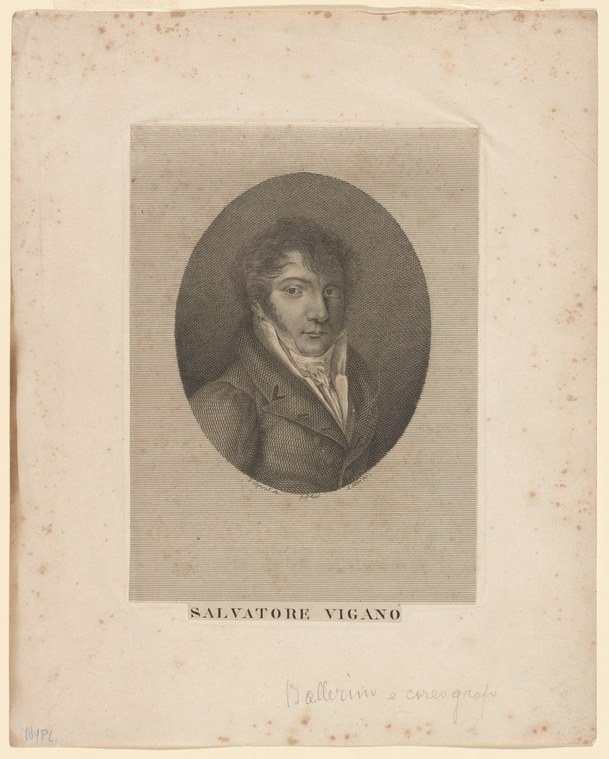
Viganò was among the most influential choreographers of his era, credited with developing the *balletto d'azione*—action ballet—a form that displaced pure divertissement and established narrative and dramatic coherence as central to theatrical dance. This portrait is evidence of his celebrity and cultural standing; the care of its execution and the fact of its circulation show that dance makers of his caliber were subjects worthy of formal portraiture and publication.
What you are looking at
This is a portrait engraving of a young man in early 19th-century dress, presented in an oval format within a rectangular frame. The subject wears a dark coat with a high collar and a white cravat or neckerchief, rendered with careful attention to the folds and fabric. The face is turned slightly to the viewer's left, with dark curled hair in the fashion of the Napoleonic era. The background is rendered in fine parallel lines typical of engraving technique, creating a subtle tonal field that makes the figure advance. There is no setting beyond this neutral background; this is a formal portrait of the kind used for prints and publications. The inscription below reads "SALVATORE VIGANÒ" in capitals.
The dancing
The subject presents a three-quarter bust view with shoulders squared toward the viewer. The head is poised with slight contrapposto, turned leftward, and the expression is composed and contemplative. The left hand is raised to the neck or shoulder area, a gesture that both frames the face and was conventional in formal portraiture of the period. There is no active dance movement or physical exertion visible; this is a commemorative portrait.
The dance depicted
Salvatore Viganò (1769–1821) was an Italian choreographer and ballet master who revolutionized theatrical dance in the early 19th century. He is best known for creating *pantomime ballets*—lengthy works that told complex narratives through dance and gesture alone, without sung text. This portrait documents him as a historical figure but contains no depiction of dance itself; it serves as a record of his appearance rather than his art. Viganò's innovations in dramatic ballet and his influence on Romantic choreography were substantial, but they are not visible in this image.
How it was made
This is an engraving, likely a line engraving, executed with the fine parallel hatching visible throughout. The oval bust format and formal presentation suggest this was a print made for circulation—either as a separate commemorative sheet or as an illustration for a publication such as a theatrical almanac or biographical dictionary. The technique of engraving allowed mass reproduction and wide distribution; such portraits were affordable and were commonly mounted or bound into collections. The quality and finish indicate a professional workshop of some skill, probably created during or shortly after Viganò's lifetime.
About this work
This is a formal commemorative portrait engraving of Salvatore Viganò, the transformative Italian choreographer and ballet master of the late 18th and early 19th centuries. The work does not depict dance or dancers at work; instead, it functions as a visual record of Viganò's appearance—his fashionable dress and composed bearing—as a man of letters and artistic consequence. It sits within the broader category of theatrical portraiture and artist documentation, the kind of engraved portrait that was produced to honor and memorialize cultural figures. For a dance history collection, it serves as primary documentary evidence of how Viganò was presented and commemorated to his contemporaries, and it marks the cultural importance attributed to him during his lifetime.
How to look at it
This is a portrait meant to memorialize and dignify a public figure, not to document performance. What to observe: the formal oval frame, which lends an almost medallion-like quality appropriate to commemoration; the fashionable but restrained dress, which presents Viganò as a man of taste and learning rather than theatrical exuberance; and the composed, intelligent expression, which reflects the cultural view of the ballet master as artist and intellectual. The print itself, in its fineness of execution, was intended to demonstrate that Viganò was a person of sufficient importance to warrant skilled reproduction and distribution.
The artist
The printmaker is not identified in the catalogue record. The style, technique, and format are consistent with Italian or Italian-trained engravers working in the early 19th century, when such portraits were a standard commercial and artistic output. The quality suggests a professional of some reputation, likely working in Milan or Rome, where Viganò spent much of his career.
The period
Salvatore Viganò lived and worked during the transition from the 18th-century ballet d'action of Jean-Georges Noverre toward the Romantic ballet of the 1830s–1840s. His choreographic innovations—particularly his use of pantomime to advance narrative, his ensemble work, and his integration of music and action—positioned him as a bridge between the Enlightenment ballet of reform and the emotionally intense, supernatural stories of Romantic dance. In the visual arts, formal engraved portraiture of artists and intellectuals was experiencing a renaissance, part of the broader Romantic-era celebration of individual genius. This portrait belongs to that cultural moment when dancers and choreographers were recognized as artists deserving of the same commemorative treatment as painters and musicians.
Where it lives
The work is held in the Prints depicting dance collection at the New York Public Library, catalogued with an era label of "unknown" and a generic dance label. It is a commercial engraving, likely produced in the early 19th century for distribution as a loose print or as part of a bound theatrical publication or biographical compilation.
Questions about this work
Who was Salvatore Viganò?
Salvatore Viganò (1769–1821) was an Italian choreographer, dancer, and ballet master who revolutionized theatrical dance in the early 19th century. He is credited with developing the *balletto d'azione* (action ballet), a form in which dance, pantomime, and music were integrated to tell dramatic stories without spoken text. His works, such as *The Titans* and *Othello*, influenced the development of Romantic ballet and established the choreographer as a major creative force.
Why is this just a portrait and not a dance scene?
Commemorative engraved portraits of distinguished people—including artists—were standard products of 19th-century printmaking. This print documents Viganò as a public figure and cultural authority rather than depicting his choreography in action. Such portraits were circulated to honor and memorialize important individuals and to make their appearance known to a wide audience.
Where did Viganò work?
Viganò had a cosmopolitan career. He worked in Rome, Florence, Venice, and Milan, and also in Austria and Southern Europe. He spent much of his most productive period in Milan, where he created major works for the Teatro alla Scala. His influence extended throughout Europe, shaping the development of ballet in the Romantic era.
What does this image tell us about how dance was valued in this period?
The fact that Viganò was commemorated in a formally executed engraved portrait—a medium traditionally reserved for statesmen, generals, artists, and intellectuals—indicates that he was recognized as a major cultural figure. It suggests that by the early 19th century, a choreographer of genius could achieve the same public status and lasting memorial as a composer or painter.
More dance artwork





