49 works in this view — arrow keys or swipe to move between them.
Dance in Art
La tarantella
Unknown artist
- Collection:
- Prints depicting dance
- Source:
- New York Public Library
- Rights:
- Public domain — free to use, share and adapt.
- Recorded as:
- Public Domain
This is rare evidence of how tarantella was performed and understood in the 19th century, before film or photography. The inscription and hand-coloring suggest it circulated as a popular souvenir or educational print in Italy, making it a document of folk practice at a moment when such dances were beginning to attract ethnographic attention. For dance historians, it shows the transition from living folk tradition to documented cultural artifact.
What you are looking at
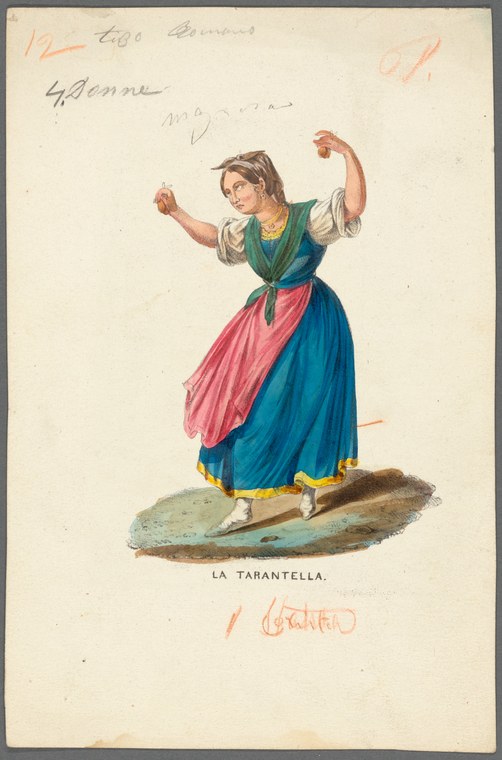
A single female dancer stands on a rocky or uneven ground, captured mid-movement in a dynamic pose. She wears a full-skirted dress combining teal and deep blue fabrics with a contrasting coral-pink overskirt or drape, cinched at the waist with a dark belt. Her white chemise shows at the sleeves. Her hair is bound up, and she wears what appears to be a yellow or gold trim at the hem. Both arms are raised expressively—one bent upward, the other extended outward—and her body twists slightly, suggesting rotational movement. The composition is a hand-colored print on cream paper, with handwritten annotations in Italian at the top and bottom margins. The figure occupies most of the frame against the pale background, emphasizing the dynamic thrust of her pose.
The dancing
A single dancer stands in a semi-turned position with significant rotation through the torso. Both arms are raised and active: the right arm bends sharply upward near the face, while the left extends laterally. Her weight appears shifted onto one leg, with the free leg's position suggested by the flare of her full skirt. The pose conveys spiraling, centrifugal energy rather than grounded stability—characteristic of turning or whirling movement. The raised arms and open chest position her body in an expansive frame typical of folk or regional dance rather than ballet's turned-out carriage.
The dance depicted
The title and inscription identify this as La Tarantella, the rapid southern Italian folk dance traditionally danced solo or in couples, known for its accelerating tempo and spinning movements. The dancer's pose—particularly the raised arms, rotational energy, and dynamic skirt deployment—captures the essential character of tarantella movement: continuous turning with rhythmic arm gestures. The vivid regional dress (the combination of teal, coral, and gold trim) indicates Neapolitan or Campanian origin. This is not a theatrical representation but a document of actual vernacular practice, showing how the dance was performed outside the concert stage.
How it was made
This is a hand-colored lithograph or engraving on paper, with subsequent hand-coloring in watercolor or gouache. The delicate line work and the precision of the figure suggest engraving or lithographic printing, while the soft, transparent color application indicates manual hand-coloring typical of 19th-century popular prints. The inscription and catalog marks in Italian script suggest publication in Italy, likely Naples or another southern Italian city. This technique and format were characteristic of cheap, widely circulated prints made for popular consumption—the equivalent of contemporary postcards or illustrated songsheets.
About this work
This is a document of tarantella as a living folk practice in 19th-century southern Italy, preserved in the popular print tradition. The work belongs to a large corpus of ethnographic dance prints made for mass circulation, recording regional dances in their authentic dress and movement vocabulary. Unlike theatrical ballet prints of the same period, which idealized and abstracted the body into a courtly frame, this image presents the tarantella as vigorous, embodied, and rooted in place—the actual dance of actual people. It demonstrates that dance documentation existed outside the concert hall: popular prints served as records of how communities danced, reaching audiences who would never see a formal performance.
How to look at it
Notice the moment captured: not a pose of rest, but of dynamic rotation. The raised arms and twisted torso convey the accelerating spin that defines tarantella; the flared skirt makes the rotational energy visible. The artist has chosen the moment of maximum extension and openness, not a grounded step. Compare the arm position and lack of formal turnout to contemporary ballet prints: here the body moves through space as an organic whole, not arranged according to courtly geometry. The dress itself—bright, regional, practical—is as much the subject as the body within it.
The artist
The artist is not recorded. The style and inscription suggest an Italian printmaker working in the early-to-mid 19th century, likely active in Naples or another southern Italian city where tarantella was performed and documented. The work belongs to a large tradition of ethnographic and regional costume prints—often unsigned—made for popular circulation.
The period
The 19th century saw growing European interest in regional and folk dances as expressions of national character. Dance prints documenting 'authentic' regional practice proliferated alongside romantic ballet, which took folk materials and abstracted them into courtly frames. In Italy specifically, tarantella was becoming a symbol of southern identity and regional pride. This print sits at the intersection of ethnographic documentation and popular entertainment—it records real practice while packaging it for purchase and display. The hand-coloring and Italian inscription suggest circulation within Italy, where such prints were used to preserve and commemorate regional traditions.
Where it lives
The work is held in the New York Public Library's Prints collection, catalogued as part of a series of hand-colored dance prints. It bears handwritten annotations in Italian, including what may be a catalog number or artist attribution. The object is a mass-produced popular print, not a unique work; other impressions likely exist.
Dance in this work
Questions about this work
What is tarantella?
Tarantella is a rapid, spiraling folk dance from southern Italy, traditionally performed solo or in couples, characterized by continuous spinning and rhythmic arm and hand movements. It has many regional variants. The dance was traditionally associated with celebration, courtship, and festival occasions. By the 19th century, it had become a symbol of Italian regional identity and was widely documented in prints, sheet music, and travel accounts.
How do we know this shows a real dance and not an invention?
The title, Italian inscription, and specific costume details ground this in documented practice. The pose—the rotation, the arm positions, the energetic frame—matches descriptions and depictions of tarantella in other 19th-century sources. The dress combines elements typical of Neapolitan women's costume. This is not a theatrical idealization but a record intended to show how the dance was actually performed.
Why was this print made and who bought it?
Popular dance prints served multiple audiences: tourists seeking souvenirs of Italian travel, families documenting regional heritage, people interested in costume and ethnography, and dancers or musicians wanting visual reference. Such prints were cheap to produce and widely distributed through booksellers and street vendors. They made distant regional practices visible to urban or foreign audiences before photography and film.
How does this compare to ballet prints of the same period?
Ballet prints typically showed dancers in courtly poses—turned out, elevated, idealized. This print shows vernacular movement as embodied and vigorous, with weight grounded and torso actively engaged. There is no pretense to courtly elegance; the dance is presented as regional, popular, and rooted in community practice rather than refined aesthetics.
More dance artwork





