49 works in this view — arrow keys or swipe to move between them.
Dance in Art
Tarantella napoletana
Unknown artist
- Collection:
- Prints depicting dance
- Source:
- New York Public Library
- Rights:
- Public domain — free to use, share and adapt.
- Recorded as:
- Public Domain
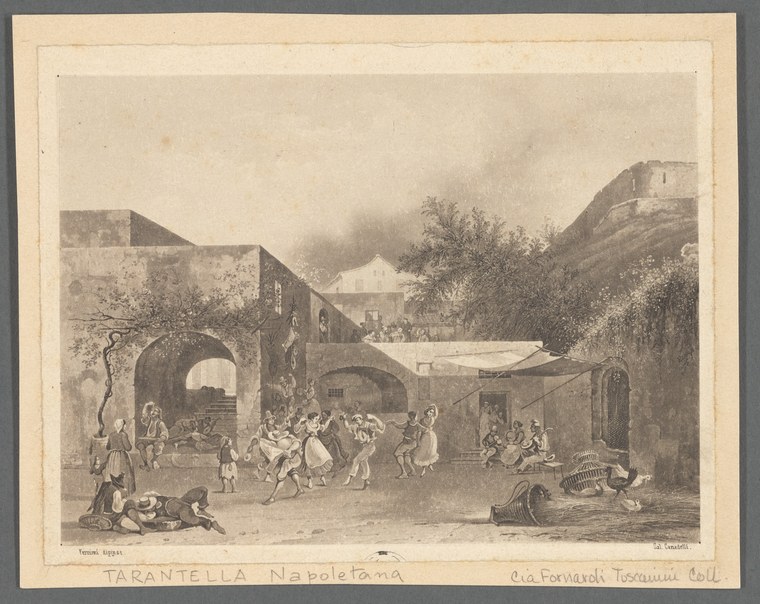
The tarantella was a powerful symbol of Italian identity and popular culture in the 19th century, and this image shows how it was actually performed in urban Naples, not as a staged revival but as a lived tradition. For dancers and choreographers studying the roots of Italian and Mediterranean movement vocabularies, this print offers visual documentation of posture, energy, and social context that written descriptions alone cannot provide.
What you are looking at
A lively street scene in Naples, rendered in sepia tones with atmospheric perspective. Figures in 19th-century dress occupy a cobbled courtyard bounded by weathered stone buildings with arched passageways. On the left, seated figures in darker clothing; in the center, multiple dancers in light-colored dresses are in active motion—some with arms raised, bodies tilted, skirts flaring. The composition is crowded and energetic, with figures of varying scales suggesting depth receding toward distant architecture. On the right, fortification walls and a tower anchor the scene. The artist has captured a moment of public celebration or street festival, with musicians or performers suggested among the gathered crowd. The light is bright and even, typical of southern Italian midday.
The dancing
The central dancers display raised arms, tilted torsos, and swirling skirts characteristic of rapid rotational movement. Their legs are not clearly detailed enough to discern footwork precisely, but the posture—weight shifted, bodies leaning inward and outward in turning—matches the dynamic action of the tarantella, a spinning partner or group dance. The figures are arranged in loose clusters rather than rigid pairs or lines, suggesting the informal, spontaneous character of street dancing. Their dresses are long and full, allowing the skirts to create the visual drama of movement that the artist has emphasized.
The dance depicted
This is almost certainly the tarantella napoletana, the rapid, whirling dance of Naples and southern Italy, as the title states. The tarantella is a social dance traditionally performed at festivals and celebrations, often in public spaces. It is characterized by quick turning movements, frequently executed by couples or groups, with considerable rotation and high energy. The composition suggests the democratic, communal nature of the dance—it was danced in streets and piazzas by working people, not in ballrooms. The print captures the moment of peak motion, when skirts billow and bodies lean into the turn, a convention of 19th-century dance imagery that emphasizes liveliness and abandon.
How it was made
This is a hand-colored engraving or lithographic print, rendered in sepia or brown ink with light wash to create atmospheric depth. The technique allows fine detail in architectural elements and costume while sacrificing precise anatomical clarity in the dancers themselves—a trade-off common in 19th-century popular prints. The soft tonal modeling and the way light diffuses across the scene suggest lithography rather than a sharp engraving; the dotted marks visible in some areas confirm this. Such prints were inexpensive to produce and distribute, making them ideal for popular consumption and tourism imagery—this would have appealed to visitors to Naples and buyers of picturesque travel scenes.
About this work
This is a record of how the tarantella napoletana was performed and experienced in public space during the 19th century. The tarantella, one of Italy's most distinctive folk dances, was not confined to rural villages or formal celebrations but was a living part of urban street culture—as this print documents. The image captures the visual grammar of Romantic-era dance representation: the emphasis on motion through swirling fabric, the informality of the setting, the sense of joy and spontaneity. For historians of European folk dance and for those studying how social dances were represented in popular visual culture, this scene is evidence of both the dance itself and how artists chose to depict movement and celebration.
How to look at it
Attend to the way the artist has frozen multiple moments of the dance simultaneously—some figures at the height of a turn, others beginning or completing the rotation. The tilted axes of the bodies, the way weight is displaced outward, and the way the skirts respond to centrifugal force all convey the rotational character of the dance. The architectural setting is as important as the dancers: this is not a stage performance but a street festival, a claim made by the casual positioning of figures and the integration of the dance into everyday urban space. Notice also how the artist uses light and atmosphere to suggest the specificity of Mediterranean geography and light, reinforcing the sense that this is a document of a particular place and tradition.
The artist
The artist is not recorded. The print bears an inscription reading 'Disegnato Tornassi Coll.' (Drawn by Tornassi Coll.?), though this attribution is difficult to verify from existing records. The style and technique are consistent with mid-19th-century Italian or northern European lithography, popular for scenes of picturesque life and folk customs. Such prints were typically created for a commercial market of educated middle-class consumers interested in ethnographic or travel imagery.
The period
This print dates from an era—likely mid-19th century—when European artists and publishers were intensely documenting folk traditions, often with a romanticizing impulse. The Neapolitan tarantella had become famous across Europe as a symbol of Italian vitality and exoticism, especially after musical compositions by composers including Rossini popularized it. Simultaneously, lithography was the dominant technology for inexpensive, widely distributed color imagery, making folk customs visible to urban audiences far from their origins. This coincided with the rise of ethnographic interest and the early museum collection of dance and costume documentation.
Where it lives
This print is part of the New York Public Library's collection of prints depicting dance, indicating its recognized value as a dance document. It is catalogued only as 'Tarantella napoletana' with no artist, date, or medium recorded, suggesting it entered the collection as one of many similar 19th-century prints of folk and popular dances.
Dance in this work
Questions about this work
Is this a real depiction of how the tarantella was actually danced?
Likely yes in broad outline—the rotational movement and the use of public space match historical accounts and other documentation of the tarantella. However, this is a stylized representation, not a photograph. The artist has emphasized motion and liveliness through conventions of the period, and may have exaggerated or idealized elements. The architectural setting appears to be a real Neapolitan location, which adds credibility.
What is the tarantella and why was it famous?
The tarantella is a rapid, spinning couple dance from southern Italy, characterized by whirling movement and high energy. It became celebrated across 19th-century Europe as a symbol of Italian passion and folk vitality, partly through musical compositions and partly through travel writing and imagery like this print. It was performed at festivals, celebrations, and in streets, making it a symbol of popular rather than elite culture.
Who would have seen or owned a print like this?
Educated middle-class Europeans interested in travel, ethnography, and picturesque scenes of foreign lands. Such prints were inexpensive and widely distributed through print shops and as souvenirs. Tourists visiting Naples would have bought them as records of what they saw or as picturesque mementos.
Can you identify the location in Naples?
The fortification tower on the right and the architectural style suggest this may depict a specific neighborhood, but without clearer landmarks or additional documentation, a precise location cannot be confirmed. The artist has clearly aimed at verisimilitude in the architectural setting, which was typical of topographic prints of the period.
More dance artwork





