49 works in this view — arrow keys or swipe to move between them.
Dance in Art
Tarantella
Unknown artist
- Collection:
- Prints depicting dance
- Source:
- New York Public Library
- Rights:
- Public domain — free to use, share and adapt.
- Recorded as:
- Public Domain
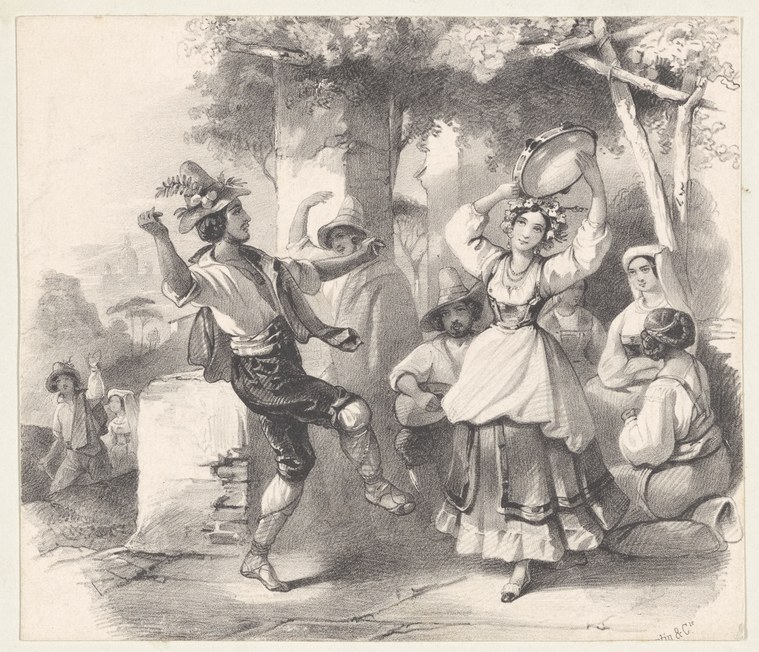
The tarantella is central to Italian identity and European folk dance history, yet images of it in its original social context are rare. This print preserves the actual posture, costume, and participation structure of the dance before it was codified for the concert stage, making it invaluable for dance historians and performers seeking to understand what the dance was rather than what it became. It also testifies to the 19th-century fascination with folk culture as a subject worthy of fine art reproduction.
What you are looking at
A lively outdoor scene set beneath tall trees in what appears to be a Southern Italian or Mediterranean setting. A woman in a white chemise and dark bodice dances at center, her right arm raised high holding a tambourine above her head, her body in a spirited contrapposto with weight shifted to one leg. She is surrounded by onlookers: to her left a man in ornate military dress with plumed hat plays a pipe or flute with animated gesture; to her right sit three women in white shifts and dark skirts, one of whom claps; in the background left, two more figures observe from the middle distance. The composition is theatrical and celebratory, with strong tonal contrasts between the shadowed foliage and the brightly lit figures. The print shows accomplished draftsmanship in rendering fabric, posture, and the energy of the moment—this is a snapshot of folk festivity, not a formal or posed arrangement.
The dancing
The central dancer stands in a single-leg stance with pronounced weight on her back leg, her torso upright and forward-facing, her free arm lifted to shoulder height and bent at the elbow to hold the tambourine. Her other arm hangs at her side. The male musician plays with his body in a loose lunge, one leg bent, creating visual rhythm that echoes the dancer's energy. The seated women are poised attentively, their postures upright; one gestures with both hands in a clapping motion. The arrangement is asymmetrical and informal, suggesting the spontaneity of participatory folk dance rather than performance or choreography.
The dance depicted
This is a *Tarantella*, the most iconic solo or couple dance of Southern Italy, and this print documents it as a social, participatory form rather than a stage spectacle. The image captures the essential elements: the solo woman as focus, the tambourine as her rhythmic instrument, the pipe player providing melody, and the circle of friends or family participating through music and clapping. The dancer's posture—upright, dynamic but controlled, weight shifted rather than lifted—matches historical accounts of the tarantella's character: rapid footwork to an accelerating beat, with the upper body relatively still and the arms used for balance and emphasis. The outdoor, informal setting and the mix of ages suggest this is a community or family occasion, not a theatrical performance.
How it was made
This is a lithograph, identifiable from the characteristic stone-grain texture, the tonal range from deep blacks to delicate half-tones, and the soft edge quality typical of the medium. The artist has used lithography's capacity for rendering fabric texture and human anatomy with subtlety—note the play of light across the dancer's chemise and the modelling of faces and hands. Lithography allowed this work to be reproduced in multiple impressions and distributed at modest cost, making it an accessible record of folk custom for educated urban audiences in the 19th century. The print was likely intended for a middle-class market interested in ethnographic or picturesque views of Italian folk life.
About this work
This lithograph documents the *Tarantella*, the most celebrated folk dance of Southern Italy, as it was performed in the early-to-mid 19th century. It captures the dance not as a theatrical form but as a living social practice: a woman dancing with a tambourine while a musician plays pipe, surrounded by an intimate circle of spectators who participate through music and gesture. The print is precise in its observation of posture, costume, and the structure of the moment—the dancer's stance, the play of instruments, the layered participation of the community around her. It is both a document of ethnographic interest and a testament to lithography's power to render human movement and sociability with immediacy and grace.
How to look at it
Attend first to the dancer's stance and weight: she is not in the lifted, turned-out frame of theatrical dance, but grounded and dynamic, her posture suggesting rapid footwork and stamina. Notice the positioning of her arms—one raised with the instrument, one at rest—and how this asymmetry creates visual momentum. Look at the arrangement of the surrounding figures: they are not in an audience but embedded in the scene, participating through sound and attention. The outdoor setting, the informal grouping, and the mix of activity (dancing, playing, clapping, watching) all indicate that this is a social occasion, not a performance. The artist has chosen the moment of full engagement, not the spectacle.
The period
The tarantella was danced in Southern Italy from at least the 16th century, though its origins and original functions remain debated among historians. By the 19th century, when this print was made, the dance had become a symbol of Italian cultural identity and a subject of intense interest to European Romantic artists and writers, who were drawn to folk forms as expressions of authentic national character. The dance began its migration to the concert stage in the early 19th century, appearing in ballets and becoming a spectacle for urban audiences. This print sits at the threshold: it documents the dance as a social and participatory form, before its full transformation into a theatrical genre. The date is unknown, but the style and quality of the lithography, combined with the ethnographic interest, suggests the middle decades of the 19th century.
Where it lives
The work is held in the New York Public Library's collection of prints depicting dance, a collection that spans media, periods, and cultures to document dance as a visual subject. It is catalogued as a lithograph, though the catalogue record provides no artist attribution, date, or medium designation; these have been inferred from the image.
Dance in this work
Questions about this work
What is a tarantella?
The tarantella is a folk dance of Southern Italy, traditionally performed by a single dancer (usually a woman) with a tambourine, accompanied by musicians playing pipes, tambourines, or drums. It is characterized by rapid footwork, an upright carriage, and an accelerating tempo. The dance has been the subject of much romantic interpretation, including unfounded claims that it originated as a cure for tarantula bites, but it is most accurately understood as a social and participatory form tied to courtship, celebration, and community gathering.
How was the tarantella performed in daily life, as opposed to the stage?
This print shows the key differences: the dance took place outdoors or in homes, was surrounded by participatory music-making and clapping from friends and family, and was embedded in social occasions rather than formal performance. The dancer performed in everyday dress (a chemise and skirt, as shown), not in a costume designed for a stage. The presence of multiple participants—musicians, clappers, observers—made the tarantella a collective activity, not a solo spectacle, even though one dancer was the focus.
Why are there so few historical images of folk dances?
Folk dances were performed in everyday settings by ordinary people and were not considered subjects worthy of fine art until the 19th-century Romantic movement elevated folk culture as an expression of national character and authenticity. Even then, most documentation came from prints and illustrations, not paintings. Photography, which might have captured the dances directly, was not widely available until the later 19th century, and by then many folk forms had already begun their transition to the concert stage.
What is a lithograph, and why was it used for prints like this?
Lithography is a printmaking process based on the chemical antipathy between oil and water: an image is drawn on a stone using greasy materials, the stone is dampened and rolled with oily ink, and paper pressed against it picks up the ink only where the image has been drawn. This allows multiple identical copies to be made from a single stone. It was cheaper than engraving and more versatile in its tonal range, making it ideal for circulating images of cultural interest to educated middle-class audiences in the 19th century.
More dance artwork





