49 works in this view — arrow keys or swipe to move between them.
Dance in Art
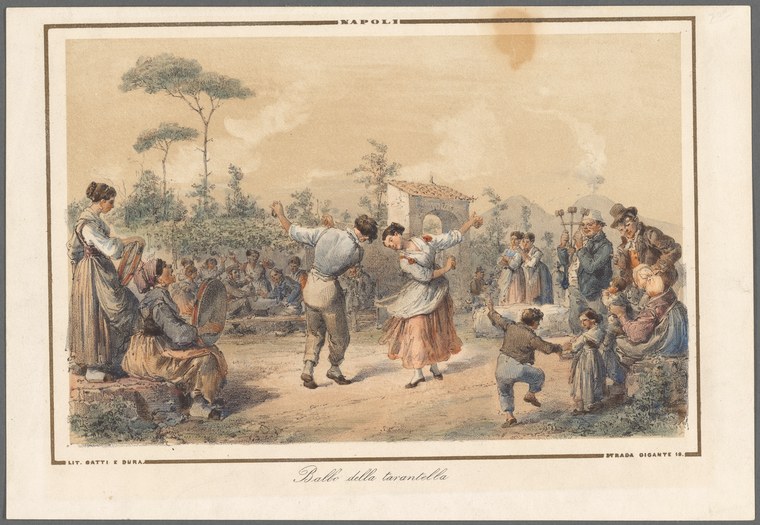
Napoli. Ballo della tarantella
Unknown artist
- Collection:
- Prints depicting dance
- Source:
- New York Public Library
- Rights:
- Public domain — free to use, share and adapt.
- Recorded as:
- Public Domain
This is one of the few surviving images that shows the tarantella as a lived social practice rather than a theatrical or salon performance. For dancers and historians, it documents the posture, grouping, and social context of a dance that remains widespread and vital today, and it shows how the tarantella operated as a collective ritual rather than an individual display. The image also records an important moment in European visual culture: the moment at which folk traditions of the Mediterranean became subjects of artistic and commercial interest to northern European audiences.
What you are looking at
A festive outdoor gathering in a sunlit landscape, likely southern Italian, shows a large crowd assembled around a central group of dancers. Tall umbrella pines frame the composition and soften the bright sky. The assembled figures—men, women, and children in folk dress of muted earth tones, whites, and warm ochres—form a loose semicircle around the dancers. In the foreground, a woman in a long skirt and corset stands at left, watching; at center, two or three figures move in a rapid rotational pattern characteristic of the tarantella, their bodies leaning inward. The setting is rural and informal: there is no stage, no musicians visible, no formal boundary between dancers and onlookers. The print's soft hand-coloring and the relaxed posture of the crowd suggest this is a moment of social pleasure rather than theatrical performance—a village celebration captured as if by an eyewitness.
The dancing
The central dancers move in a tight, rotating formation with bodies inclined toward the center and arms raised or extended, a posture distinctive to the tarantella's centrifugal energy. Their feet appear to move rapidly along the ground in the quarter-turn shuffles and quick articulations of that style. The surrounding figures—some standing, some seated on the ground—are relaxed and attentive, positioned to watch rather than to join, which was typical of tarantella performance in village settings where not all participants danced at once. The woman on the left, in particular, displays the alert posture of a spectator on the verge of entering the circle.
The dance depicted
This is a tarantella, the most iconic social dance of southern Italy, particularly Naples and the southern regions. The tarantella was typically danced outdoors in villages and at celebrations, performed by pairs or small groups who would dance in rapid rotation, often to the accompaniment of percussion and song. The painting's title confirms this identification. The tarantella's origins were folk, but by the 18th and 19th centuries it had been adopted into theatrical and fashionable contexts while remaining a living village practice. This image documents the social form—a moment of collective pleasure in which the dance belongs to the community rather than to trained performers.
How it was made
This is a hand-colored print (likely an engraving or etching, based on the linear technique and the evidence of hand application of watercolor or gouache). The technique allowed for relatively inexpensive and reproducible imagery suitable for a broad audience interested in picturesque views of Italian folklore. The soft palette and atmospheric handling of the landscape suggest the print was hand-colored after printing, a common practice for popular prints of the 18th and early 19th centuries. The style and technique point to circulation among a European audience curious about Italian rural life and regional difference.
About this work
This hand-colored print depicts a tarantella performance in a rural Italian setting, almost certainly Naples or the Campania region. It captures the dance not as a theatrical spectacle but as a moment of community celebration, with spectators gathered informally around a small group of rapidly rotating dancers. The work belongs to a body of European imagery documenting regional folk customs and peasant life, particularly the picturesque traditions of southern Italy. The tarantella itself was central to Italian identity and musical culture, and this image preserves a record of how it was danced in its original social context—outdoors, collectively, and as an expression of village festivity rather than artistic ambition.
How to look at it
Attend to the rotation of the dancers' bodies and the way they lean inward, a posture that generates the characteristic centrifugal spin of the tarantella. Notice how the spectators are positioned—not in a formal audience arrangement, but dispersed around the dancing circle, suggesting spontaneous gathering rather than scheduled performance. The landscape setting, with its tall pines and open sky, is essential to reading this as a village celebration: this is not a salon or theater, but outdoors, in daylight, in the community's own space. The print's soft hand-coloring and atmospheric handling suggest a nostalgic or picturesque treatment of the subject, shaped by the artist's or publisher's assumption about what would appeal to an outside viewer.
The artist
The artist is not recorded. The work is part of a substantial body of 18th and early 19th-century prints documenting Italian regional life and landscape, many of which were produced in or for German and French markets. The style and hand-coloring suggest production by a commercial printmaking shop rather than a named artist, reflecting the common practice of the period in which popular prints were produced collectively and attributed to publishers rather than creators.
The period
The tarantella achieved significant cultural prominence in Europe during the 18th century, when Italian folklore became a subject of Romantic and picturesque interest among northern European audiences. At the same time, southern Italy was increasingly documented in prints, paintings, and travel narratives as a source of exotic and authentic cultural difference. In the context of dance, the tarantella represented an alternative to the formalized ballroom dances of the aristocracy—it was energetic, collective, and rooted in regional tradition. This image dates to a period when European artists and publishers were systematically recording regional and 'peasant' practices, partly from genuine antiquarian interest and partly from a commercial interest in the picturesque.
Where it lives
The work is held in the Prints collection at the New York Public Library. It is one of a substantial number of hand-colored prints documenting Italian regional customs and landscape from the 18th and early 19th centuries, reflecting the circulation of such imagery among European collectors and the commercial production of picturesque views of Italy.
Dance in this work
Questions about this work
What is the tarantella?
The tarantella is a rapid social dance native to southern Italy, traditionally performed outdoors by pairs or groups moving in a rotating formation. It was typically accompanied by percussion and song, and it remains an important expression of Neapolitan and southern Italian identity. In the 18th and 19th centuries, it was adopted into theatrical and salon contexts, but it remained rooted in village celebration and collective festivity.
Why does this print show spectators around the dancers?
The tarantella was a social practice in which the entire village or gathering was involved—some as dancers, some as musicians, and some as spectators and encouragers. It was not a performance for a paying audience, but a moment of collective pleasure. The positioning of onlookers around the dancers was typical of how the tarantella functioned in its original social context.
Who made this print and why?
The artist is not recorded, but the work is part of a substantial body of prints documenting Italian regional life, produced for European audiences interested in picturesque and exotic views of southern Italy. The hand-coloring and the subject suggest production for a broad commercial market rather than for a specialized or elite audience. Such prints circulated widely among European collectors in the 18th and 19th centuries.
How does this compare to theatrical representations of the tarantella?
This image documents the tarantella as it was performed in villages and rural settings, by ordinary people, outdoors, and in daylight. Theatrical versions of the tarantella, popular in ballet and opera, were typically more stylized and performed by trained dancers in formal settings. This print preserves a record of the dance as a living social practice rather than as artistic interpretation.
More dance artwork





