49 works in this view — arrow keys or swipe to move between them.
Dance in Art
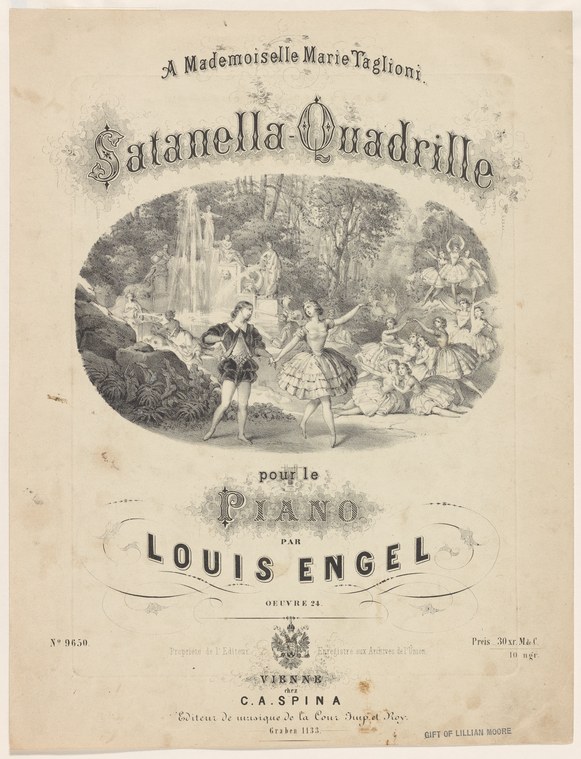
A Mademoiselle Marie Taglioni. Satanella-quadrille pour le piano par Louis Engel
Unknown artist
- Collection:
- Prints depicting dance
- Source:
- New York Public Library
- Rights:
- Public domain — free to use, share and adapt.
- Recorded as:
- Public Domain
The dedication to Taglioni and the theatrical setting depicted in the engraving suggest that by the 1840s, the quadrille—a social dance—had begun to move into the theatrical world. For historians of Romantic ballet and ballroom culture, this image is evidence of how social and theatrical dance worlds intersected at this period. The work also preserves a moment in music publishing history: the ornate, engraved title page as a form of artistic presentation aimed at a specific market of educated, affluent dancers and music consumers.
What you are looking at
This is the title page of a piano composition published in Vienna, likely in the 1840s. The engraving shows an elaborate theatrical or ballroom scene set within a decorative oval frame. In the middle distance, four or five couples dance in formal dress across a checkered or patterned floor. The women wear full skirts and the men wear tailcoats; the nearest couple are shown mid-movement, the woman's skirt caught in elegant swirl. Behind them, additional figures populate the scene—some standing, some seated—suggesting an audience or gathered company. The setting includes theatrical elements: a classical structure or pavilion with columns rises in the background, flanked by trees and drapery. The entire composition is rendered in fine engraving, with careful attention to light and shadow to create depth. At the top, in ornate script, runs the dedication "A Mademoiselle Marie Taglioni." Below the scene, in larger letters, the work is identified as "Satanella-Quadrille pour le Piano par Louis Engel, Œuvre 24." The publication information appears at the foot, identifying the Vienna publisher C. A. Spina.
The dancing
The central couple are captured mid-waltz or quadrille figure, the man in a formal closed hold behind the woman, whose weight appears to shift as her voluminous skirt swings outward in the moment of turn. The other dancers nearby maintain similar closed positions, suggesting the orderly partnering of a ballroom set dance. All figures wear the formal dress of the mid-nineteenth century ballroom: tailcoats and trousers for men, full-skirted gowns for women. The poses are animated but controlled, characteristic of the ballroom dances of the era rather than the theatrical extension of Romantic ballet.
The dance depicted
This is a quadrille, a set dance for couples that dominated European ballrooms in the mid-nineteenth century. The work is a piano arrangement of a quadrille, meaning it was designed for performance by a solo pianist to accompany social or theatrical dancing. The dedication to Marie Taglioni—the most celebrated dancer of the Romantic era, famous for her ethereal technique in works like *La Sylphide*—suggests this composition may have been intended either as a tribute to her artistry or possibly for use in a theatrical or quasi-theatrical ballroom spectacle. The engraved scene shows the quadrille as it was danced in formal ballrooms: couples in closed holds, moving through the geometrically ordered figures that characterize the form.
How it was made
This is a fine engraving, likely a wood or steel engraving, used as the title page of a published musical score. The engraving technique allowed for the reproduction of complex linear detail and tonal modeling through cross-hatching and varied line weight, creating a sense of three-dimensional space and theatrical atmosphere. The choice of engraving for the title page indicates this was a commercial publication intended for a relatively affluent market—piano-owning households that could afford printed music and would value the visual presentation of the work. The date and publisher information suggest this was issued during the height of the quadrille's popularity in European ballrooms.
About this work
This is the published title page of a quadrille for piano, a set dance composition from the mid-nineteenth century dedicated to the Romantic ballet star Marie Taglioni. The engraving depicts the quadrille as performed in the ballroom of the era: formally dressed couples moving through the orderly figures that structure the dance, set within an idealized theatrical space. It belongs in a gallery of dance imagery because it captures a precise historical moment in dance practice—the midpoint between the ballroom as social custom and the ballroom as theatrical display. The work documents not only what was danced but how it looked, how it was dressed, and what artistic authority (Taglioni's name) gave it cultural weight.
How to look at it
Notice the moment chosen: the artist has frozen the dancers mid-movement, capturing the characteristic swirl of the woman's skirt and the controlled partnering position. The theatrical setting—with its classical pavilion, trees, and gathered spectators—elevates the ballroom scene to something between social reality and theatrical fantasy. This reflects a characteristic technique of mid-nineteenth-century ballroom imagery: depicting social dance as spectacle, worthy of the kind of attention normally reserved for theatrical performance. The engraving's fine detail and careful modeling of light and shadow create an idealized, almost dreamlike quality, appropriate to the Romantic sensibility of the era.
The artist
Louis Engel was a Vienna-based composer and pianist active in the mid-nineteenth century, specializing in dances for the piano and the ballroom. The opus number and publisher information suggest he was a professional composer working within the commercial music trade. Little is currently known of his biography, but his output of quadrilles and similar social dances was typical of the vast production of dance music for the ballroom market in this period.
The period
The 1840s were the height of the Romantic era in ballet, dominated by the figure of Marie Taglioni. At the same time, the quadrille was at the height of its fashion as a social dance in European ballrooms. The two worlds—theatrical ballet and ballroom dancing—were beginning to intersect; quadrilles were sometimes performed on stage, and ballroom dances were sometimes adapted for theatrical use. This publication sits at that intersection. The engraved title page reflects the visual and commercial sophistication of the music publishing industry in Vienna, a major center of dance music production.
Where it lives
This is a published score title page held in the New York Public Library's collection of prints depicting dance. It is part of the Library's documentary record of dance imagery across media and periods, including sheet music covers, engravings, and illustrations.
Dance in this work
Questions about this work
Who was Marie Taglioni?
Marie Taglioni (1804–1884) was an Italian-Swedish dancer and the most celebrated ballerina of the Romantic era. She was famous for her technique, delicate artistry, and the creation of *La Sylphide* (1832), one of the founding works of Romantic ballet. Her name became synonymous with graceful, ethereal dancing, and dedications to her appear on many musical compositions of the era, suggesting cultural prestige.
What is a quadrille?
A quadrille is a set dance for two, three, or four couples arranged in a square, popular in European ballrooms from the late eighteenth century through the nineteenth century. It consists of several distinct figures, danced to music in duple meter (typically 2/4 or 6/8). The form was eventually adapted for the theatrical stage, and many composers, including Chopin and Brahms, wrote quadrilles.
Why would a ballroom dance be dedicated to a ballet dancer?
By the 1840s, Taglioni's fame and artistic authority made her name a valuable endorsement or tribute. The dedication may suggest that this particular quadrille was performed in a theatrical context, at a benefit for Taglioni, or simply that the composer and publisher sought to associate the work with her prestige and artistry.
What can we learn from this image about how the quadrille was danced?
The engraving shows the standard formal dress (tailcoats and full skirts), the closed partnering position, and the orderly arrangement of couples characteristic of ballroom quadrille dancing in this period. It confirms that the dance was performed with upright posture, moderate arm positions, and controlled, elegant movement—quite different from the high extensions and virtuosity of Romantic ballet.
More dance artwork





