49 works in this view — arrow keys or swipe to move between them.
Dance in Art
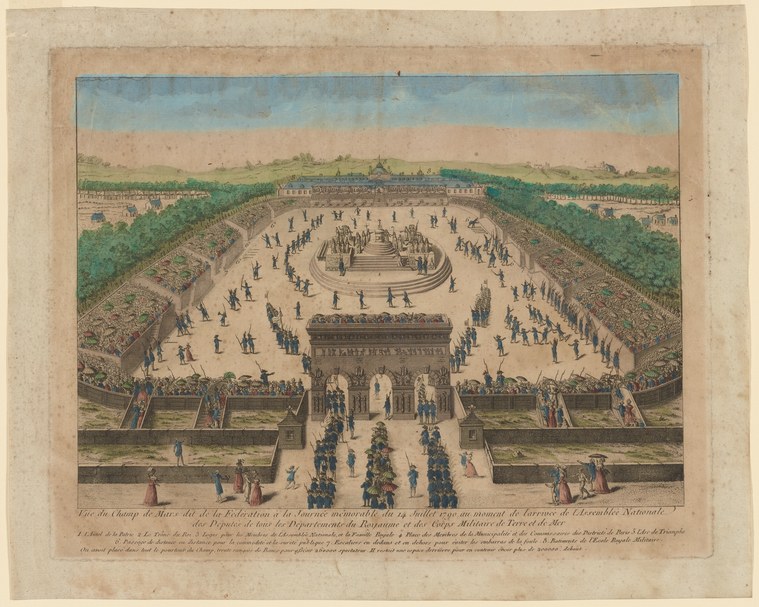
Vüe du Champ de Mars: dit de la Fédération à la Journée mémorable du 14 Juillet 1790 au moment de l'arriveé de l'Assembleé Nationale des Deputés de tous les Départements du Royaume et des Corps Militaire de Terre et de Mer
Unknown artist
- Collection:
- Prints depicting dance
- Source:
- New York Public Library
- Rights:
- Public domain — free to use, share and adapt.
- Recorded as:
- Public Domain
For dance historians, this engraving demonstrates how the Revolutionary period mobilized choreographic principles—formation, procession, rhythm, collective synchronization—to express political ideology without the apparatus of theatrical dance. It also shows how printmaking democratized access to large-scale spectacle, allowing citizens who could not attend the event to witness and understand its choreographic meaning through visual representation.
What you are looking at
A bird's-eye perspective of the Champ de Mars in Paris during the Fête de la Fédération of 14 July 1790. The vast amphitheatrical space is ringed with green terraces and filled with thousands of figures arranged in formal patterns. At the center stands an elevated platform or altar, the focal point toward which orderly rows of military personnel and civic participants orient themselves. The composition emphasizes the monumental scale of this revolutionary civic gathering: the space is divided by processional lines of figures moving or standing in formation, with dense crowds occupying the outer areas and a clear architectural hierarchy radiating from the central ceremonial structure. The sky is pale blue, the lighting even and frontal, rendering this as a document of an important historical moment rather than a dramatic scene.
The dancing
The figures are rendered as small, schematic elements—rows of soldiers in uniform, civilians in period dress, and groups of dignitaries. Rather than individual dancers, they function as choreographic masses: the composition treats thousands of bodies as a unified spectacle. The arrangement emphasizes procession and ordered movement in parallel lines and concentric formations, creating what amounts to a geometric, architectural choreography of the crowd itself. There is no intimate dance frame or partnering; the interest is in how human bodies create patterns at monumental scale.
The dance depicted
This is not a depiction of theatrical or social dance, but rather a visual record of civic performance and processional ritual. The Fête de la Fédération was a revolutionary ceremony celebrating national unity and the new constitutional order: the 'dance' here is the coordinated movement of the assembled crowd, the procession of the National Assembly, and the formal ceremonies conducted at the central altar. The engraving documents the choreographic arrangement of a political spectacle—thousands of citizens and soldiers moving in ordered formation as an expression of collective will and civic solidarity. The image is primarily historical and propagandistic rather than concerned with dance technique or aesthetic performance.
How it was made
This is a hand-colored engraving, likely a popular print distributed to commemorate the event. The technique of engraving allowed for the precise rendering of architectural perspective and the dense patterning of figures across the vast space—something essential to communicate the scale and order of the gathering. The coloring (blue sky, green terraces, period-appropriate dress) was applied afterward, layer by layer. Such prints were central to how revolutionary events entered public consciousness and were distributed widely; this object is evidence of how printmaking served as a mass medium for political communication and the visual spectacularization of the revolutionary moment.
About this work
This engraving documents the Fête de la Fédération of 1790, a pivotal moment when the revolutionary French state staged a civic ceremony of unprecedented scale. Rather than depicting theatrical dance or social dancing, it visualizes the choreography of a political gathering—the ordered movement of thousands of citizens, military personnel, and elected representatives assembled as a visual expression of national unity. The print belongs in a dance history because it shows how bodily arrangement and collective movement functioned as a primary language of political meaning-making during the Revolution, and because it records a moment when the body politic was literally staged as a choreographic event. It is also a rare document of how engraving technology made revolutionary spectacle reproducible and circulated it as popular imagery.
How to look at it
Begin with the overall composition: notice how the engraver's choice of bird's-eye perspective renders the human crowd as a geometric pattern, transforming thousands of individual bodies into a unified, abstract design. Look at the central altar and how all the linear formations radiate toward it—this is the choreographic principle of the event, the way the spatial arrangement itself communicates meaning. Trace the paths of movement suggested by the lines of figures; they create a visual grammar of procession and assembly. Finally, observe the tiny scale of individual human figures relative to the architectural frame—this subordination of the body to the collective structure is the point: the Fête de la Fédération was about the individual citizen as a unit of the nation, not as an expressive subject.
The artist
The artist is not recorded in the catalogue. The print bears a French title and inscription, suggesting it was created for a French-speaking audience and likely published in Paris in the immediate aftermath of 14 July 1790. The style and technique are consistent with commercial commemorative printmaking of the period—the kind of work produced quickly and in volume to capitalize on public interest in revolutionary events. Such prints were often made collaboratively or anonymously by workshops rather than individual artist-engravers.
The period
The Fête de la Fédération occurred at a pivotal moment in the French Revolution, before the radical turn of 1792–1794. It was staged as a celebration of the new constitutional monarchy and national unity, bringing together the National Assembly, the National Guard, and thousands of citizens. Visually and rhetorically, the event drew on ancient Rome and Enlightenment ideals of civic virtue and universal brotherhood. In the broader history of dance, 1790 sits between the ancien régime's court ballet and the emergence of Romantic nationalism; this print captures a moment when spectacle shifted from aristocratic theater to mass political ritual. Popular prints depicting the event disseminated revolutionary imagery throughout France and Europe, making this a key document of how visual culture served revolutionary propaganda.
Where it lives
This hand-colored engraving is held in the New York Public Library's collection of prints depicting dance. It is a commemorative print, likely produced in Paris in 1790 or shortly thereafter, and represents a popular, mass-produced medium for disseminating images of the revolutionary event.
Questions about this work
Was the Fête de la Fédération actually a dance event?
No—it was a civic ceremony and political ritual. However, historians of dance and spectacle study it because it employed choreographic principles: the coordinated movement, formation, and rhythmic assembly of thousands of bodies to express political meaning. The Fête used bodily arrangement as a language of power and unity, much as theatrical dance does.
Why is this in a collection about dance?
Dance history is not only about theatrical or recreational dancing. It includes the choreography of the body in public and political space—processions, military formations, crowd movements organized for spectacle. This print documents a moment when the Revolutionary state transformed the entire citizen body into a choreographic ensemble.
Who is the artist?
The artist is not identified in the catalogue or visible on the print (though the inscription may contain this information in French). It was likely created by a Parisian print workshop in the commercial commemorative tradition, possibly by multiple hands.
How many people attended the Fête de la Fédération?
Historical sources suggest attendance was in the tens of thousands—perhaps 50,000 or more. This engraving attempts to visualize that scale through dense patterning of tiny figures, conveying the event's monumental character.
More dance artwork





