49 works in this view — arrow keys or swipe to move between them.
Dance in Art
On Princess Emelia
Unknown artist
- Collection:
- Prints depicting dance
- Source:
- New York Public Library
- Rights:
- Public domain — free to use, share and adapt.
- Recorded as:
- Public Domain
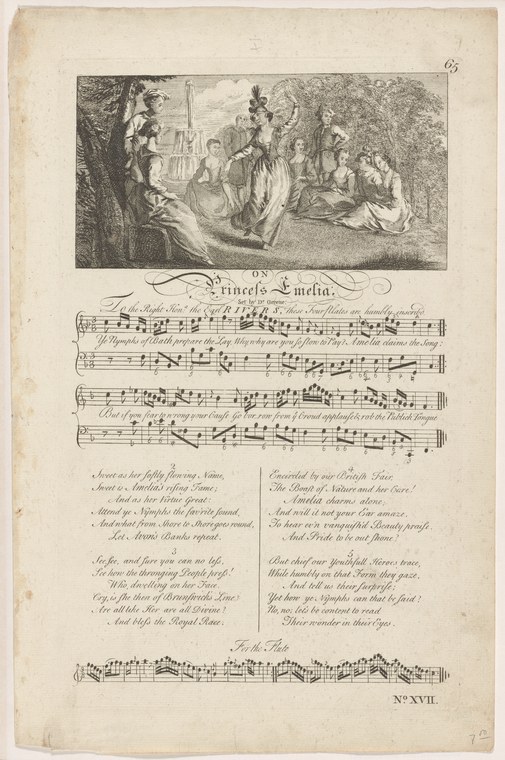
This engraving preserves a record of theatrical spectacle at a moment when dance, music, and narrative gesture were still understood as aspects of a single integrated art form. For historians of eighteenth-century theatrical dance and courtly performance, the image documents both the physical conventions of the era—the poses, the dress, the grouping—and the medium by which such performances were circulated and remembered. The inscription of musical notation alongside the image shows how visual and sonic information were packaged together for educated audiences.
What you are looking at
An engraved theatrical scene depicts a group of aristocratic figures in a garden setting, arranged in a loose semi-circle beneath trees. The figures wear eighteenth-century court dress: the women in wide panniers and elaborate gowns, the men in fitted coats. In the foreground, a reclining female figure gestures dramatically toward the standing group, her body arched and arm extended upward. The other figures attend to her with varied poses of concern and attention. Musical notation is engraved beneath the scene, indicating this is a moment from a sung dramatic work. The composition uses fine parallel lines to create depth and atmosphere, with the foliage rendered in dense cross-hatching. Light falls unevenly across the group, emphasizing the central reclining figure.
The dancing
The reclining woman's body is the visual anchor: her torso lifted, one leg extended, her face turned upward and arms raised in an attitude of distress or emotional climax. The standing figures around her adopt static poses of observation and response rather than dance positions—several stand with weight evenly distributed, hands gesturing but not holding partners. No couple is in a closed or open dance hold. The overall composition suggests staged action and emotional expression rather than coordinated social or theatrical dance.
The dance depicted
This does not depict social or theatrical dance in the conventional sense. The scene is theatrical and gestural, but the figures are positioned in attitudes of dramatic narrative rather than executing a recognizable dance form. The musical notation confirms this is from a sung work—likely an opera, masque, or theatrical entertainment—where stylized gesture and posed movement conveyed emotion and story rather than dance steps. The reclining figure's exaggerated pose follows the neoclassical convention of expressing passion through the body, but no specific dance style is being performed.
How it was made
This is a finely executed engraving, likely made in the mid-eighteenth century based on technique and style. The artist used careful parallel line work and cross-hatching to model form and create atmospheric depth. The inclusion of both image and musical notation on a single page indicates this was a printed document—possibly a published score, a commemorative print of a theatrical production, or an illustration to a libretto. Such hybrid image-and-music pages were a common format for circulating knowledge of fashionable theatrical works to audiences who could not attend performances.
About this work
This is a theatrical scene engraving that documents a moment from an aristocratic entertainment, likely an opera or masque performed in the mid-eighteenth century. The title 'On Princess Emelia' suggests it depicts a scene involving the character Emelia, and the inclusion of musical notation confirms the scene was sung rather than danced. The work belongs in a gallery of dance imagery because theatrical entertainments of this period were hybrid forms, blending music, sung narrative, posed gesture, and stylized movement. Though the figures are not executing a recognizable dance pattern, they occupy the same aesthetic and social world as the court dances and theatrical ballets of the era. The engraving is a primary document of how aristocratic bodies were arranged for public entertainment during the height of the ancien régime.
How to look at it
Attend to the geometry of the composition: how the artist arranged the figures to create a hierarchy of attention, with the reclining woman commanding the visual center. Notice the careful rendering of fabric and the distinctions in posture between active and reactive figures. The exaggeration of the reclining woman's arch and arm gesture—beyond what a body could naturally hold—signals the neoclassical convention of expressing emotional extremity through pose. The musical notation at the bottom is not decorative; it anchors the image to a specific sung moment and tells us that this frozen gesture corresponds to a particular melodic or harmonic phrase.
The artist
The artist is not recorded. The engraving's style and finish are professional, suggesting work by a trained printmaker working for a commercial publisher or theatrical company. Mid-eighteenth-century theatrical engravings of this quality were typically produced in London, Paris, or Venice to commemorate successful stage productions or to serve as illustrations for published scores or libretti.
The period
The mid-eighteenth century was the golden age of European opera and theatrical spectacle. Court ballets and masques were elaborate productions combining music, dance, poetry, and visual design. Though ballet as a distinct theatrical form was beginning to emerge (particularly in France under the influence of innovators like Hilverding and Noverre), theatrical movement remained largely gestural and narrative-driven rather than balletic in the later nineteenth-century sense. The refined, aristocratic poses in this engraving reflect the aesthetic that prioritized elegance, emotional expression, and courtly decorum over technical virtuosity in footwork or elevation.
Where it lives
This print is held in the New York Public Library's collection of prints depicting dance. It is catalogued by title and collection category rather than by accession number or individual artist attribution, which was common practice for theatrical prints of this era that were often circulated anonymously or under publisher names rather than artist names.
Questions about this work
Is this a dance scene?
It is a theatrical scene with posed, gestural movement—common in opera and masque of the period—but not a depiction of social or ballet dancing. The figures are arranged to convey emotion and narrative rather than to execute a recognizable dance pattern. However, such theatrical entertainments were closely related to the dance culture of the aristocracy, and the poses reflect the same bodily aesthetics.
What is the musical notation?
The engraved staff lines and notes indicate that this scene was sung, not spoken or danced to instrumental music alone. This print may have been published as part of a score or libretto, or as a commemorative print of a theatrical production. The notation connects the frozen visual moment to a specific musical phrase.
When and where was this made?
Based on style, dress, and technique, it was likely made in the mid-eighteenth century, probably in a major European print center such as London, Paris, or Venice. The exact date and place are not recorded. The work circulated as a printed object, likely reaching educated audiences across multiple cities.
Who were the performers?
That information is not recorded. The title suggests the scene involves a character named Princess Emelia, but the artist, the theatrical work from which it came, and the performers who embodied these roles are not documented in the catalogue record.
More dance artwork





