49 works in this view — arrow keys or swipe to move between them.
Dance in Art
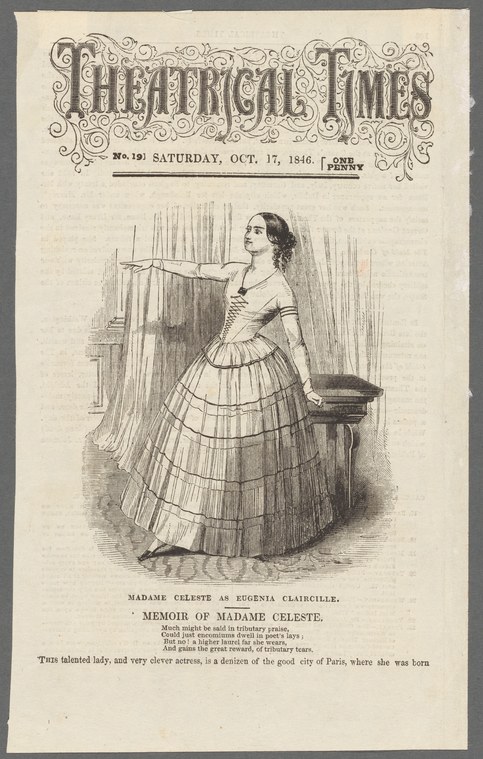
Madame Celeste as Eugenia Claircille [with accompanying article]
Unknown artist
- Collection:
- Prints depicting dance
- Source:
- New York Public Library
- Rights:
- Public domain — free to use, share and adapt.
- Recorded as:
- Public Domain
Theatrical prints like this are primary documents of nineteenth-century performance practice and celebrity culture. They show how performers were marketed and visualized for audiences, and how costume functioned as visual narrative in an era before photography could easily capture stage moments. For dance history specifically, this image demonstrates the boundary between theatrical costume display and active dance—and the commercial infrastructure (periodicals, engravings, celebrity culture) that supported and promoted performers who might sing, act, and dance across a single career.
What you are looking at
This is a wood-engraved theatrical print from the mid-nineteenth century, part of the theatrical press coverage of the era. A woman in an elaborate crinoline ball gown stands in an interior setting, her body turned in three-quarter view toward the right. She wears a dress of extraordinary volume—the skirt extends outward in the distinctive cone shape achieved by hooped petticoats, with multiple horizontal bands or flounces creating a heavily articulated silhouette. Her hair is parted in the center and styled in the fashion of the 1840s. She holds what appears to be a small fan or floral accessory in her right hand, which rests at her side. The setting suggests a theatrical interior, with vertical drapery visible behind her and what may be a piece of furniture to her left. The composition is formal and display-like—a portrait of a costumed performer rather than a scene of active dance.
The dancing
A single figure dominates the composition, standing nearly upright with minimal movement suggested. Her weight appears centered, with the body held in an upright, dignified posture typical of stage presentation. There is no evidence of dynamic motion, partnering, or the kind of bodily extension associated with ballet. The arms are held passively at the sides, and the legs are concealed entirely within the voluminous skirt. This is a pose for viewing the costume rather than demonstrating dance technique.
The dance depicted
This image does not depict active dance. It is a theatrical costume portrait—a record of a performer's stage appearance in a specific role. The accompanying text identifies the figure as "Madame Celeste as Eugenia Claircille," indicating this is a portrayal of a character from a theatrical work (likely a play or melodrama rather than a dance-specific piece). The dress is consistent with elite female costume of the 1840s-50s as it would have been worn on the English or American theatrical stage. While such roles might include choreographed movement or ballet interludes, this image documents the costume itself, not a dance performance.
How it was made
This is a wood engraving, a relief-printing technique that produces fine lines and tonal gradations through the density of parallel lines and cross-hatching. The technique allowed for mass reproduction and was the standard method for theatrical illustration in nineteenth-century periodicals and newspapers. The precision of the engraving—visible in the careful rendering of fabric texture, the articulation of the flounces, and the delicate lines of the face—suggests this was produced for a publication of some circulation and cost. The format and presentation match the style of theatrical newsprint from the 1840s-1850s.
About this work
This is a theatrical costume print documenting the appearance of Madame Celeste in a specific stage role, published in the periodical *Theatrical Times* on October 17, 1846. It belongs in a dance archive not because it depicts dance in action, but because theatrical costume and theatrical celebrity are inseparable from the social and visual history of dance in the nineteenth century. The print records both a performer and a moment in the commercial theatrical culture that surrounded and sometimes incorporated dance. The crinoline silhouette and the formal presentation also document the aesthetic standards of female elegance on stage during a period when ballet and ballroom dancing were redefining the idealized female body.
How to look at it
Look at the construction of the skirt and the flatness of the front plane of the dress—this is the silhouette of the mid-nineteenth-century crinoline, a costume technology that shaped not only fashion but also the possibilities of movement on stage. Note the absence of any indication of active pose or gesture: the figure is presented as a display object, not a moving body. The horizontal banding of the skirt is rendered in meticulous detail, a demonstration of the engraver's skill and also of the commercial and aesthetic investment in fabric and costume detail that characterized theatrical culture of the period.
The artist
The artist is not recorded in the catalogue. The engraving was produced for *Theatrical Times*, a theatrical periodical. The style and technique are consistent with the commercial theatrical press of London and New York in the 1840s, where anonymous or uncredited engravers produced weekly or daily costume portraits and scene illustrations as part of the theatrical coverage industry.
The period
This print dates to 1846, a moment when ballet in Europe and America was entering the Romantic period (the era of *La Sylphide*, 1832, and *Giselle*, 1841), characterized by an idealization of the ethereal and supernatural. The voluminous crinoline skirt—constructed with rigid hoops rather than the softer layers of earlier decades—became increasingly associated with theatrical femininity. Simultaneously, Madame Celeste was known as a performer of melodrama and physical comedy, not primarily as a ballet dancer, which contextualizes the costume as theatrical rather than balletic. The periodical press was expanding its coverage of theatrical life, making costume engravings a standard form of entertainment journalism.
Where it lives
This print is held in the New York Public Library's collection of prints depicting dance and theatrical performance. It is a page from *Theatrical Times*, a periodical, indicating it was originally part of a weekly publication (or daily issue) and has been retained as part of an archive of theatrical documentation.
Questions about this work
Is this a picture of a ballet dancer?
No. Madame Celeste was known primarily as a performer of melodrama and physical comedy. This costume portrait documents her appearance in a theatrical role, not a ballet. However, the image is valuable for understanding the theatrical context in which ballet developed and the costume aesthetics of the mid-nineteenth-century stage.
What is the dress she is wearing?
This is a crinoline ball gown of the 1840s, constructed with rigid hoops to achieve the cone-shaped silhouette. The multiple horizontal flounces (ruffles or bands) are typical of the period. Such dresses restricted movement significantly and would be worn for formal theatrical roles in plays and melodramas rather than for dancing, though performers in some works might have danced or moved within them.
Why is this in a dance archive if there is no dancing?
Theatrical costume and celebrity are part of dance history. This print documents how performers, theaters, and audiences understood the female body on stage during a period when ballet was transforming theatrical culture. It also shows the commercial infrastructure—periodicals, engravings, celebrity culture—that supported and promoted theatrical performers of the era.
Who was Madame Celeste?
Madame Celeste (1807–1882) was a French-born performer known for her work in English and American melodrama. She was a physical performer with skills in pantomime and acrobatics, and she had a long stage career. She was not primarily known as a ballet dancer, though she may have performed in theatrical contexts that included dance.
More dance artwork





