49 works in this view — arrow keys or swipe to move between them.
Dance in Art
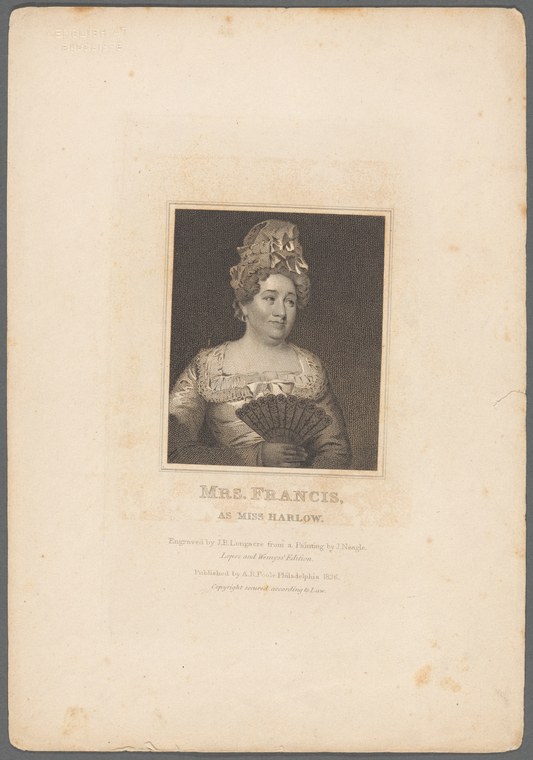
Mrs. Francis as Miss Harlow
Unknown artist
- Collection:
- Prints depicting dance
- Source:
- New York Public Library
- Rights:
- Public domain — free to use, share and adapt.
- Recorded as:
- Public Domain
This image documents the visual culture of early 19th-century theatrical performance and the centrality of printed portraiture to an actor's public identity and marketability. For historians of dance and theater, it preserves evidence of how performers presented themselves and how they were marketed to audiences.
What you are looking at
A three-quarter-length portrait of a woman in early 19th-century dress, shown against a dark background. She wears a high-waisted, low-cut white or cream-colored gown typical of the Regency period, with delicate fabric gathered at the bodice. Her dark hair is elaborately arranged atop her head with curls and what appears to be a decorative comb or ornament. She holds a folded fan in her right hand at waist level, a standard accessory of the period. Her posture is upright and composed, her gaze directed slightly away from the viewer. The figure is rendered in a mezzotint or similar tonal engraving technique, with careful attention to the play of light across the fabric and the modeling of her face and neck. The woman's bearing and costume suggest she is a performer or public figure of some note.
The dancing
A single standing female figure in a relaxed but dignified pose. Her weight appears to rest evenly; there is no active dance movement. Her arms are gently positioned with the fan held as an accessory rather than as part of an active gesture. Her torso is upright, shoulders back, presenting the formal carriage expected of a Regency-era gentlewoman or performer. There is no indication of active footwork, turnout, or the physical demands of dance.
The dance depicted
The catalogue identifies this as a portrait of Mrs. Francis in the role of Miss Harlow, suggesting this is a theatrical portrait documenting a performer in a named stage role. The image does not depict active dance; it is a formal portrait in the mode of theatrical portraiture common in the early 19th century. The elegance of dress and the formal studio setting indicate this was made to document and promote an actress, likely from the London stage. Without additional historical context on the play or role, the specific dance content—if any—cannot be determined from the image alone.
How it was made
This is a mezzotint or stipple engraving, a tonal reproductive print technique that was standard for theatrical portraiture in the early 1800s. The soft gradations of tone, the careful modeling of flesh, and the fine detail in the fabric all indicate skilled work in a medium that allowed wide distribution and affordability compared to oil painting. The technique was particularly favored for promoting actors and actresses, as prints could be sold to the public and distributed to theaters. The caption below the image—engraved in serif type—is integral to the print, linking image to identity and role.
About this work
This is a Regency-era theatrical portrait documenting an actress named Mrs. Francis in a named stage role. It is a formal, dignified three-quarter-length portrait rendered in mezzotint or stipple engraving, techniques that made it a reproducible commodity for public circulation. The subject wears the fashionable high-waisted white muslin gown and elaborate coiffure of the 1820s, held as a performer's image rather than as a private portrait. Though catalogued in a collection of dance imagery, the work itself is a portrait rather than a depiction of dance, and its inclusion likely reflects either a secondary association with dance or the importance of theatrical portraiture to the wider history of performance.
How to look at it
Attend to the careful composition: the half-turned posture, the downward gaze, and the fan held with studied grace were all conventions of theatrical portraiture designed to convey gentility, modesty, and stage presence without depicting active performance. The high finish and tonal subtlety of the mezzotint technique—the soft shadows around the face, the luminosity of the fabric—were meant to flatter and dignify the sitter. Notice how the printed caption below transforms the image from a generic portrait of a beautiful woman into a specific, named role: the text is as essential to the work's meaning as the image itself.
The artist
The artist is not recorded in the catalogue. The engraving is signed or marked with a credit line that is legible in the impression, but the catalogue does not preserve this information. The style and execution suggest a professional theatrical print shop, likely London-based, working in the well-established tradition of mezzotint theatrical portraiture that dominated the market in the 1810s–1830s.
The period
This portrait dates to the Regency or early Georgian period (circa 1810s–1830s), when theatrical portraiture was a major commercial genre and mezzotint was the dominant technique for reproducing actors' likenesses. The costume reflects the high-waisted neoclassical silhouette that dominated women's fashion in this era, which was also the period of Regency quadrilles, cotillions, and the rise of Romantic ballet. Theater and dance were closely linked in this period, with many stage roles involving dance or movement as a key element; however, this particular portrait captures a moment of stillness and formal presentation rather than theatrical action.
Where it lives
The print is held in the New York Public Library's collection of prints depicting dance. The catalogue entry is minimal, providing only the title, a date estimate of unknown, and no artist or publisher attribution. The collection's holding reflects a 20th-century curatorial decision to file theatrical portraiture alongside dance imagery, suggesting the library regarded performance documentation as relevant to dance history.
Questions about this work
Is this a portrait of a real person or a character?
Both. The caption names a real performer, Mrs. Francis, but she is shown in the character of Miss Harlow, a named stage role. The portrait thus documents both the historical actress and the role she played, using the standard theatrical convention of marketing actors in their most famous parts.
What is the fan for?
The fan is both a fashionable accessory of the Regency period and a prop signaling gentility and stage presence. In theatrical portraits of this era, such accessories were included to enhance the figure's elegance and to anchor the image in a specific historical and social moment. The fan might also have been used as a gesture or prop in the play itself.
Why is this in a dance collection if there is no dancing shown?
Early 19th-century theatrical roles often incorporated dance, and the library may have included this as documentation of stage performance and theatrical costume. Additionally, performers of the period—especially women—were expected to move gracefully and often trained in dance regardless of their primary role. The collection reflects a broader interest in preserving images of historical performance.
More dance artwork





