49 works in this view — arrow keys or swipe to move between them.
Dance in Art
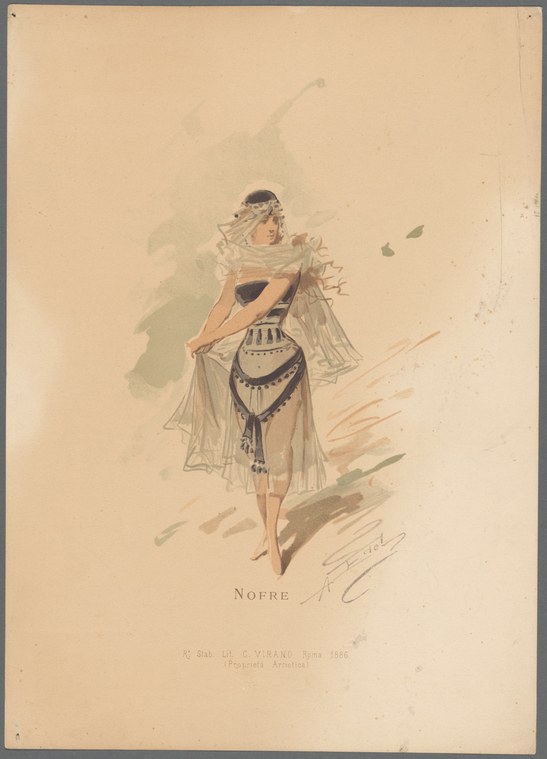
Nofre
Unknown artist
- Collection:
- Prints depicting dance
- Source:
- New York Public Library
- Rights:
- Public domain — free to use, share and adapt.
- Recorded as:
- Public Domain
The work documents the design and visual imagination behind 19th-century theatrical production, a crucial but often fragmentary archive. It shows how designers conceived the body, drapery, and ornament as inseparable elements of character and emotion, even in stillness. For theater historians and scholars of design history, such sketches are primary evidence of the visual and material culture of performance.
What you are looking at
A single female figure dominates this watercolor sketch, positioned against a pale cream background with loose, gestural brushwork suggesting drapery or atmosphere. She wears a delicate, translucent wrapped garment—possibly a shawl or veil—that floats away from her body, caught mid-movement. Beneath it is visible a darker, decorated undergarment or belt with geometric patterning and what appears to be ornamental clasps or jewelry. Her pose is contemplative and graceful: she stands with weight shifted, one arm raised near her face in an introspective gesture, the other at her side. The figure's head is crowned with what appears to be a decorative headdress or circlet. The artist has used economical means—watercolor washes in ochre, brown, and green tones—to suggest form and fabric, leaving much of the paper bare. The inscription "NOFRE" appears below, and there is a signature or mark at lower right. The overall effect is of a costume study or theatrical design sketch rather than a narrative scene.
The dancing
A single standing figure with an upright but relaxed posture. The weight appears to rest on one leg, creating a subtle contrapposto. One arm is raised, hand near the face or head in a pose suggesting emotion—contemplation, weariness, or introspection—rather than active dancing. The other arm hangs loosely. The body is not in a tense or engaged hold; there is no partner and no clear indication of active step or footwork. The pose reads as a moment of stillness or repose rather than the kinetic energy of dance in progress.
The dance depicted
This does not appear to be a depiction of dance in action. The pose—solitary, introspective, with raised hand to face—is more consistent with theatrical portraiture, character study, or costume design for dramatic performance. If this is a dancer, the moment captured is one of stillness, not movement. The figure may represent a character from Romantic-era theatrical work, but the image does not show recognizable dance vocabulary, hold, or frame. The name "Nofre" does not immediately correspond to a known ballet or character in standard dance history, and the costume—while elaborate and theatrical—does not carry clear markers of a specific dance tradition.
How it was made
This is a watercolor sketch on paper, executed with economy and speed. The artist has used transparent washes of earth-toned pigment (ochre, brown, muted green) to suggest form and fabric, leaving much of the paper's own tone visible as part of the composition. Fine penwork or darker pigment articulates details: the geometry of the belt, the outline of the headdress, the contour of the body. This technique—quick, gestural watercolor combined with linear definition—was standard for theatrical costume studies and design proposals in the 19th century. The work appears to be a study or proposal rather than a finished artwork, consistent with how theatrical designers documented ideas for production.
About this work
This watercolor is a theatrical costume study, likely from the 19th century, depicting a single figure in elaborate dress. The inscription "Nofre" may be a character name or production title, though it remains unidentified in standard dance and theatrical references. The work belongs to the archive of dance-adjacent theatrical imagery—costume design, character portraiture—rather than documentation of dance in motion. It is valuable not as evidence of a specific dance practice, but as a window into how theatrical designers conceived and communicated costume for dramatic characters during the Romantic era. The figure's introspective pose and luxurious, flowing costume suggest a character of emotional depth, possibly from a narrative ballet or theatrical play of the period.
How to look at it
Attend first to the pose: the raised hand near the face suggests a specific moment of feeling or reflection, frozen mid-gesture. This is the artist's choice of which moment to document—not the peak of a jump or the climax of a turn, but a quieter, more psychological instant. Notice how the drapery is rendered: the artist captures not just the garment's structure but its movement away from the body, suggesting the moment is one of living, breathing presence, not static costume display. The detail of the geometric belt and headdress suggests this was a character of some status or exoticism in the narrative. Finally, observe the economy of the technique: the artist uses watercolor's transparency strategically, letting the paper breathe, which gives the figure a lightness and ethereality suited to Romantic theatrical aesthetics.
The artist
The artist is not recorded. The style—economical watercolor technique, assured line work, the purpose as a costume study—is consistent with 19th-century theatrical design practice. The signature or mark at lower right may be a monogram, but it is not clearly legible in reproduction. Costume designers of this era often produced dozens of such studies for a single production, most of which were not individually documented or preserved; that this one survives in an archive is itself noteworthy.
The period
The watercolor technique, the Romantic-era silhouette, and the theatrical subject matter suggest a date in the mid-to-late 19th century (roughly 1840–1880). This was the height of Romantic ballet in Europe, when ballets such as Giselle, La Sylphide, and their many imitators dominated stages. It was also an era of intensive theatrical production beyond ballet—romantic plays, operas, and hybrid spectacles. Costume design was increasingly understood as a specialized craft, and designers' sketches became valued documents of the creative process. The prevalence of such watercolor studies in archives suggests that theatrical design was seen as an art form worthy of preservation, even when the productions themselves are now forgotten.
Where it lives
Held in the New York Public Library's collection of prints depicting dance. The work is catalogued minimally, with no recorded artist, date, or medium attribution in the standard record.
Questions about this work
Is this a ballet?
Possibly, but the image itself does not show dance in action. It is a costume study or character portrait—a single standing figure in theatrical dress, not dancing. If this was created for a ballet production, it documents the design concept rather than the choreography or movement.
What does 'Nofre' mean or refer to?
Unknown. It may be a character name from a ballet or play, or a title of a production. The name does not correspond to any well-documented work in standard dance history, so it may refer to an obscure or now-forgotten production, or it may be a personal notation by the designer or collector.
Why is the figure's hand near their face?
This gesture—hand to face or head—conventionally suggests emotion: contemplation, sorrow, fatigue, or introspection. In theatrical design, such a pose often characterized Romantic heroines, who were frequently portrayed in moments of emotional vulnerability or longing. The artist has chosen to show not the character dancing, but the character feeling.
Who made this?
The artist is not recorded in the catalogue. The style and technique are consistent with 19th-century theatrical costume designers working in Europe, but without a signature that can be clearly read or attributed, the maker remains anonymous.
More dance artwork





