49 works in this view — arrow keys or swipe to move between them.
Dance in Art
Fête nationale, 14 juillet
Unknown artist
- Collection:
- Prints depicting dance
- Source:
- New York Public Library
- Rights:
- Public domain — free to use, share and adapt.
- Recorded as:
- Public Domain
This print is a documentary image of vernacular social practice—how ordinary Parisians danced in public space during the Third Republic. It shows waltz as genuinely popular culture, not confined to the ballroom elite, and demonstrates the role of dance in republican civic identity. For dancers and historians, it is evidence of how and where people actually danced, and of the values—gender equality, public mixing, festive freedom—that the French Republic associated with the waltz.
What you are looking at
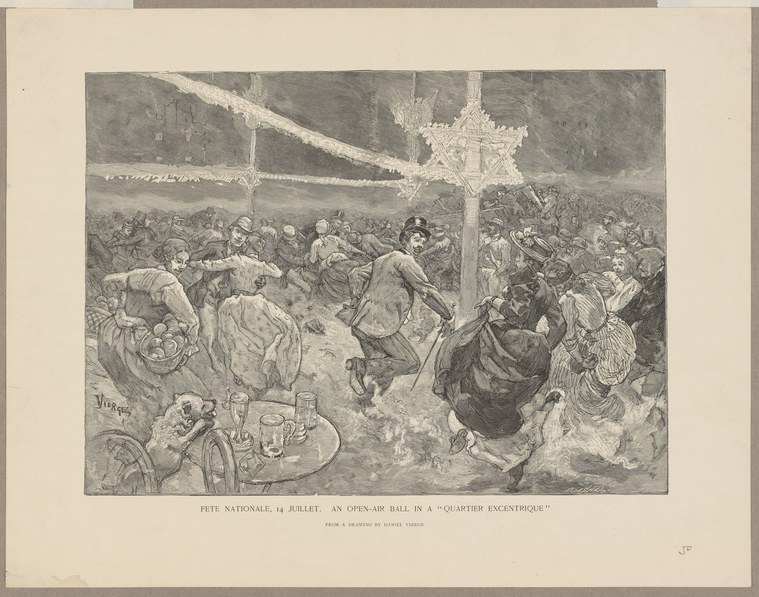
An outdoor ball in progress on Bastille Day (14 juillet), likely in a quartier excentrique—a working-class district of Paris—as indicated by the caption. A large crowd of dancers and spectators fills the lower half of the composition beneath strings of lights and bunting strung overhead, creating a festive atmosphere. The scene is rendered in gray tones characteristic of wood engraving or lithography. Dancers occupy the central ground: couples in closed hold, women in long skirts with gathered or bustled silhouettes typical of the late 19th century, men in suits and hats. The crowd extends across the canvas in a dense, energetic mass; some figures stand watching, others dance. The composition emphasizes the scale and democratic character of the celebration—all classes mingling in public space. A prominent star or light fixture hangs from the overhead framework, possibly a decorated lantern or architectural feature.
The dancing
Couples throughout the crowd hold in closed ballroom position—the standard social dance hold of the period. The nearest visible dancers show the man's right hand at the woman's waist, her left hand on his shoulder or arm, their bodies angled in profile to the viewer. Weight and posture suggest waltzing or a similar turning dance. The women's arms and shoulders are mobile and graceful; their long skirts obscure legwork but drape in a way that suggests movement. Most figures are arranged in couples, though bystanders and solo figures punctuate the crowd. No visible footwork detail, but the overall frame and bearing is consistent with social ballroom dance of the 1870s–1890s.
The dance depicted
This depicts a public Bastille Day ball (fête nationale), a republican celebration that typically featured social dancing open to the neighborhood or quarter. The dancers are waltzing or performing a similar turning couples dance common to French popular celebration. The setting—an outdoor ball in a working-class quartier excentrique—tells us this is not court or theatrical dance but vernacular social practice. The caption's emphasis on the location suggests the artist or publisher considered the democratic, local character of the celebration noteworthy. The dance is identifiable as Waltz from the closed holds and body positions visible throughout the crowd, though the vernacular and celebratory context distinguishes it from concert ballroom practice.
How it was made
This is a wood engraving or possibly a lithographic print, executed in black ink on paper. The fine parallel hatching lines, the economy of tone, and the way detail emerges through density of line rather than continuous shading are characteristic of 19th-century reproductive engraving. The technique allowed rapid circulation via newspaper or illustrated journal—this was likely published in a contemporary press source given the dated topical subject and the publication format evident from the document's layout. The medium constrained the artist to work in line and tone rather than color, which concentrates attention on composition, gesture, and expression rather than costume color or setting detail.
About this work
This is a wood engraving (or fine lithograph) depicting a popular outdoor ball held in a working-class quarter of Paris on Bastille Day, probably dating to the Third Republic era (1870–1900). The scene captures social waltz dancing as a form of public republican celebration—not a formal ballroom, court, or theatrical event, but democratic street festivity. The work documents both dance practice and the civic culture of the period: the mingling of classes, the inclusion of women as active participants, and the use of public space for celebration. It belongs in a gallery of dance in art because it visualizes the social function of waltz dancing outside the theater or ballroom, and because it records a specific historical moment when dance was a primary form of popular gathering and expression.
How to look at it
Look first at the composition's depth and density: how the artist manages to convey a crowd in motion without descending into chaos. Notice how the closed-hold couples are distributed across the space—some clear and near, others compressed into the crowd—to suggest simultaneous dancing across a large ground. Look at the women's skirts and their movement; the artist used drapery folds and directional lines to suggest the swinging, turning motion of the waltz even though the technique cannot capture actual movement. Observe the overhead framework of lights and bunting; this is architectural documentation as much as festive atmosphere, telling us exactly what the venue looked like. The engraver's choice to show dancers at various distances and angles suggests observation of an actual event rather than an invented ideal.
The artist
The artist is not recorded in the catalogue. The work is credited only to a source collection on dance in art from the New York Public Library. The style and subject suggest a professional wood engraver or lithographer working for the French illustrated press in the late 19th century—a period when topical, socially engaged imagery was a staple of newspapers and journals. The engraver's treatment of the crowd, the attention to costume detail, and the emphasis on democratic participation suggest sympathy with republican values.
The period
This print dates to an era when the waltz had moved from ballroom formality into popular, even street, culture across Europe—a shift facilitated by the rise of outdoor dance halls, public gardens, and the cheap press that publicized them. In France specifically, the Bastille Day celebration was formalized and widely observed after 1880, making such neighborhood fêtes routine occasions for public dance. The Third Republic promoted dance as a symbol of liberty and social equality. This was also the heyday of the wood engraving for mass reproduction; such prints appeared in illustrated newspapers and journals, reaching a broad audience. The artistic tradition of depicting contemporary popular life—scenes of work, leisure, and public gathering—was well established by this date.
Where it lives
The work is held in the New York Public Library's Prints depicting dance collection. It appears to be a published print, likely from a French illustrated newspaper or journal of the late 19th century. The format and layout of the document indicate a museum or archive reproduction rather than the original publication.
Dance in this work
Questions about this work
When and where was this Bastille Day ball held?
The catalogue record does not specify. The caption indicates a "quartier excentrique" (outlying neighborhood) of Paris, suggesting a local or district-level celebration rather than an official civic ceremony. The style and printing technique suggest a date between 1870 and 1900, during the Third Republic, when such neighborhood fêtes were routine.
Why is this dance called a waltz if I can't see the footwork?
The closed hold—the man's right hand at the woman's waist, her left on his shoulder, bodies angled and intimate—is the waltz's signature. The engraver shows this hold across multiple couples in the composition. Waltz was the predominant social dance of public balls in this period, and the holds and postures visible here match contemporary descriptions and photographs of waltzing.
Who were these dancers?
The caption specifies a quartier excentrique, meaning a working-class or outer district. The dancers were ordinary Parisians—workers, artisans, clerks, and their families—celebrating the national holiday. This was public, popular dance, not elite ballroom society. The inclusion of women as active dancers, and the mixing of ages and dress styles visible in the crowd, suggests broad, democratic participation.
How was this image made and why does it look this way?
This is a wood engraving, a printmaking technique that uses fine lines cut into the end-grain of a block. The tonal effects come from varying the density of parallel lines (hatching). This technique allowed rapid reproduction and wide circulation via newspapers and journals. The resulting look—stark, graphic, with strong contrasts—was typical of 19th-century press illustration.
More dance artwork





