49 works in this view — arrow keys or swipe to move between them.
Dance in Art
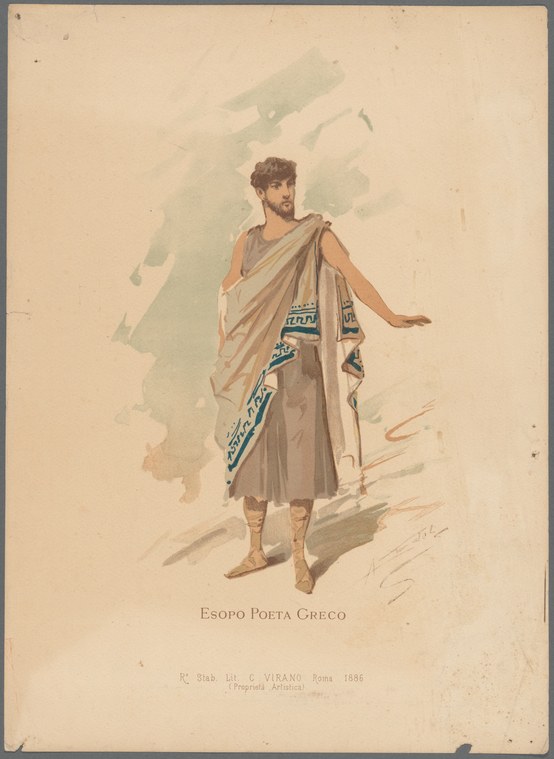
Esopo Poeta Greco
Unknown artist
- Collection:
- Prints depicting dance
- Source:
- New York Public Library
- Rights:
- Public domain — free to use, share and adapt.
- Recorded as:
- Public Domain
The work is historically significant as evidence of 19th-century theatrical practices of historical costume design and classical revivals, and it demonstrates how images of ancient Greek figures were constructed and circulated as visual references for stage production. For dancers and historians, it is a reminder that not all theater was dance, and that classical references in 19th-century visual culture often conflated oratory, classical learning, and costume without depicting actual movement.
What you are looking at
A single male figure stands in a relaxed contrapposto pose against a softly rendered background, his weight shifted to one leg while the other rests lightly forward. He wears an ancient Greek himation (a draped garment) thrown loosely over his shoulder in cream and pale brown tones, leaving his chest and right arm exposed. His left arm hangs naturally at his side; his right arm extends outward with an open, gesturing palm. The figure has dark curly hair and a beard, rendered in loose watercolor washes. In his left hand he holds a scroll or tablet marked with text. The composition is minimal—there is no architectural setting, no audience, no dance partner. The pale washed background and the thin border frame suggest this is a study or theatrical costume design rather than a scene of active performance.
The dancing
The single figure displays the weight distribution and stance of classical rhetoric or oratory rather than dance—one leg bearing weight, the opposite leg relaxed. The extended right arm with open palm is a gesture of address or exhortation, not a dance position. The body is upright and stationary, with no indication of movement, turning, or weight transfer through the feet. The scroll or tablet in the left hand reinforces this as a figure of authority or intellect rather than a performer.
The dance depicted
This is not a depiction of dance in the active sense. The inscription 'Esopo Poeta Greco' identifies the figure as Aesop, the ancient Greek fabulist and poet, rendered in the costume and pose of a classical orator or sage. While the work is housed in a collection labeled 'Prints depicting dance,' it appears to represent a theatrical or historical costume figure rather than an actual dance or choreographic moment. The stance and gesture follow the conventions of classical male oratory—a figure addressing an audience—rather than any known Greek dance tradition. It may have belonged to a theatrical production, costume book, or historical drama series, but no active dance movement is present.
How it was made
This is a watercolor or gouache on paper, rendered in muted earth tones and pale washes typical of 19th-century costume or theatrical design studies. The technique allows for swift, economical definition of form—the figure is modeled with soft shadows and the fabric rendered with minimal brushwork. The style and execution suggest this is a study for costume, scenery, or character design rather than a finished exhibition work. The thin decorative border and the inscription below indicate this was part of a series, likely a bound volume of historical or theatrical reference images.
About this work
This is a costume study for the figure of Aesop, the ancient Greek fabulist, executed in watercolor in what appears to be a 19th-century theatrical or historical costume reference series. The figure stands in an orator's pose rather than a dancer's position, holding a scroll and gesturing as if addressing an audience. Although cataloged within a collection of dance imagery, the work depicts neither dance movement nor a dancer, but rather a scholarly or theatrical personification of an ancient literary figure in period dress.
How to look at it
Observe the contrast between the relaxed, stationary stance and the gesturing arm: this is the pose of a speaker, not a mover. Note the scroll and the contemplative bearing, which align the figure with intellectual authority rather than physical virtuosity. The soft, unfinished background and the minimal setting direct attention entirely to the figure's dress and persona. The artist has chosen to freeze a moment of oratical address, using classical drapery and pose to evoke the ancient world rather than to capture choreographic content.
The artist
The artist is not recorded. The style and execution suggest a mid-to-late 19th-century theatrical or historical illustrator working within a studio tradition of costume and character design. The consistent framing, border, and inscription indicate this was part of a published or bound series, likely produced for reference by theater companies, designers, or historical societies. The competent handling of the watercolor medium and anatomically informed rendering suggest professional training.
The period
This work reflects the 19th-century European fascination with classical antiquity and historical costume authenticity. The period saw widespread production of theatrical design books, historical costume references, and illustrated classical texts, driven by a growing antiquarian interest and the development of more historically informed stage production. Theater companies began commissioning detailed costume studies based on archaeological and historical sources. At the same time, neoclassical ballet (such as the works of Carlo Blasis) was dominant, yet this figure is clearly not rendered as a dancer—it adheres instead to conventions of historical illustration and oratorical portraiture.
Where it lives
The work is held by the New York Public Library in a collection labeled 'Prints depicting dance.' The inscription at the bottom references 'Roma 1888' and credits 'Property Adriani,' suggesting it may have been part of a theatrical archive or costume book produced in Rome and later acquired by a collector. The framing and presentation indicate it was part of a bound or serialized reference work.
Questions about this work
Is this actually a dance image?
Not in the sense of depicting choreography or active movement. It is a costume study of the ancient Greek poet Aesop, rendered in an orator's pose. It was cataloged within a dance collection, possibly because it was part of a theatrical archive that included costume references for historical dramas or because the original collection was broadly theatrical. The image itself shows a static figure of authority and intellect, not a dancer.
What is the scroll or tablet in his hand?
It appears to represent a text or manuscript—appropriate to Aesop, who was known for his fables and literary legacy. In 19th-century costume and historical design, such attributes were included to identify the historical figure and reinforce his role as a poet and sage.
Why is this in a dance collection at all?
It likely belonged to a broader theatrical archive or costume reference collection, which may have included both dance and dramatic works. Alternatively, the collection itself may be organized thematically around performance and theatrical imagery rather than exclusively choreographic content.
What does 'Roma 1888' mean?
It indicates the work was produced or held in Rome in 1888. The credit 'Property Adriani' suggests it belonged to a collector or theatrical company called Adriani, and the NYPL later acquired it as part of a larger collection.
More dance artwork





