49 works in this view — arrow keys or swipe to move between them.
Dance in Art
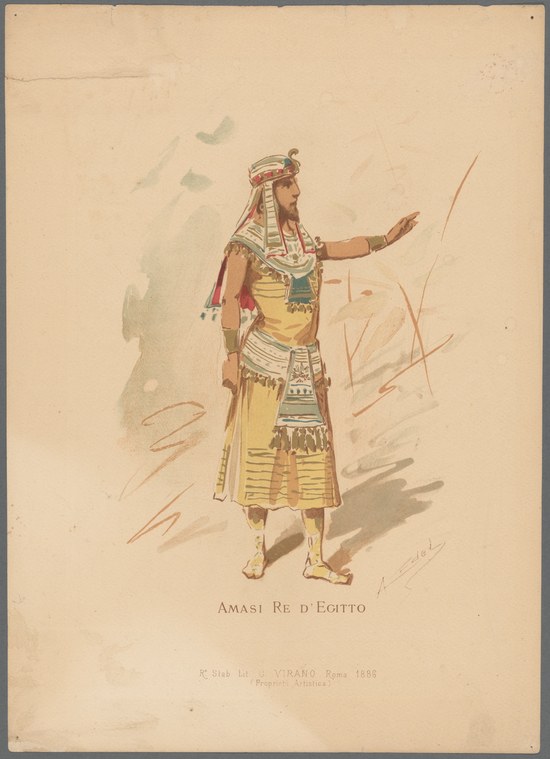
Amasi Re D'Egitto
Unknown artist
- Collection:
- Prints depicting dance
- Source:
- New York Public Library
- Rights:
- Public domain — free to use, share and adapt.
- Recorded as:
- Public Domain
This sketch shows how European theater translated and codified the visual language of ancient Egypt, establishing costume conventions that persist today. For historians of theatrical production and design, it records what 'Egypt' meant visually in the performance culture of the period, and what an educated audience was expected to recognize.
What you are looking at
A standing figure in Egyptian royal dress is depicted in three-quarter view against a cream background with faint watercolor washes suggesting shadow and depth. The figure wears a striped linen kilt (schenti) with a decorative apron, a broad collar (wesekh) of red and gold geometric pattern, and an ornate headdress with a uraeus serpent and tall plumes. The left arm is raised with palm open in a gesture of speech or benediction; the right arm hangs at the side. The figure stands in a formal, frontal pose with weight evenly distributed. Red pen sketching marks in the background suggest this is a working study or costume design. The title identifies this as Amasi, King of Egypt.
The dancing
A single figure, presumably male, stands in an upright, formal posture characteristic of Egyptian royal portraiture. The raised left arm with open palm suggests proclamation or ritual gesture rather than active movement. The stance is static and hieratic—feet planted, body facing forward—with no indication of locomotion or the dynamic weight shifts that would suggest dance movement in the Western theatrical sense.
The dance depicted
This is not a depiction of dance in the sense of rhythmic, deliberately trained movement. It appears instead to be a costume or character study for theatrical representation of an Egyptian pharaoh. The posture is that of state ceremony and royal protocol. If this belongs to a theatrical production, it documents the visual language used to represent ancient Egypt on stage rather than recording any actual Egyptian movement practice.
How it was made
A watercolor and ink study on paper, worked with careful attention to ornamental detail. The medium supports rapid iteration and color study; the visible red-pen annotations in the background confirm this is a preparatory sketch rather than a finished artwork. The technique is consistent with 19th-century theatrical costume and character design, where watercolor allowed designers to communicate color, pattern, and silhouette efficiently to makers and performers.
About this work
This is a costume and character study for theatrical use, depicting a pharaonic Egyptian king in formal regalia. The figure embodies the visual vocabulary of ancient Egyptian royal dress as understood and staged in 19th-century European theater. The work is a document of how Egypt was visually reconstructed for the stage during an era of intense Orientalist engagement with classical antiquity, rather than a record of dance practice proper. Its inclusion in a dance archive reflects the overlap between theatrical costume design, historical pageantry, and the spectacular staging of non-European courts that characterized Victorian and post-Victorian theater.
How to look at it
Note the precision of the ornamental detail—the weave pattern of the collar, the striping of the kilt, the symbolic serpent at the brow—which would need to be legible from the audience. The frontality and stillness of the pose are intentional: this is how a king presents himself in ceremony, not how he moves through space. The red sketching marks show the designer working out positioning and proportions, thinking about how the costume will read on a lit stage.
The artist
The artist is not recorded in the catalogue. The style and technique are consistent with late 19th-century French theatrical design practice (the inscription shows 'Rome 1888' and what appears to be a French attribution), suggesting this was produced by a professional costume designer or scene painter working for a major theater house.
The period
The late 1880s mark the height of European Orientalism and the popularity of grand operas and historical pageants set in exotic or ancient settings. Works like Verdi's *Aida* (1871) had established Egypt as a prestigious subject for theatrical spectacle. Costume studies of this type were essential to professional theater production, serving as technical documents for makers and as visual shorthand for performers and directors.
Where it lives
Held by the New York Public Library as part of a collection of prints depicting dance. The attribution and date (Rome 1888) appear on the lower margin of the sheet.
Questions about this work
Is this actually a dance?
No. This is a character study for theatrical representation, not a record of dance movement. The pose is ceremonial and hieratic, the stance static. It belongs in a dance collection because theater was a principal site where dance and spectacle intersected, and because costume design was central to how dance narratives were communicated to audiences.
What does the title 'Amasi Re d'Egitto' mean?
It translates as 'Amasis, King of Egypt.' Amasis II was a historical pharaoh (570–526 BCE), but this figure represents the generic visual language of Egyptian kingship as staged in 19th-century European theater rather than a historically specific portrait.
Who would have used this sketch?
A costume maker, wardrobe master, or performer preparing for a stage production set in ancient Egypt. The annotations and working marks suggest it was a functional document, probably one of many studies produced for a single production.
More dance artwork





