49 works in this view — arrow keys or swipe to move between them.
Dance in Art
Araba
Unknown artist
- Collection:
- Prints depicting dance
- Source:
- New York Public Library
- Rights:
- Public domain — free to use, share and adapt.
- Recorded as:
- Public Domain
This work preserves a record of a non-European performance tradition at a moment when European theatrical culture was increasingly documenting and exchanging images of "exotic" dance and costume. It demonstrates how specific dance traditions were observed, rendered, and circulated through artistic channels—often without clear attribution or contextual documentation. The work's survival depends entirely on this archival drawing; without it, no other trace of this performer or performance moment would remain.
What you are looking at
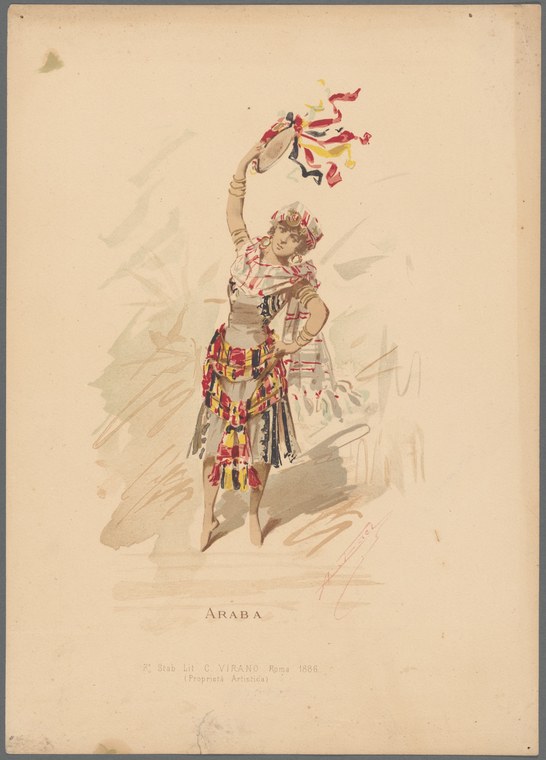
A single figure in elaborate costume stands against a pale, sketched architectural background. The dancer is dressed in a richly ornamented tunic or short dress with horizontal bands of decoration in red, yellow, and dark colors, arranged in stripes or panels across the torso and legs. The costume includes what appears to be a decorated belt or girdle. The figure wears a headdress or crown and holds aloft in one raised arm an ornamental object—possibly a fan, shield, or ceremonial prop—rendered in red and yellow with flowing ribbons or streamers that cascade downward. The pose is frontal and statuesque, with the weight evenly distributed, suggesting a moment of display or presentation rather than active motion. The drawing technique is delicate watercolor or gouache, with fine linear detailing in the costume ornament and a loose, gestural quality to the background architecture, which appears to be classical in style with arched forms.
The dancing
The single dancer stands in a symmetrical, almost heraldic pose with one arm raised to shoulder height or above, holding the decorative object high. The body is upright and frontal, with legs visible beneath the short skirt in a stance that neither suggests weight shift nor active stepping. The upper body is formal and contained; there is no sense of torsion or dynamic movement through the torso. The arm position is display-oriented rather than functional to locomotion or partnering.
The dance depicted
This appears to be a performer in theatrical or ceremonial dress from a non-European tradition, most likely Middle Eastern or North African based on the costume vocabulary and the title *Araba*. The pose and ornament suggest a solo display dance associated with court or palace entertainment—possibly part of a classical Egyptian or Ottoman theatrical tradition. The raised arm and ceremonial object may indicate a moment within a longer movement vocabulary, but the frozen, presentation-like quality suggests this is a costume study or a record of a specific theatrical pose rather than a captured moment of kinetic dance. Without clearer documentation of the dance form itself, confident identification is not possible, though the formal, statuary quality implies trained, codified movement rather than social or vernacular dance.
How it was made
This is a watercolor or gouache drawing on paper, executed with fine brushwork and pen detail. The technique is delicate and illustrative, with careful attention to the ornamental detail of the costume rendered in transparent or semi-opaque washes. The light background and linear architectural sketch suggest this is a costume design study or performance documentation rather than a finished narrative scene. The medium and approach—a single figure isolated on the page with minimal setting—is consistent with 19th-century theatrical costume documentation and artist's studies for opera, ballet, or dramatic entertainments.
About this work
This is a costume study or performance record of a solo dancer in elaborate ceremonial or theatrical dress, rendered in watercolor on paper. The work documents a single moment or pose—one arm raised, holding an ornamental prop—in what may be a Middle Eastern or North African theatrical tradition. The technical skill in rendering ornament, the formal isolation of the figure, and the architectural setting suggest this was created as documentation of a specific performer or theatrical role, possibly for circulation among opera or theater companies. It belongs to the tradition of theatrical costume studies that flourished in the 19th century, when European artists recorded and circulated images of performers and performance styles from around the world.
How to look at it
Attend to the formal, frontal pose and the deliberate elevation of the right arm—this is a moment of display or presentation, not a moment of dynamic movement or transition. The ornament on the costume is rendered with precision, suggesting the artist understood that the costume itself was central to the performance. The architectural setting in the background, though sketched lightly, establishes a formal or palatial context. This is a study made to preserve and communicate the visual impression of a specific performer in a specific role—not a narrative scene, but a portrait of a theatrical moment.
The artist
The artist is not recorded. The style and technique suggest a trained illustrator working within 19th-century European theatrical or operatic documentation practices. The careful rendering of ornament and the professional quality of the figure suggest someone with access to performers or reliable costume documentation, possibly an artist employed by a theater company or opera house, or someone working from description or from live performance.
The period
The 19th century saw intense European interest in non-European performance traditions, particularly in the context of Orientalist aesthetics and the global circulation of performers. Dance from the Ottoman Empire, Egypt, and North Africa was documented, studied, and performed in European theaters, often mediated through the eyes and hands of European artists. This period also saw the development of theatrical costume studies as a distinct artistic and archival practice, with major theaters and opera companies commissioning or acquiring documentation of important roles and performers. The careful, illustrative style of this work is consistent with such documentation practices.
Where it lives
The work is held in the New York Public Library's collection of prints depicting dance. It entered the collection as part of the Library's efforts to document performance traditions and theatrical design across cultures and centuries.
Dance in this work
Questions about this work
What does 'Araba' mean?
Araba (also spelled 'arabi' or 'arabah') refers to performance traditions or performers from the Arab world or Arabic-speaking regions. The term in a 19th-century theatrical context often indicated Middle Eastern or North African dance or costume. The exact referent here—whether a specific dancer, a role, or a generalized costume type—is not documented in the catalogue record.
Is this a record of a real performance?
Almost certainly yes. The specificity of the costume rendering and the professional quality of the drawing suggest this was made either from live performance, from a performer's own costume, or from reliable theatrical documentation. However, without artist attribution or performance records, we cannot identify the specific dancer, company, or date of the performance.
What is the object the dancer is holding?
The object is rendered with red and yellow decoration and appears to have flowing streamers or ribbons. It may be a decorative fan, a ceremonial shield, a prop banner, or an element of ceremonial regalia. Its exact function within the dance is not clear from the image alone.
How was this image used?
Costume studies like this were typically used as theatrical reference documents, exchanged between theater companies, included in performance archives, or circulated to other artists and companies interested in obtaining or recreating specific roles. They served as both artistic records and practical tools for costume production.
More dance artwork





