49 works in this view — arrow keys or swipe to move between them.
Dance in Art
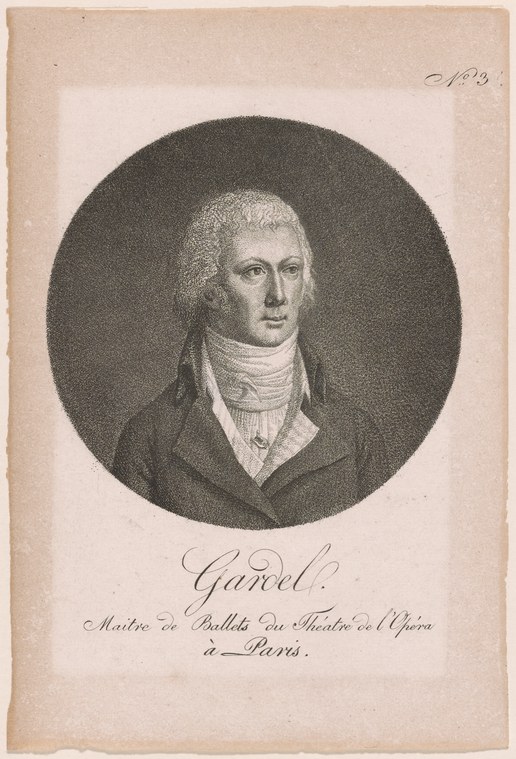
Gardel: Maitre de Ballets du Théatre de l'Opera à Paris. No. 3
Unknown artist
- Collection:
- Prints depicting dance
- Source:
- New York Public Library
- Rights:
- Public domain — free to use, share and adapt.
- Recorded as:
- Public Domain
Gardel's reforms—particularly his development of ballet d'action with coherent narrative and his systematization of technique—laid the foundation for all ballet that followed. A portrait of Gardel is a portrait of institutional power in dance at the moment when ballet was being codified as a high art form separate from court aristocratic practice. Understanding who Gardel was and how he was visually represented helps explain how professional ballet became possible.
What you are looking at
A three-quarter length portrait bust of a man set within a dark oval vignette against a cream background. The subject is rendered in the neoclassical portrait style typical of late 18th-century French engravings. He has swept-back gray hair, a thin face with prominent nose, and wears the formal dress of a Parisian gentleman: a dark coat with a high collar and a white cravat or neckerchief gathered at the throat. The engraving is finely detailed, with careful hatching and stippling creating volume and texture. Below the portrait, an elegant script inscription reads "Gardel. Maître de Ballets du Théâtre de l'Opéra à Paris."
The dancing
The subject is presented in a contemplative three-quarter pose, head slightly tilted, gaze directed outward in a manner characteristic of 18th-century portrait convention. The pose conveys authority and dignity without dramatic gesture. The absence of movement or dance posture indicates this is a portrait of the man as a public figure and administrator rather than as a performer in motion.
The dance depicted
This is a portrait of Pierre Gardel, the most influential ballet master of late 18th-century France, who served as maître de ballet at the Opéra (also called Académie Royale de Danse) in Paris. The inscription confirms his title and position. Gardel was central to the development of ballet d'action and reformed ballet technique and repertory during his decades-long tenure. The portrait documents him as an institutional figure—a choreographer and administrator shaping professional dance practice rather than a performer captured mid-movement.
How it was made
This is a line engraving, a reproductive print technique widely used in the 18th century for distributing portraits of notable figures to a broad audience. The fine parallel lines and crosshatching create tonal gradation; the dark vignette background frames the face and emphasizes the sitter's features. Engraving allowed precise detail and multiple impressions, making such portraits accessible to educated audiences across Europe. The technique and presentation identify this as a formal, officially sanctioned portrait intended for circulation among the theatre-going public and the artistic establishment.
About this work
This portrait of Pierre Gardel, dated to the late 18th century, presents the most powerful dance administrator of his era at the height of his influence. Gardel led the Paris Opéra ballet for over thirty years, revolutionizing choreography and technique and establishing the vocabulary and methods that would define Classical ballet. The engraving is one of many reproductive prints made to commemorate and circulate the likenesses of celebrated public figures in the arts. It documents not a dance moment but the authority and social standing that an accomplished ballet master could command in Revolutionary and post-Revolutionary France.
How to look at it
This is a portrait of authority and stasis rather than action. The oval frame, the formal pose, and the inscription together present Gardel as a figure of institutional permanence rather than a fleeting moment of performance. Note the restraint and dignity of the presentation: there is no suggestion of the theatrical, no hint of the spectacular or sensational. Instead, the portrait invests Gardel with the gravitas of a scholar or statesman. This choice of presentation—this refusal to depict him as a performer or even in a rehearsal setting—tells viewers that his power lay in administration, vision, and influence, not in bodily virtuosity.
The artist
The artist is not recorded in the catalogue. The engraving style and the inscription format are consistent with Parisian reproductive print practice of the 1780s–1800s. Such portraits were produced by professional engravers working from drawings or paintings, often commissioned by theatres or the subjects themselves for public distribution.
The period
This engraving was likely produced between the 1780s and early 1800s, a period of radical transformation in French ballet. Gardel took over direction of the Opéra ballet in 1781 following the death of Jean-Georges Noverre and immediately began reshaping the institution. The 1780s saw the creation of major works like Télémaque (1790) and La Dansomanie (1790), which showcased his innovations in narrative structure and the technical demands placed on dancers. The French Revolution (1789) and subsequent political upheaval altered patronage and performance contexts, yet Gardel's authority persisted; his ability to be commemorated in this formal engraved portrait attests to his institutional indispensability. The engraving also reflects the broader 18th-century fascination with commemorating accomplished individuals across professions through circulated prints.
Where it lives
The work is held in the Prints collection of the New York Public Library, catalogued as depicting dance. It is one of many theatrical portraits from the late 18th and early 19th centuries in European collections, produced as both historical record and promotional material.
Questions about this work
Who was Pierre Gardel?
Pierre Gardel (1758–1840) was a dancer, choreographer, and ballet master at the Paris Opéra from 1781 until his retirement. He revolutionized ballet by emphasizing narrative coherence, dramatic expression, and technical rigor. His works and administrative policies shaped professional ballet practice across Europe and established the foundations of Classical ballet technique.
Why is this a portrait and not a dance image?
This engraving commemorates Gardel in his official capacity as maître de ballet, the administrative and creative head of the Opéra ballet institution. Contemporary ballet masters were as likely to be commemorated in formal portraiture as painters, musicians, or men of letters—their contributions recognized as intellectual and institutional, not merely physical.
What was the Paris Opéra ballet in the 18th century?
The Paris Opéra (Académie Royale de Musique) was the official state theatre and the premier institution for ballet in Europe. Its ballet school and company set standards for technique, repertory, and training. By Gardel's time it had ceased to be a court entertainment and had become a public theater for an educated urban audience, with professional dancers and an international reputation.
How do we know this is Gardel?
The inscription directly identifies him: 'Gardel. Maître de Ballets du Théâtre de l'Opéra à Paris.' The format, style, and archival records confirm it as a formal commemorative portrait of the man and his office.
More dance artwork





