49 works in this view — arrow keys or swipe to move between them.
Dance in Art
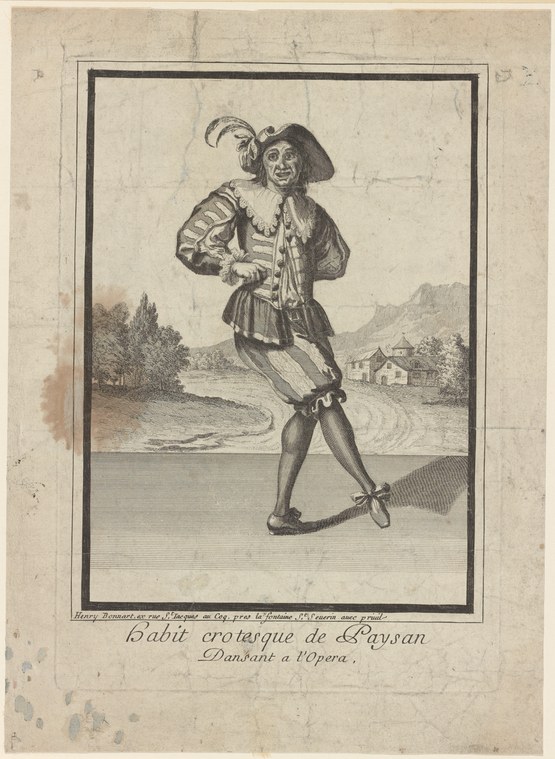
Habit crotesque de paysan. Dansant à l'Opéra
Unknown artist
- Collection:
- Prints depicting dance
- Source:
- New York Public Library
- Rights:
- Public domain — free to use, share and adapt.
- Recorded as:
- Public Domain
This print documents the persistence of commedia dell'arte character types in theatrical contexts well into the 18th century, and shows how grotesque and comic dance coexisted with other entertainment forms on the opera house stage. For dance historians, it offers visual evidence of movement style and costume in a tradition that left no other record, and demonstrates that 'dance' in historical performance contexts included mime, gesture, and character work distinct from balletic virtuosity.
What you are looking at
A young male dancer strikes a exuberant pose center-stage in a rural landscape setting. He wears an elaborate costume of the commedia dell'arte tradition: a plumed hat, short doublet with puffed sleeves, striped or patterned hose, and shoes with curled toes. His expression is animated, mouth open as if laughing or speaking. One arm gestures upward in a flourish while the other is positioned near his torso; his legs are in a wide stance with one knee bent, suggesting mid-leap or mid-gesture rather than a stable ground position. The background shows a pastoral scene with trees, a small building or cottage, and distant hills rendered in lighter tones, creating depth. The figure occupies the foreground in sharp relief. The print is a black-and-white engraving with hand-coloring (light browns and greens in the landscape), bordered by a double-line frame.
The dancing
A single male figure dominates the composition in a dynamic, unstable stance: weight appears to shift between the legs, one knee bent in a potential plié or mid-leap position, suggesting physical exuberance rather than balletic control. The arms are asymmetrical and emphatic—the raised arm reaches upward with an open hand, while the other rests lower on the body. The posture is open and expansive, the torso upright but not formally aligned. This is the body language of comedy and mime, not the turned-out, controlled geometry of theatrical ballet.
The dance depicted
This is a theatrical entertainment character rather than concert dance. The figure is identified in the caption as 'Baby crotesque de paysan dansant à l'Opéra'—a grotesque peasant character dancing at the Opera house. The 'crotesque' (grotesque) genre was a staple of commedia dell'arte and related court spectacles, featuring buffoonery, exaggerated gesture, and mimetic storytelling. The costume—plumed hat, puffed sleeves, curled-toe shoes—and the animated facial expression confirm this is character dance rooted in popular theatrical traditions, not balletic form. Peasant characters ('paysan') were stock roles in these spectacles, typically portrayed as comic, rustic figures through exaggerated movement and dress.
How it was made
This is a hand-colored engraving, a technique allowing fine linear detail combined with wash-tinted color. The precision of the line—particularly in rendering costume detail, fabric textures, and the figure's musculature—suggests a professional printmaker of skill. The engraving's composition and execution indicate this was a commercial print: likely a theatrical playbill illustration, character sheet, or souvenir image circulated to document stage spectacles. The technique and format suggest production for a literate audience with access to print culture, possibly early-to-mid 18th century based on style conventions, though the catalogue gives no date.
About this work
This hand-colored engraving depicts a character dancer from the commedia dell'arte tradition performing in a theatrical context—specifically identified as an opera house ('à l'Opéra'). The grotesque peasant character was a recognizable comedic type in early modern European spectacle, distinguished by exaggerated costume, animated facial expression, and body language emphasizing buffoonery over formal dance technique. The print circulated knowledge of theatrical performances to a public who might never see the live show, functioning as a document of stage practice and character types. It belongs in a dance collection because it records an actual entertainment form—character dance and mime—that was performed as part of opera and court spectacles, even though the movement vocabulary differs radically from ballet or social dance. The rural landscape setting, despite the 'à l'Opéra' attribution, may represent either a theatrical backdrop or a generic pastoral convention for peasant characters.
How to look at it
Attend to the moment of maximum expressivity the artist chose: the dancer mid-gesture, mouth open, in an unstable, asymmetrical pose that reads as urgency and play rather than formal control. This is the opposite of the balletic ideal of stillness within motion. Notice the costume detail—the plumed hat, striped hose, curled shoes—which situates the character in a recognizable tradition even without narrative context. The hand-coloring of the landscape, though light, grounds the figure in a depicted world rather than a timeless stage, reinforcing the idea that this is a specific character in a specific theatrical context. The rural setting may be ironic or satirical, playing on the 'peasant' designation while the performance occurs in an opera house.
The artist
The artist is not recorded in the catalogue. The engraving bears what appear to be inscription or signature marks, possibly present on the plate, but these are not legible in the image. The style and technique suggest professional execution and commercial publication, consistent with the 18th-century print trade in theatrical documentation. Such prints were often produced by anonymous or semi-anonymous printmakers working in established workshops, prioritizing marketability and rapid circulation over artist attribution.
The period
This print dates to an era when commedia dell'arte conventions were transitioning from street and fair performance into formalized theater and court spectacle. By the 18th century, grotesque comedy and character dance had become established components of opera and ballet d'action across Europe. At the same time, theatrical dancing was professionalizing and becoming codified—the contrast between this figure's exuberant, mimetic physicality and the emerging balletic norm (verticality, turnout, ethereal lightness) illustrates the coexistence of competing aesthetic ideals. The inscription 'crotesque de paysan dansant à l'Opéra' suggests that even in elite theatrical contexts, the grotesque peasant remained a valued character type, performing a function distinct from serious or heroic roles.
Where it lives
The print is held in the New York Public Library's collection of prints depicting dance. It is catalogued with minimal metadata: no artist, date, or medium recorded in the primary record. This is consistent with theatrical prints of the 18th and early 19th centuries, which were often mass-produced, circulated informally, and not systematically documented at the point of acquisition by libraries and museums.
Questions about this work
What is 'grotesque' dance and why does this figure look so exaggerated?
Grotesque dance was a recognized genre in early modern theater, the comic counterpart to serious ballet. It emphasized mimicry, exaggerated gesture, asymmetrical poses, and facial expression to portray comic and rustic characters. The term 'grotesque' came from Renaissance visual art terminology and referred to a deliberate distortion or caricature of the human form for comic effect. In theatrical performance, grotesque dancers needed virtuosity in timing, expression, and character work—not balletic control, but different skills.
Was this a real dance performed at the opera, or is it just a costume?
The inscription 'dansant à l'Opéra'—'dancing at the opera'—suggests this was a performed role. Opera houses of the period included multiple types of entertainment: arias, ballets, divertissements, and character interludes. A grotesque peasant character could have appeared in a comic scene or as part of a larger spectacle. The print documents an actual stage type, even if this particular image may be a generalized representation rather than a specific performance.
Why is the setting rural if this is an opera house performance?
Theatrical settings were often depicted as painted backdrops or generalized landscapes suggesting genre or character type. A rural or pastoral setting conventionally signaled a peasant or comic character. The inscription 'paysan' (peasant) established the character's identity; the landscape reinforced it visually. The contradiction between 'opera house' and 'countryside' is resolved by understanding that the print documents the character type as it would appear on stage, complete with its conventional scenic associations.
More dance artwork





