49 works in this view — arrow keys or swipe to move between them.
Dance in Art
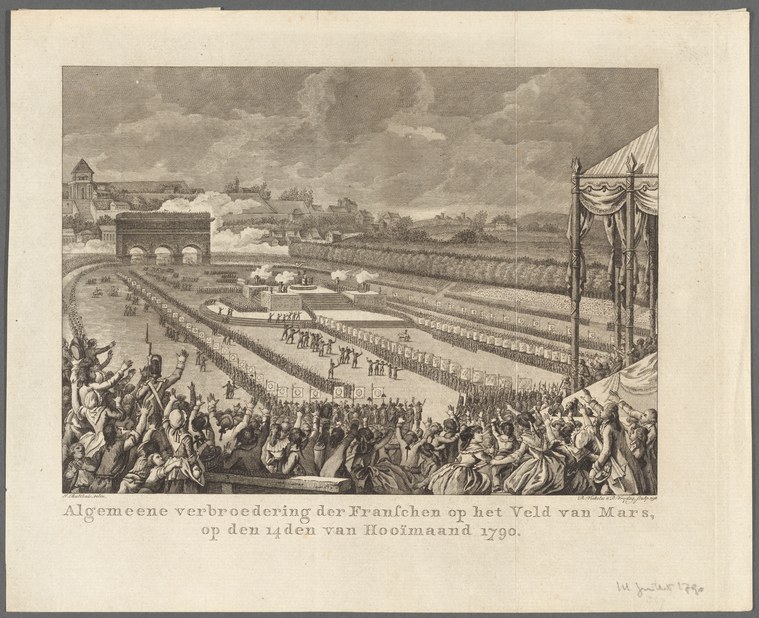
Algemeene verbroedering der Franschen op het Veld van Mars, op den 14den van Hooïmaand 1790
Unknown artist
- Collection:
- Prints depicting dance
- Source:
- New York Public Library
- Rights:
- Public domain — free to use, share and adapt.
- Recorded as:
- Public Domain
For dance historians and curators, this image is crucial evidence of how choreography extended beyond ballroom and stage into revolutionary public space, and how mass gathering itself became a form of political and social expression. It reveals the moment when dance scholars and historians might look to understand collective movement as a language of citizenship, predating modern political choreography by more than a century.
What you are looking at
This engraving depicts a vast outdoor gathering on the Champ de Mars in Paris on 14 July 1790, commemorating the first anniversary of the storming of the Bastille. The composition is crowded and celebratory, with thousands of figures arranged in formation across an open field. In the foreground, a dense mass of citizens stands watching; in the middle distance, lines of uniformed figures (soldiers or national guards) form geometric patterns across the plain. At the far left, fortified structures and city buildings frame the landscape under a dramatic, cloud-filled sky. The right side is dominated by a large draped pavilion or reviewing stand with swags of fabric, suggesting an official platform. Throughout the scene, figures gesture upward and outward, many holding poles, banners, or flags, creating an impression of collective exuberance and patriotic fervor.
The dancing
The gathered figures are not executing a coordinated dance in the ballroom sense, but rather moving in a loose, celebratory throng—groups cluster together, some with raised arms, others gesturing toward the sky or toward the reviewing stand. The density of bodies varies across the composition, with tighter groupings in the foreground and more dispersed formations in the middle distance. Many figures appear to be standing rather than dancing, though the overall posture and arm positions convey excitement and animated movement. This is not a formal partnered or processional dance but rather a mass civic gathering in which bodies occupy space expressively.
The dance depicted
This image documents a civic celebration rather than a codified dance genre. However, the mass gathering and gestural animation of the crowd suggest elements of early Revolutionary era public assembly, in which crowds moved together in quasi-choreographed formations—what some scholars have termed 'the choreography of citizenship.' The event itself (the Fête de la Fédération, 14 July 1790) was designed to create unity through collective presence and movement. While no specific ballroom or folk dance is being performed, the image captures a moment when dance as social cohesion—the movement of many bodies together for political purpose—was central to Revolutionary ideology.
How it was made
This is an engraving (established from the fine parallel line-work and tonal gradations characteristic of intaglio printing rather than lithography or woodcut). The technique allowed for fine detail across a large composition and wide distribution through printed copies. The execution is careful: the artist rendered atmospheric perspective through lighter handling of the sky, architectural precision in the city silhouette and pavilion, and careful density variation in the crowd to suggest depth and scale. Engraving of this period was a major mode for documenting public events and circulating images to a broad audience, making this a primary historical document rather than a private commission.
About this work
This engraving records the Fête de la Fédération of 1790, a mass political gathering on the Champ de Mars designed to celebrate French unity and Revolutionary ideals. While not a dance performance in the traditional sense, the image captures the collective movement and gestural language through which a revolutionary crowd performed political identity—what historians now recognize as a form of choreography central to the era's reimagining of public assembly and civic participation. The print documents how movement, formation, and crowd presence became tools of political expression during the French Revolution.
How to look at it
Attend to the composition's radical expansion of the space of dance: the entire field becomes the stage, and the crowd itself becomes the performer. Notice how the artist uses density, gesture, and directional pull (many figures face toward the pavilion or gesture upward) to create the sense of unified emotional direction and movement without depicting a formal choreography. The pavilion at right anchors the composition and marks the presence of official spectators—suggesting that even this revolutionary civic gathering maintained a distinction between performers and watchers, albeit on a vastly expanded scale. The sky's turbulent clouds and the fortress at left suggest both celebration and the residual power structures being challenged.
The period
The Fête de la Fédération was held at the height of Revolutionary optimism, during the constitutional monarchy phase (1789–1792) when revolutionaries and the crown still attempted to govern together. The 1790 gathering was the largest public event France had yet seen, designed to unite city and countryside, military and civilian, in a single space. In the same years, formal ballroom dances (contredanses, minuets, and newly popular waltzes) were being performed in urban salons, but this image testifies to a parallel development: the invention of revolutionary public ceremonial in which movement, formation, and gathered bodies became meaningful political speech. The print circulated widely and became an iconic image of the Revolutionary period.
Where it lives
This engraving is held in the New York Public Library's collection of prints depicting dance. The catalogue identifies it as a depiction of the Fête de la Fédération, recorded in Dutch ('Algemeene verbroedering'—general fraternization/brotherhood) with the date 14 July 1790.
Questions about this work
Is this actually a dance?
Not in the sense of a learned choreography or ballroom form. It documents a political gathering. However, it captures something dance historians increasingly study: how crowds move together expressively and how collective presence becomes a form of political speech. The Revolutionary era explicitly theorized citizenship as a kind of choreography—synchronized bodies creating national unity.
Why was the Champ de Mars chosen?
The open field allowed unprecedented numbers to gather—estimates range from 50,000 to 250,000 people. It was a blank canvas for collective formation, aligned with Revolutionary ideals of transparency and unity. The flatness and scale made the event itself a kind of large-scale geometric dance.
Who created this print?
The artist is not recorded. The print was likely created soon after the event to circulate widely as a documentary image. Such prints were major vehicles for distributing news and creating shared understanding of major public events.
More dance artwork





