49 works in this view — arrow keys or swipe to move between them.
Dance in Art
Louise Fairbrother
Unknown artist
- Collection:
- Prints depicting dance
- Source:
- New York Public Library
- Rights:
- Public domain — free to use, share and adapt.
- Recorded as:
- Public Domain
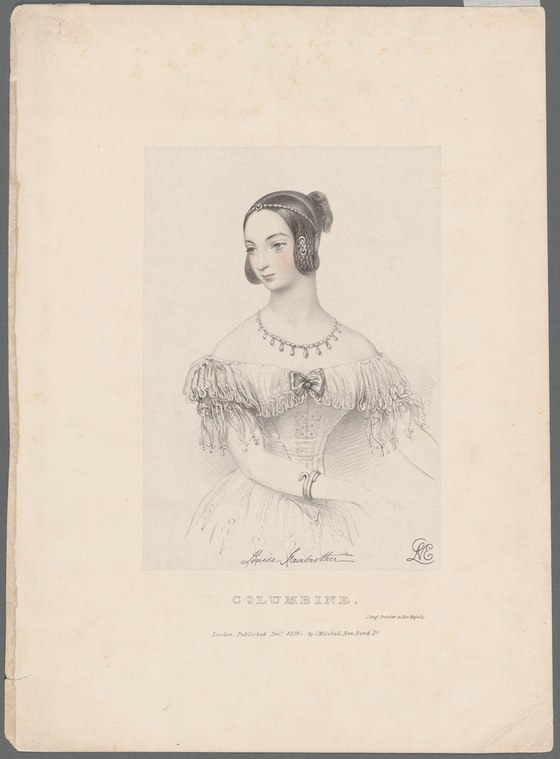
As a named portrait of a mid-19th century British theatrical performer, this print is evidence of how dancers and actresses were marketed and remembered in an era before photography became the standard. The work illuminates the visual culture surrounding dance and performance in the Victorian theatre, including the fashions, conventions of portraiture, and the celebrity apparatus that elevated and promoted theatrical women.
What you are looking at
A three-quarter length portrait of a young woman dressed in fashionable mid-19th century attire, shown in a moment of refined repose rather than active movement. She wears an off-shoulder dress with voluminous sleeves edged in deep fringe or tassel trim, the bodice fitted and adorned with a bow at the center front. Her dark hair is gathered in a chignon at the back of her head and decorated with a delicate circlet or headpiece. Around her neck hangs a simple beaded necklace. She gazes to the left with a gentle, composed expression, one hand resting naturally at her side. The figure is rendered with fine detail in what appears to be a lithograph or steel engraving, set against a plain background within a rectangular frame. The work is signed, and the subject is identified by inscription as Louise Fairbrother.
The dancing
A solitary standing figure shown in an elegant but static pose. Her body is angled three-quarters to the picture plane, weight evenly distributed, arms relaxed at her sides. There is no indication of active dance movement—no lifted leg, no dynamic arm extension, no turning motion. The pose is the conventional one for a mid-Victorian theatrical or social portrait, designed to display the sitter's dress and bearing rather than to suggest choreographic action.
The dance depicted
This is not a depiction of dance in progress. It is a theatrical portrait of Louise Fairbrother, the English dancer and actress, likely created to promote her performances or commemorate her as a public figure. The elegant dress and fashionable styling indicate a woman of the theatre, but the static, composed pose characteristic of Victorian portraiture means the work records her appearance and status rather than her art. Any interpretation of her as a dancer rests on the subject's known identity rather than on visual evidence of movement or dance technique in the image itself.
How it was made
The work is a finely detailed engraving or lithograph, the technique evident from the delicate tonal gradations, the precise line-work in the fabric textures and hair, and the tinted or gray-washed background. This medium allowed for mass reproduction and distribution—such prints of theatrical celebrities were a standard form of popular portraiture and fan ephemera in the mid-19th century. The signed notation indicates it was issued by a professional printmaker or publishing house, designed for a commercial audience of theatregoers and collectors.
About this work
This is a mid-Victorian theatrical celebrity portrait in engraved or lithographic medium, depicting Louise Fairbrother in fashionable dress of approximately the 1840s–1860s. Fairbrother was a dancer and actress of the period; the work documents her public image and the aesthetic conventions of her time rather than her practice as a performer. The portrait belongs in a dance archive not because it depicts dance itself, but because it preserves the likeness and social status of a historical figure whose primary identity lay in theatrical and dance performance.
How to look at it
Approach this as a historical document of theatrical celebrity rather than a dance image. Note the fashionable details of dress—the off-shoulder neckline, the fringed sleeves, the fitted bodice—which convey her status and the era's aesthetics. Observe how the pose is one of refined stillness, designed to display the figure and face rather than to suggest motion. The fine, even rendering of light and fabric tells you this was a professional commercial product, made to be looked at and possessed as a souvenir of a performer's fame.
The artist
The artist is not recorded in the catalogue. The work is unsigned in the visible image, though the catalogue identifies it as part of the collection of dance-related prints at NYPL. The print was likely created by an established engraver or printmaker working in London or another major theatrical center, producing such portraits on commission or for a theatrical print publisher.
The period
The 1840s–1860s were a period of flourishing theatrical celebrity culture in Britain and America. Dancers occupied an ambiguous but prominent place in this world—celebrated performers but also subjects of social scrutiny. Romantic ballet, with its ethereal heroines and emotional narratives, was at the height of its popularity, and ballerinas were among the most famous public figures of the day. Theatrical portraiture in engraved and lithographic form was a primary medium for circulating and monetizing the images of these performers, reaching audiences far beyond those who could attend live performances.
Where it lives
The work is held in the Prints collection at the New York Public Library as part of their holdings of images related to dance. It is a catalogued print, likely acquired as an example of 19th-century theatrical ephemera and performance culture.
Questions about this work
Was Louise Fairbrother a famous dancer?
Louise Fairbrother was a dancer and actress active in the mid-19th century British theatre. The circulation of her portrait in engraved form indicates she achieved public prominence, though the extent and nature of her fame and career are not established by this image alone.
Why does this portrait not show her dancing?
Theatrical portraits of this period were almost never action scenes. Their purpose was to display the performer in fashionable dress, as a souvenir for admirers and as advertisement. Dance technique and movement were experienced live; prints preserved the celebrity's appearance and social standing.
What technique was used to make this print?
The image appears to be an engraving or lithograph, the method standard for mass-producing and distributing theatrical portraits in the 19th century. These prints were affordable and collected widely, making them the primary way the public encountered images of their favorite performers.
More dance artwork





