49 works in this view — arrow keys or swipe to move between them.
Dance in Art
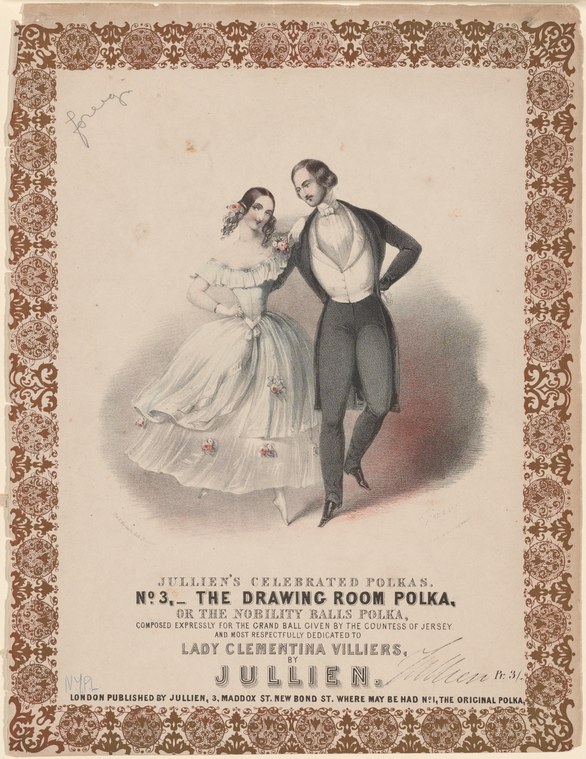
Juliens celebrated polkas... No. 3
Unknown artist
- Collection:
- Prints depicting dance
- Source:
- New York Public Library
- Rights:
- Public domain — free to use, share and adapt.
- Recorded as:
- Public Domain
The polka was a revolutionary social dance that broke from rigid eighteenth-century formality and introduced playful, energetic movement and closer partnership between men and women. This print is evidence of how commercial print culture, music publishing, and visual instruction shaped who danced, what they danced, and how they learned—a distribution system that would define popular dance for the next two centuries.
What you are looking at
A fashionable couple in mid-nineteenth-century dress occupy the center of the composition against a plain background. The woman wears a full white ball gown with a fitted bodice and voluminous skirt gathered at the waist, her dark hair adorned with flowers; she gazes toward her male partner with an animated expression. The man stands in profile to her right, dressed in black tailcoat and trousers, his posture upright and his gaze directed outward. The woman's right hand rests on his left arm in a gesture of engagement or instruction, while her left hand is raised. Their bodies are positioned close but not in a closed ballroom hold. The composition is framed by an ornate brown rococo border, and the print quality and hand-coloring suggest this is a commercial dance instruction or entertainment print from the mid-1800s.
The dancing
The woman's body faces three-quarters toward the viewer, her weight appears to be on one leg with the other extended or lifted, creating a sense of movement or turning. The man stands nearly upright in profile, his arms at his sides or loosely positioned. There is no tight closed hold; instead, the woman's contact with the man's arm suggests she is either leading, demonstrating, or they are about to enter a step. The raised hand position and the woman's animated facial expression suggest instruction or flirtation rather than active partnered movement. The spatial relationship and body angles do not correspond to the standard closed hold of a formal ballroom dance of the period.
The dance depicted
The title identifies this as a polka—specifically 'The Drawing Room Polka,' composed expressly for a grand ball given by the Countess of Jersey. The polka was a wildly fashionable couple dance across Europe and America in the mid-nineteenth century, characterized by a lively 2/4 tempo and energetic hopping or bouncing steps. This print appears to be a lesson or demonstration image rather than a depiction of active dancing; the positioning suggests the moment of instruction or courtship rather than mid-movement. The polka's association with informal, playful interaction between men and women made it a favorite subject for popular prints aimed at ballroom dancers and those aspiring to learn.
How it was made
This is a hand-colored lithographic print, recognizable from the soft tonal modeling, the decorative border treatment, and the characteristic way the colors sit on the stone surface. The ornate frame and the commercial printing suggest this was published as a sheet music cover or standalone dance instruction print for mass circulation. The presence of the composer's name (Jullien) and the dedication to Lady Clementina Villiers indicate this was a commercially released work intended for drawing-room performance and ballroom instruction, typical of the mid-nineteenth-century print industry's role in popularizing dance and music.
About this work
This is a mid-nineteenth-century lithographic dance print depicting a fashionable couple in the context of the polka, one of the most popular social dances of the era. Published as part of Jullien's celebrated polka series, it served both as sheet music cover art and as a visual guide for ballroom dancers learning the steps. The print captures not active dancing but the social interaction and courtship ritual surrounding the polka—the moment of introduction, instruction, or invitation that framed the actual dance on the ballroom floor. The work documents a specific moment in dance history when popular social dances were being democratized through print media, music publishing, and instruction guides aimed at the aspiring middle-class dancer.
How to look at it
Observe the deliberate stillness of the composition—this is not a moment mid-leap or mid-turn, but a posed, instructional tableau. The woman's raised hand and animated expression, combined with her contact on the man's arm, suggest the social protocol of the polka: the woman's agency in accepting or initiating the dance, the moment of connection before movement begins. The precision of the fashionable dress—the woman's flowers, the man's formal tailcoat—emphasizes that this is a ballroom event, not a stage performance, and that the polka belonged to the world of social aspiration and middle-class leisure.
The artist
The print is published by Jullien, a celebrated London music publisher and composer of the mid-nineteenth century known for producing vast quantities of popular dance music and instruction prints. The series 'Jullien's Celebrated Polkas' was a commercial success, with individual polkas dedicated to aristocratic patrons and society figures—a strategy that combined musical fashion with social networking and helped drive the polka's rapid adoption across ballrooms in Britain and Europe.
The period
The 1840s–1850s saw the polka transform from a Czech folk dance into the dominant social dance of European and American ballrooms, a shift enabled by music publishing and print culture. Unlike the stately minuet or the formally choreographed quadrille of earlier decades, the polka celebrated spontaneity, speed, and close partnership, making it a marker of modern, fashionable society. At the same time, the rise of commercial dance prints and lithographed sheet music covers created a new visual genre documenting ballroom fashion, steps, and social behavior—these prints were both aesthetic objects and practical teaching tools.
Where it lives
This print is held in the NYPL's collection of prints depicting dance. It is catalogued as sheet music cover art or a standalone dance instruction print published by Jullien in London, part of a commercial series marketed to ballroom dancers and music enthusiasts.
Dance in this work
Questions about this work
What is a polka and why was it so popular?
The polka is a lively couple dance in 2/4 time, originating in Bohemia and becoming the dominant ballroom dance of the 1840s–1860s across Europe and America. Its appeal lay in its energetic hopping steps, its allowance for closer partnership and interaction between men and women, and its modernity—it represented a break from the formal, choreographed dances of the previous century. It was fashionable, fun, and democratic, accessible to the middle classes rather than reserved for aristocratic courts.
How did people learn dances in the nineteenth century?
Ballroom dancers learned from printed instruction manuals, sheet music covers with illustrated figures, live demonstrations by dancing masters, and imitation of other dancers in the ballroom itself. Commercial prints like this one served both as sheet music covers (which sold the music) and as visual instruction—the figures shown the basic positioning and etiquette of the dance. These prints were mass-produced and affordable, making dance instruction available beyond the private lessons of the wealthy.
Who was Jullien and why did he publish so many polka prints?
Jullien was a celebrated London music publisher and composer of the mid-nineteenth century who built a commercial empire on popular dance music. Polkas were in enormous demand, and Jullien capitalized on this by publishing hundreds of titled polkas dedicated to society women, aristocrats, and celebrities—each dedication was a form of advertisement and flattery that helped sell copies. The prints served as both sheet music and visual merchandise, part of a larger strategy to capture the ballroom music market.
What does the dedication to Lady Clementina Villiers tell us?
Dedicating a polka to a well-known society woman was a common commercial strategy in nineteenth-century music publishing. It was both a compliment to the patron and an advertisement—people would buy a polka if it bore a name they recognized and admired. It also implied that the dedicatee danced the polka, linking the music and the dance to fashionable, elite circles and encouraging others to follow suit.
More dance artwork





