49 works in this view — arrow keys or swipe to move between them.
Dance in Art
Giovanni Coralli
Unknown artist
- Collection:
- Prints depicting dance
- Source:
- New York Public Library
- Rights:
- Public domain — free to use, share and adapt.
- Recorded as:
- Public Domain
Coralli was a significant choreographer and performer in the early Romantic ballet period; this print is documentary evidence of his prominence and the methods by which theatrical celebrity was constructed and distributed in the pre-photographic era. The work illustrates how dancers were marketed and memorialized through print culture—a crucial historical record of the profession's status and visibility.
What you are looking at
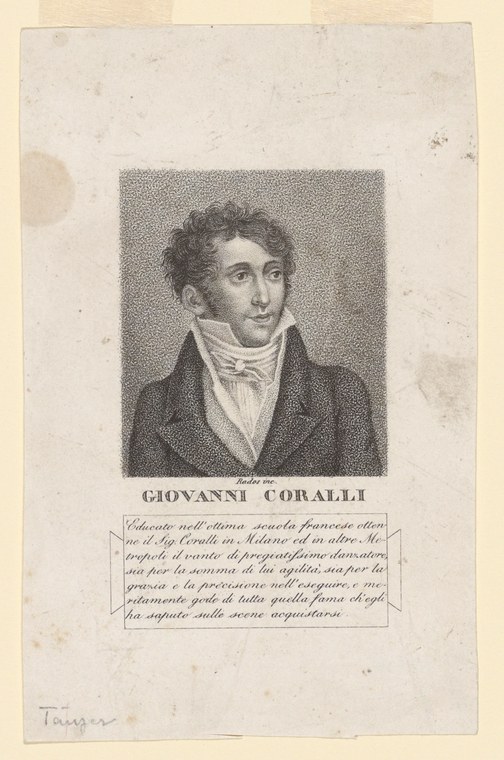
A portrait engraving of a man in early 19th-century dress, presented as a formal commemorative print. The subject is shown from the chest up, turned slightly to the left, wearing a dark coat and a white shirt with a high collar and cravat tied in the period fashion. His curly dark hair is styled in the Romantic era manner. The background is rendered in fine dotted stippling typical of engraving technique, creating a neutral, dignified setting that focuses attention entirely on the face and upper body. Below the portrait is an inscription in Italian identifying the subject and providing biographical information. The overall composition follows the convention of theatrical or cultural celebrity prints of the period—the kind of engraving that would be collected, framed, or bound into anthologies of notable figures.
The dancing
The figure is stationary, posed formally for the portrait. There is no depiction of movement, dance position, or choreographic content. The posture is upright and composed, the gaze directed slightly away from the viewer. This is not a work depicting dance in action but rather a commemorative portrait of a person associated with dance.
The dance depicted
The inscription identifies this as Giovanni Coralli, noted as a dancer and choreographer of the early 19th century. The print itself shows no dance movement or technique—it is a celebrity portrait, the kind circulated to commemorate and publicize prominent theatrical performers. The image does not convey specific information about his dancing style or the repertoire he performed, but rather serves as a documentary record of his appearance and social standing.
How it was made
This is an engraving, identifiable from the fine parallel hatching and stippled tonal modeling characteristic of the medium. The technique is consistent with European theatrical celebrity prints of the 1820s–1840s, widely reproduced and distributed through print shops, theatrical publications, and collected portfolios. Engraving allowed for precise detail and relatively economical reproduction compared to painting, making such portraits accessible to a broad audience of theatre-goers and patrons. The legibility and finish suggest a professional workshop production.
About this work
This is a formal commemorative engraving of Giovanni Coralli, a significant figure in early 19th-century theatrical dance. It belongs in a gallery of dance imagery not because it depicts dance itself, but because it documents the appearance and public identity of a working dancer and choreographer during the Romantic period. Such prints are primary sources for understanding how dancers were publicized, valued, and remembered—they circulated among audiences and served as tangible connection between the ephemeral performance and the collector's home or archive. The inscription suggests an Italian or Central European context, reflecting the widespread circulation of dancers and choreographers across European theatrical networks in this era.
How to look at it
Attend to the formal conventions of the theatrical portrait: the carefully composed pose, the emphasis on the face and refined features, the fashionable dress that marks Coralli as a man of taste and status rather than as a laboring performer. Notice the inscription below, which frames this as a commemorative object—a public claim of importance. The print itself, as an engraving, represents an investment in reproduction and circulation; the fact that this image survives in an institutional collection is evidence that Coralli was considered significant enough to memorialize in a format intended for multiple copies and wide distribution.
The artist
The engraver is not identified in the catalogue record. The print is part of the collection of dance-related imagery at the New York Public Library, suggesting it was acquired as documentary material rather than as a signed artwork. The style and execution are consistent with professional theatrical print production of the period, likely created either in Italy (given the Italian inscription and Coralli's likely Italian or Swiss origin) or in a major European theatrical center.
The period
This engraving dates to the Romantic era of ballet, roughly 1820–1840, when theatrical dance was undergoing transformation toward the ethereal, supernatural subject matter and technical emphasis that characterize Romantic ballet. Coralli was active during this period as both performer and choreographer. Theatrical portraiture in print was at its height in this era—before photography made such images obsolete—and served an important social function in promoting dancers and cementing their reputations. Such prints were collected by enthusiasts, bound into albums, and displayed in homes, making them key artifacts in the emergence of dance as a documented, collectible cultural practice.
Where it lives
The print is held in the New York Public Library's collection of prints depicting dance. It is catalogued as part of their historical dance imagery holdings, which document performance, performers, and dance-related culture from multiple periods and traditions.
Questions about this work
What was Giovanni Coralli's role in dance history?
Coralli was a significant choreographer and dancer active during the early Romantic ballet period in the early 19th century. While the print itself shows only his portrait, his place in dance collections and the effort invested in reproducing his image suggest he was a figure of considerable professional importance.
Why is a portrait print included in a dance collection if it doesn't show dancing?
Commemorative prints of dancers are primary historical documents about how the profession was valued, publicized, and remembered. They reveal the celebrity status of performers, the economics of theatrical culture, and how dance practitioners were presented to the public before photography. Coralli's presence in institutional collections testifies to his historical significance.
How were such prints made and distributed?
Engravings like this were made by professional print workshops and sold through print sellers, theatrical venues, and subscription. They were collected, framed for display, and bound into albums. This method of reproduction made theatrical celebrity portable and collectible, and allowed a single portrait to reach dozens or hundreds of viewers across different cities and years.
More dance artwork





