49 works in this view — arrow keys or swipe to move between them.
Dance in Art
The celebrated varsovienne
Unknown artist
- Collection:
- Prints depicting dance
- Source:
- New York Public Library
- Rights:
- Public domain — free to use, share and adapt.
- Recorded as:
- Public Domain
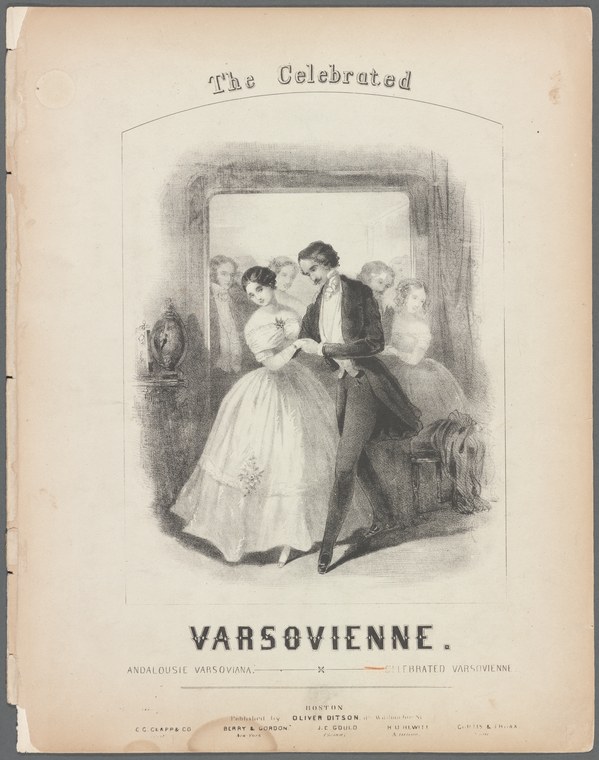
The varsovienne was one of the most widely danced social couple dances of its era, yet it has left almost no film record and survives chiefly through prints, photographs, and the written notes of dance instructors. This image is one of the primary visual sources for understanding what the dance looked like in motion, how the body was held, and the ballroom culture in which it lived. For historians and dancers attempting to reconstruct 19th-century ballroom practice, the varsovienne print is irreplaceable.
What you are looking at
A parlor or ballroom scene rendered in soft graphite, showing five figures in mid-dance. A well-dressed couple occupies the center—a woman in a pale, full-skirted dress (the skirt catching light as it swings) and a man in dark tailcoat and trousers, their bodies in close contact. Behind them, three additional figures (two women in similar pale gowns, one man) watch or participate in the background, visible through the soft atmospheric perspective of the interior space. A mirror or window frame is visible to the left, and what appears to be upholstered furniture anchors the right side of the composition. The light is gentle and diffuse, typical of an indoor social setting by gaslight or daylight filtered through heavy curtains. The moment captured is one of rotation or pivot—the woman's weight appears shifted, her skirt displaced by the momentum of the turn.
The dancing
The leading couple stands in a closed ballroom hold: the woman's right hand rests in the man's left, his right hand at her back or waist. Their bodies are close, frontal, and aligned. The woman's head is slightly averted, a conventional gesture of modesty in period dance portraiture. Her skirt is gathered and displaced by the motion—a detail that suggests the artist observed or understood the particular way fabric behaves in rotational figures. The supporting figures in the background are less precisely rendered, their posture suggesting either watching or waiting their turn to dance.
The dance depicted
This is a varsovienne, a popular couple dance of the 19th century originating in or named for Warsaw (Warszawa). The varsovienne was a promenade and turning dance typically in 2/4 time, with a characteristic figure that began in closed position, progressed forward, and included marked rotations. It was particularly fashionable in ballrooms from the 1850s through the 1890s. The title and the formal indoor setting, along with the closed hold and the prominent turning motion, all confirm this identification. The dance was danced by the bourgeoisie and upper classes in mixed-gender couples at public balls and private assemblies, exactly as depicted here.
How it was made
This is a lithographic print, evidenced by the soft tonal gradations, the characteristic crayon-like marks, and the caption typography integrated into the stone. The technique allowed for rapid reproduction and mass distribution—lithography was the dominant medium for popular prints and sheet-music covers of the period. The relatively refined execution, the presence of a printed title and publication line (visible at bottom: 'Published by Oliver Ditson,' a major Boston music publisher), and the care taken to render the figures suggest this was a commercial product intended for domestic consumption, likely as the cover or advertisement for a varsovienne composition.
About this work
This is a commercial lithograph advertising a varsovienne, a couple dance that dominated ballrooms across the nineteenth century. The print documents not only the dance itself—the closed hold, the forward promenade, the pivoting turn that displaces the woman's skirt—but the social context in which it was performed: a parlor or public assembly room, an even-gender mixed gathering of the respectable classes, a structured ritual of courtship and display. Varsovienne prints and sheet music were produced in the thousands; they saturated middle-class homes as both instruction and fantasy. This one survives as evidence of what the dance looked like to the people who danced it, captured by an artist working from observation or convention to meet the demands of a commercial publisher.
How to look at it
Observe how the artist has arrested the dance at the moment of rotation: the woman's skirt is caught in full displacement, her body cantered into the turn, her weight visibly shifted onto her back foot. This is not a static pose but a moment frozen mid-motion. Notice also the convention of the modestly averted female gaze, a standard feature of ballroom dance prints that coded female virtue even as the dance itself was transgressive in its body contact. The man's frame is stable and frontal; he is the anchor, she the displaced, rotating element. This distribution of active and passive, typical of the period, is built into the dance's anatomy.
The period
The varsovienne emerged in European ballrooms in the 1850s and reached peak popularity in the 1870s and 1880s. It appeared in a moment when couple dancing was becoming standardized and codified—a shift from the highly various and improvised figures of the earlier quadrille era toward increasingly regulated, named, publishable dances. The same period saw an explosion of illustrated sheet-music covers, printed instruction manuals, and lithographed dance cards, all aimed at the growing bourgeois market for ballroom instruction and entertainment. The varsovienne was one of the dances that benefited most from this apparatus of print: hundreds of varsovienne compositions were published, each with its own cover art.
Where it lives
This print is held by the New York Public Library in the collection of prints depicting dance. It was issued by Oliver Ditson, a Boston-based music publisher founded in 1842 and one of the largest American music publishers of the 19th and early 20th centuries. The print likely accompanied or advertised a varsovienne composition in Ditson's catalog.
Dance in this work
Questions about this work
What is a varsovienne?
A varsovienne is a couple dance in closed position, with a 2/4 meter and a characteristic promenade-and-turn figure. It originated in or was named for Warsaw and became popular in European and North American ballrooms from the 1850s onward. The dance was one of the standard repertoire pieces for any ballroom dancer of the period, typically learned from a dance master or from instruction manuals like those published by Ditson.
Why is the woman's skirt positioned that way?
The woman is turning—rotating on her axis, likely with the man as an anchor or pivot point. The full skirt, composed of yards of fabric supported by crinolines or bustles, displaces outward and upward under centrifugal force, a characteristic visual signature of the rotational figures of 19th-century couple dances. This detail is one of the most reliable indicators that the artist understood the dance from observation or training.
Who danced the varsovienne?
The varsovienne was danced by the respectable middle and upper classes—merchants, professionals, country gentry, and their families. It was taught by professional dance masters and learned in ballroom assemblies, private parties, and subscription dances. It was not peasant or working-class dance, though like all ballroom dances it eventually filtered downward and outward through society.
Was the varsovienne difficult to learn?
No. The varsovienne was relatively simple compared to the quadrille or the cotillion, both of which required multiple figures, multiple couples, and precise timing. The varsovienne was a two-person dance with a basic repetitive figure. This simplicity was part of its appeal and partly explains its ubiquity in the latter 19th century.
More dance artwork





