49 works in this view — arrow keys or swipe to move between them.
Dance in Art
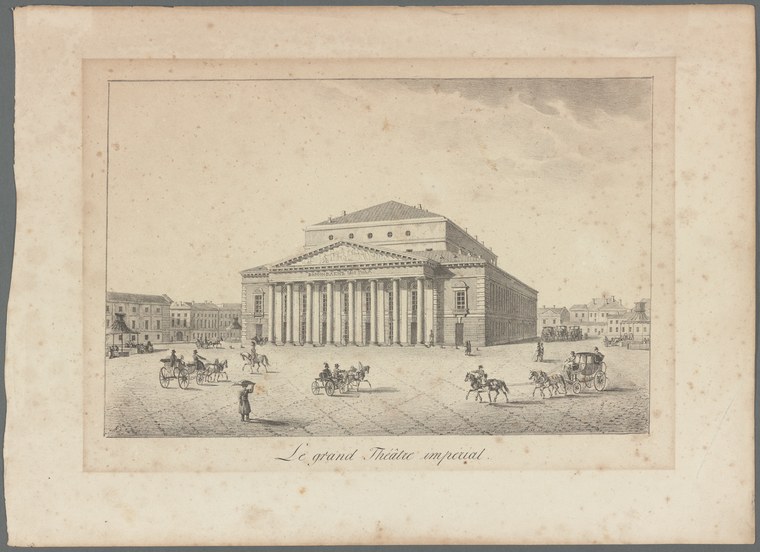
Le grand théâtre imperial
Unknown artist
- Collection:
- Prints depicting dance
- Source:
- New York Public Library
- Rights:
- Public domain — free to use, share and adapt.
- Recorded as:
- Public Domain
This print is valuable evidence for the physical and institutional history of theatrical dance. It shows that by the 18th century, imperial theatres were monumental civic structures, not marginal entertainments, signaling the elevated status of staged dance within court and national culture. For historians of dance patronage and infrastructure, the image documents the built environment in which a major European dance tradition developed.
What you are looking at
An engraving depicting the exterior of a grand neoclassical theatre in what appears to be 18th-century imperial Russia. The building dominates the composition: a massive rectangular structure with a projecting portico of tall Corinthian columns supporting a triangular pediment, and a shallow hip roof crowned with a cupola and decorative urns. The theatre faces a large open square animated with figures and horse-drawn carriages. In the foreground, elegantly dressed pedestrians—some in formal coats and breeches, others in long gowns—stroll or stand; several carriages, some with attendants, move across the plaza. Period townhouses line the sides of the square, establishing an urban setting of considerable formality and scale. The print employs careful linear perspective to emphasize the monumental architecture and create spatial recession into the distance. The tone is documentary and celebratory: this is a civic monument rendered as the centerpiece of urban life.
The dancing
The human figures are small relative to the architecture and serve primarily to give scale and animation to the public space rather than to depict specific dance movement. They are rendered in period dress—tricorn hats, long coats, full-length gowns—and assume poses of standing, walking, or being transported by carriage. There is no visible dance hold, formation, or choreographed motion; the figures move naturally through space as promenading citizens rather than as dancers in concert.
The dance depicted
This engraving does not depict dance performance or choreography. It is an architectural and civic document. However, the building itself is identified in the title as the 'grand théâtre impérial'—the grand imperial theatre—a venue where dance would have been performed. The image captures the public sphere in which theatrical dance existed: the theatre as monument, as destination, as center of cultural life. Dancers and audiences would have passed through this very square. The work thus documents the institutional and spatial context of dance rather than dance itself.
How it was made
This is an engraving, executed with fine lines and careful hatching to create modeling and tone. The technique allows precise architectural detail and orderly composition, and the print medium enabled wide circulation—this was a document that could be distributed to many viewers, making the theatre legible and memorable as a symbol of imperial grandeur. The clean, legible line work and the emphasis on accuracy suggest this was a professional architectural or commemorative print, likely produced for display or distribution to a educated public audience.
About this work
Le grand théâtre impérial is an 18th-century engraving documenting an imperial Russian theatre building and the urban plaza before it. It is not a depiction of dance performance but of the architectural and social stage on which dance was performed. The work belongs in a dance archive because it preserves evidence of how dance was institutionalized and housed in the Enlightenment: as a state-sponsored art form inhabiting monumental, formally composed public buildings. The theatre itself is the protagonist here—a statement of cultural power expressed through neoclassical order and scale.
How to look at it
Attend to the scale relationship between the building and the human figures—the theatre is not simply a gathering place but a monumental civic institution. Notice how the composition uses linear perspective to make the building recede and dominate; this is a rhetorical strategy, making architecture rather than action the primary subject. The orderly promenade of figures in the plaza suggests a public sphere of civility and order—this is the world in which formal theatrical dance was performed, a world governed by decorum, hierarchy, and aesthetic refinement. The print is didactic: it shows you what a great theatre looks like and where it sits in the city.
The artist
Unknown. The print is unsigned or the attribution is not recorded. The style and execution suggest a competent professional engraver working in the mid-to-late 18th century, likely based in Russia or a major European print center, producing architectural documentation or civic commemorative prints for an educated audience.
The period
The neoclassical architectural style and the scene of urban public life date this to the 18th century, likely the latter half. This was the era of imperial expansion in Russia, and of the professionalization of theatre and dance as courtly arts. European ballet had by this point migrated from court to professional stage; Enlightenment aesthetics celebrated reason, order, and civic virtue, all visibly expressed in the rigorous geometry of neoclassical buildings. Theatre buildings became not just functional venues but monumental symbols of state patronage and civilized society.
Where it lives
Held in the New York Public Library's collection of prints depicting dance. The work appears in the archive as evidence of the visual and institutional contexts of dance history, even though it does not depict dancers or choreography.
Questions about this work
Is this a picture of dancers?
No. It is an architectural engraving depicting the exterior of an 18th-century imperial theatre building and the public square before it. The small figures visible in the plaza are promenading citizens, not performers. The work documents the venue and setting for dance rather than dance itself.
What is the building?
The title identifies it as the 'grand théâtre impérial'—the grand imperial theatre. The architecture is neoclassical, with a columned portico and formal composition, suggesting a major court or state theatre of the 18th century, most likely in Russia based on the title and style.
Why is this in a dance collection?
It is an important historical document showing how theatrical dance was institutionalized in the 18th century. The monumental building signals the elevated cultural status of staged dance; the public plaza shows the civic visibility of the theatre. For historians of dance patronage, infrastructure, and social context, this engraving is evidence of the physical and institutional stage on which a major European dance tradition developed.
Who made this print?
The artist is not recorded. The work is a professional architectural engraving, likely produced in the mid-to-late 18th century by a skilled engraver working in Russia or a major European print center. The style suggests documentation for civic or commemorative purposes.
More dance artwork





