49 works in this view — arrow keys or swipe to move between them.
Dance in Art
Sontag polka [trimmed cover with partial score; music, Giulio Alary]
Unknown artist
- Collection:
- Prints depicting dance
- Source:
- New York Public Library
- Rights:
- Public domain — free to use, share and adapt.
- Recorded as:
- Public Domain
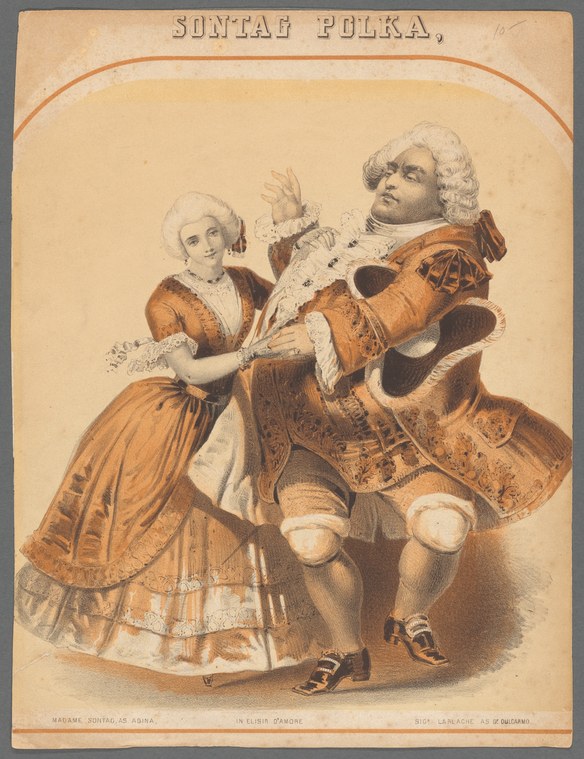
Polka sheet music covers were the mass media of 19th-century dance—the equivalent of today's music videos—and they are our most direct visual evidence of how people actually danced. This print captures the polka's distinctive mechanics (the bounce, the hip position, the turning action) with clarity and specificity, and the attribution to a celebrity dancer makes it a dated snapshot of a particular national and social moment. For dancers and dance historians, such prints are primary sources for understanding the technique, costume, and cultural meaning of a dance that was once as ubiquitous as rock and roll.
What you are looking at
A man and woman in 18th-century dress perform a lively polka against a plain cream background. The man, wearing a richly embroidered coat with gold ornaments, breeches, white stockings, and buckled shoes, holds the woman in a closed ballroom frame at his right side. His body leans back in the characteristic bounce of the polka, weight on his back foot, front leg extended. The woman wears a russet or gold-colored dress with a full skirt and white lace undersleeves and fichu; her posture mirrors his lean away from the frame. Both wear white curled wigs in the rococo style. The man's expression is animated and upward-gazing; the woman's face is tilted toward him with a slight smile. The composition captures mid-movement, with the woman's skirt spread and both figures frozen in a moment of energetic lift characteristic of the dance. A printed decorative border frames the scene.
The dancing
The couple maintain a closed ballroom embrace, the woman positioned at the man's right hip, both bodies leaning away from the frame's axis in a clear back-sway position. His posture shows the characteristic bounce action of polka—knees slightly bent, weight settled on the trailing foot, the front leg light and ready to spring. Her skirt's spread and her forward-tilted torso indicate she is being led into a turn or hop. Both figures show the upright frame and direct contact typical of mid-19th-century ballroom technique, not the looser social hold of earlier dances.
The dance depicted
This is unambiguously a polka, one of the signature social dances of the mid-19th century. The polka emerged in Bohemia (now Czech Republic) around 1830 and became a pan-European craze by the 1840s–1850s, displacing the waltz in fashionable ballrooms. The title *Sontag Polka* likely commemorates Henriette Sontag, the celebrated German soprano and actress who dominated European stages in the 1840s–50s; named dances were common tributes to celebrities. The image captures the polka's essence: a fast, bouncing couple dance in closed position with the distinctive hop and the rapid turning action visible in the woman's dynamic skirt. The rococo-style wigs are an artistic or nostalgic convention, as the polka itself is a 19th-century dance; the costume choice may reflect either the engraver's stylistic preference or the fashion of an earlier, related dance tradition.
How it was made
This is a hand-colored lithograph or engraving, approximately mid-19th century in production, printed as a trimmed cover accompanying a musical score (composer Giulio Alary). The decorative border, quality of line work, and delicate hand-tinting are consistent with commercial dance ephemera produced for middle-class parlor and ballroom use. Lithography allowed rapid, affordable reproduction of popular dance images, making such prints accessible to amateur dancers and music lovers who purchased sheet music. The work is thus both artistic record and commercial product—a teaching aid and souvenir rolled into one.
About this work
This is a colored print of a polka couple dance, likely from the 1840s–1850s, at the height of the polka craze that swept Europe and America. The image serves as a visual record of how the polka was performed—the closed frame, the upright posture, the characteristic bounce, the woman's turning action—rendered in the commercial style of dance ephemera that accompanied sheet music. The title's invocation of Henriette Sontag places it within a specific historical moment when celebrity culture and ballroom fashion were tightly woven. The work is important not as a unique artwork but as a document: it shows exactly how a popular dance was taught, performed, and memorialized in print.
How to look at it
Attend first to the couple's posture and frame: the closed ballroom hold, the slight back-sway, the woman's weight forward into the man's support. The knee action—bent and springing—captures the polka's signature bounce, which distinguishes it from the sustained glide of the waltz. Notice how the woman's skirt has spread and caught mid-motion, a compositional choice that conveys the dance's quickness and energy. The animated facial expressions and upward gaze of both dancers suggest the pleasure and social excitement the polka promised—a marked contrast to the more restrained ballroom manner of earlier dances.
The artist
The engraver or lithographer is not recorded in the catalogue. The composition and style are consistent with mid-19th-century commercial dance print production in Continental Europe, likely French or German. The musical score is by Giulio Alary, an Italian composer and pianist active in the 19th century, suggesting the print may have been produced for Parisian or Vienna-based publishers who dominated the polka sheet-music market.
The period
The polka was the defining dance of the 1840s–1860s, the first truly popular social dance to spread simultaneously across Europe and North America through a combination of live performance, emigrant dancers, and sheet music. It displaced the waltz in fashionable ballrooms not through court decree but through sheer social momentum and the energy of its music and motion. The polka's speed, bounce, and turning action were novel and thrilling to ballroom dancers accustomed to the sustained, gliding waltz. Dance prints and sheet music covers became the primary way polkas were disseminated to amateur dancers; the publication of thousands of polka compositions (many, like this one, named after celebrities or places) drove both musical and dance innovation. This print belongs to that flood of commercial material and documents the moment when the polka was at peak fashion.
Where it lives
This is a trimmed cover from a sheet-music publication, held in the New York Public Library's collection of prints depicting dance. It is a fragment of its original context (the musical score itself), preserved because its image was deemed worth keeping.
Dance in this work
Questions about this work
What is the polka?
The polka is a fast, bouncing couple dance in 2/4 time that originated in Bohemia around 1830. It became a continental craze by the 1840s and was the defining social dance of the mid-19th century in Europe and America. It is danced in a closed ballroom frame with a characteristic hop and turning action, much faster and more energetic than the waltz it often displaced.
Who was Henriette Sontag?
Henriette Sontag (1806–1854) was a celebrated German soprano and actress who dominated European opera and concert stages in the 1820s–1850s. She was a celebrity of international stature, and it was common practice to name popular dances and musical compositions after famous performers of the day as a form of tribute and commercial appeal.
Why do they wear 18th-century wigs?
The rococo-style wigs worn by both dancers are likely an artistic or nostalgic convention on the part of the engraver rather than an accurate record of how polkas were danced in the 1840s. By that era, dancers wore their own hair. The wigs may reflect a taste for historical or romantic costuming in dance imagery, or they may be a stylistic choice inherited from earlier dance print traditions.
What was this print used for?
This is a sheet-music cover, meant to accompany a published polka composition. Thousands of polka sheet-music publications were sold to amateur musicians and dancers in the 19th century. The cover served as advertisement, teaching aid, and souvenir all at once, giving dancers a visual reference for how the dance should look.
More dance artwork





