49 works in this view — arrow keys or swipe to move between them.
Dance in Art
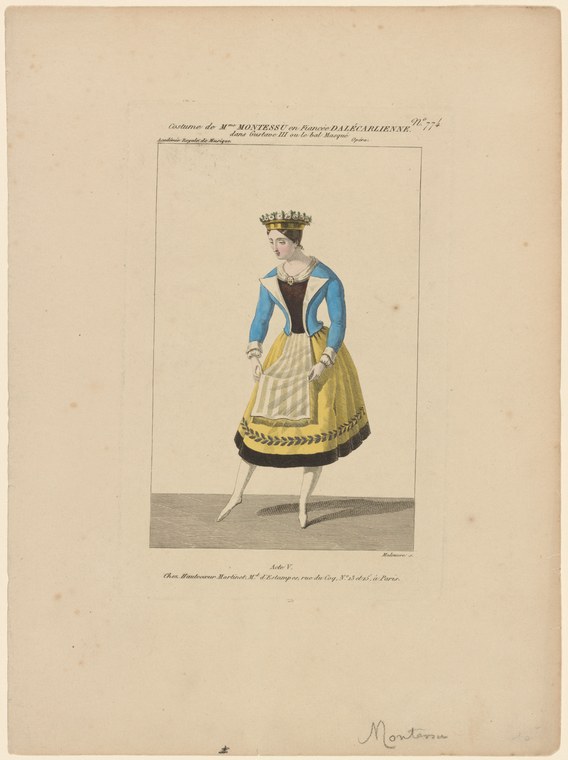
Costume de Mme. Montessu en fiancée Dalécarlienne, dans Gustave III; ou le bal masqué, opéra, Académie royale de musique, acte V
Unknown artist
- Collection:
- Prints depicting dance
- Source:
- New York Public Library
- Rights:
- Public domain — free to use, share and adapt.
- Recorded as:
- Public Domain
Costume studies like this are rare primary evidence of exactly what dancers wore in named productions on named dates—a level of specificity usually lost. The hand-colored engraving format shows how theatrical costume was circulated and consumed in the 19th century: not as photographs or film, but as reproducible prints. For historians and dancers interested in how the 19th-century operatic stage actually looked, these plates are irreplaceable.
What you are looking at
A woman in elaborate early 19th-century theatrical costume stands in a frontal pose against a plain background. She wears a blue velvet bodice with short sleeves, a dark brown or black underbodice, and a full skirt composed of a yellow-striped upper section and a deeper yellow lower skirt with a black decorative border featuring geometric patterns. A metal crown or circlet sits atop her head. Her posture is upright and formal, one leg extended slightly forward in a graceful line, her arms relaxed at her sides with hands visible. The engraving is hand-colored, using restrained palette—the blues and yellows are clear and bright against cream paper. The figure casts a shadow beneath her feet, grounding her in space. The composition is a simple costume plate: a single figure study with no action or interaction, presented as if for documentation or theatrical record.
The dancing
A single female figure stands in an elegant but static pose, with weight settled on one leg while the other extends decorously forward. Her arms are relaxed and asymmetrical, neither in a closed frame nor in any characteristic ballroom or classical ballet hold. The posture is one of presentation rather than motion—the kind a performer might hold for a costume portrait. Her head is upright, her gaze directed outward. There is no indication of a partner or interaction with another body.
The dance depicted
This is a costume study for a theatrical character, not a depiction of dance in action. The inscription identifies the wearer as Mme. Montessu performing in the role of a Dalécarlienne (a young woman from Dalarna, Sweden) in act V of Gustave III; ou le bal masqué, an opera performed at the Académie royale de musique (the Opéra). The costume suggests a Scandinavian or folk-inspired theatrical fantasy rather than any identifiable ballroom or classical dance form. Dancers in 19th-century operatic ballets wore such costumes in choreographed scenes, but this image documents only the dress and the character type, not the movement itself.
How it was made
This is a hand-colored engraving (the line-work was engraved and the color applied by hand in watercolor or similar medium). The technique was standard for theatrical costume documentation in the early 19th century, allowing multiple copies to be made and distributed to audiences, dancers, or theater archives. The clarity of the line and the precision of the engraved contours were essential for recording costume detail; the hand-coloring preserved individual variation and enhanced legibility of fabric and trim. This format confirms the work's function as a practical theatrical record rather than fine art.
About this work
This is a theatrical costume study for a minor character in a major Parisian opera of the 1820s or 1830s. Mme. Montessu wears the dress of a Scandinavian peasant girl—a stock figure in early 19th-century European theater, deployed for exotic or comic effect. The image belongs in a dance history collection not because it shows dance, but because it documents the visual environment of operatic ballet: the costumes, the character types, the bodies, and the staging that shaped how dance was seen and performed in one of Europe's most prestigious theaters. This genre of costume plate was mass-produced and circulated widely, making the visual culture of theater accessible to the public and to dancers themselves, who could study the expected silhouette and garment construction.
How to look at it
Attend to the precision of the costume detail: the cut and construction of the bodice, the construction and trim of the skirt, the metal circlet that defines the character. The pose is deliberately static—this is not a moment of dance, but a display. The formal frontality and the shadow beneath the feet are conventions of costume documentation, not theatrical realism. Notice that the dancer's body itself is incidental to the information being recorded: her role is to wear the costume, not to demonstrate a particular movement or technique.
The artist
The artist is not recorded. The engraving style and hand-coloring technique are consistent with Parisian theatrical print production of the 1820s–1840s, when opera costume plates were a routine commercial commodity produced by theaters and print shops in collaboration. The inscription attributes the image to the Académie royale de musique, suggesting it may have been produced under institutional authority.
The period
This work dates to the height of the operatic ballet in Paris, a period when multi-act operas with substantial ballet scenes were the dominant form of theatrical dance in Europe. Gustave III was first performed in 1833, making this costume plate contemporary with that production. The visual exoticism of the costume—Swedish folk dress filtered through French taste—reflects the Romantic era's fascination with picturesque foreign cultures and rural life, deployed on stage through dance and spectacle. The Scandinavian character was a familiar operatic type, familiar from Weber's Der Freischütz and other works.
Where it lives
This work is held in the New York Public Library's collection of prints depicting dance. It appears to have been preserved as part of a systematic archive of theatrical costume documentation, a collection type that became standard in major institutional libraries during the 19th century.
Questions about this work
Is this actually depicting dance?
No. This is a costume study—a theatrical document showing what an actor or dancer wore in a named role. It is static, not action. However, the costume would have been worn in choreographed scenes, so it documents the visual context in which 19th-century operatic ballet was performed.
Who was Mme. Montessu?
The record gives no biographical information. She was a performer at the Académie royale de musique (Paris Opéra) in the early 19th century, identified only through her role in this production of Gustave III. Many minor performers of this era are known only through theater records and costume plates like this one.
What is Gustave III; ou le bal masqué?
A five-act opera with substantial ballet scenes, composed by Auber and first performed in 1833 at the Académie royale de musique in Paris. The plot is a fictionalized version of the assassination of the Swedish king Gustav III. Act V featured a masked ball scene, a theatrical device that typically occasioned dancing.
Why was this costume plate preserved?
Theatrical costume plates were produced in quantity and sold to audiences and collectors as souvenirs, much like playbills today. They were also preserved by theaters and libraries as records of production history and as reference material for costume makers and performers.
More dance artwork





