49 works in this view — arrow keys or swipe to move between them.
Dance in Art
Untitled print with captions in German
Unknown artist
- Collection:
- Prints depicting dance
- Source:
- New York Public Library
- Rights:
- Public domain — free to use, share and adapt.
- Recorded as:
- Public Domain
For historians of theatrical dance and opera, this print reveals the visual languages of character, status, and exoticism that audiences would have recognized instantly. The costumes and poses encode assumptions about nobility, nationality, gender, and spectacle that shaped how performers moved and how audiences read their movement. Understanding the costume context is essential to reconstructing how 19th-century dramatic dance was actually performed and received.
What you are looking at
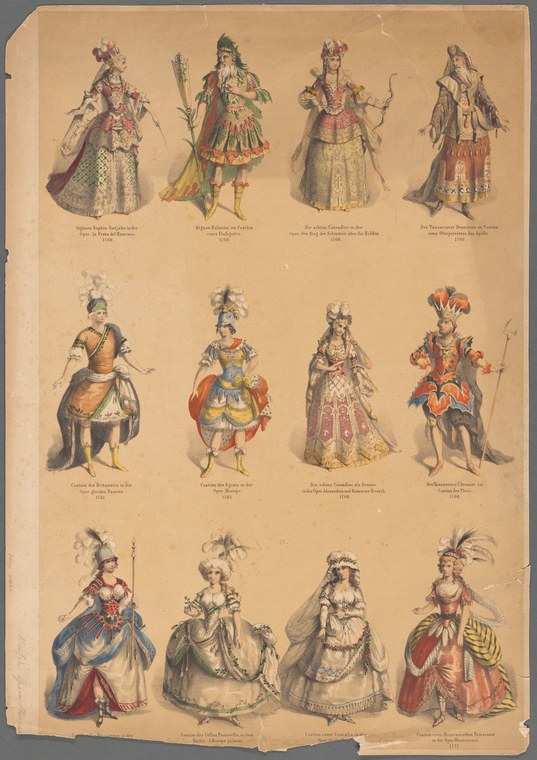
This is a colored engraving or print showing twelve figures arranged in three rows of four, each identified by German captions below. The figures are rendered in a decorative style characteristic of 19th-century theatrical or operatic costume design, with elaborate period dress, dramatic poses, and theatrical bearing. The top row presents four figures in Renaissance or early modern court dress: a woman in a jeweled gown with a long train and feathered headdress; a man in armor with a plumed helmet and staff; a woman in rich brocade with an ornate headdress; and a figure in exotic dress with a long patterned robe. The middle row shows four more elaborately costumed figures—a woman in gold damask, a figure in military regalia with a red cloak, a woman in Renaissance gown, and a figure in ornate theatrical dress. The bottom row completes the set with four more figures in progressively richer costume, including women in flowing gowns with dramatic trains and capes in red, green, and gold tones. All figures stand in frontal or three-quarter poses against a plain tan background, suggesting a costume gallery or reference sheet rather than a narrative scene.
The dancing
Each figure stands in a formal, presentational pose with little suggestion of active movement or dance. The bodies are upright and still, with arms positioned to display the costume—held at the sides, extended to show sleeves, or arranged to frame the figure. There is no visible weight transfer, no turned-out legs, and no indication of the turned-out, extended carriage that would mark classical dance training. The figures appear to be costume studies or character types rather than dancers captured mid-movement. Their gestures and bearing suggest theatrical performers in character—nobility, soldiers, exotic figures—rather than participants in a specific dance form.
The dance depicted
The print appears to be a costume and character reference sheet, likely from a 19th-century opera, theatrical production, or elaborate masquerade. The German captions and formal presentation suggest documentation of theatrical roles or costume types. While the figures are clearly meant to be dramatic and theatrical, there is no evidence of a specific dance style or movement form. The print may have been used as a design reference for costume makers, set designers, or as a promotional record of a particular production, but it does not depict people dancing or show any movement associated with a recognizable dance form.
How it was made
This is a hand-colored engraving or possibly a hand-colored lithograph on paper, typical of 19th-century theatrical and costume documentation. The fine line work and the capacity for subtle detail in faces and hands point toward engraving; the flat color application suggests hand-coloring over a printed base rather than chromolithography. The technique allowed for precise rendering of costume detail—every button, pleat, and ornament is visible—and the hand-coloring adds warmth and theatrical drama. This medium was standard for theatrical publishing and would have circulated among theater professionals, collectors of theatrical memorabilia, and the educated public interested in opera and costume history.
About this work
This is a 19th-century colored engraving presenting a gallery of twelve theatrical or operatic characters in elaborate period and exotic costume. It functions as a reference sheet or promotional record of costume design, character types, and dramatic roles, possibly from a single production or a designer's or theater company's collection. The print documents theatrical dress and characterization rather than dance itself, though it circulated in contexts where dance, theater, and costume were intimately connected. It belongs in a dance gallery as evidence of how theatrical costume and character shaped the visual and kinetic identity of dramatic performance in the long 19th century.
How to look at it
Look at the repetition and variation across the twelve figures: each costume is distinct and recognizable as a character type (nobility, military, exotic, etc.), yet all are rendered with equal theatrical weight and visual richness. Notice how costume rather than pose or movement carries characterization—it is the dress, not the body, that tells you who these figures are. The figures stand still and formal, suggesting this is a reference tool rather than a narrative or dance scene, and the lack of any dynamic movement or interaction between figures confirms that we are viewing costume studies, not choreography.
The period
The 19th century saw an explosion of theatrical and operatic spectacle, particularly in the Romantic period (1820s–1840s) and the later Grand Opéra tradition. Costume design became increasingly elaborate and historically or exotically inspired, supporting narratives of fantasy, historical drama, and nationalist pride. Theatrical prints like this one were widely published and circulated, serving both as promotional documents and as design references. The careful rendering of each costume detail reflects the period's investment in costume as a primary vehicle for storytelling and visual delight.
Where it lives
The print is held in the New York Public Library's collection of prints depicting dance. It is part of a broader category of theatrical and costume documentation from the 19th century, housed in the library's extensive holdings of performance history materials.
Questions about this work
Is this a scene from a real ballet or opera?
The German captions and costume diversity suggest it may be from a specific production, but the print itself functions as a costume reference sheet rather than a narrative scene. Without identifying the captions, we cannot say which production or even whether it documents a single work or a collection of character types.
Why are there no dancers actually dancing?
This is a costume gallery, not a performance record. The figures stand in formal poses to display their dress. Costume documentation of this kind prioritized visibility of every detail—trim, embroidery, headdress, train—over the representation of movement.
What does this tell us about dance in the 19th century?
It shows that theatrical spectacle relied heavily on costume and visual identity. The elaborate, distinct costumes indicate that character and narrative were conveyed as much through dress as through movement, and that designers invested enormous care in making each role visually unmistakable.
More dance artwork





