49 works in this view — arrow keys or swipe to move between them.
Dance in Art
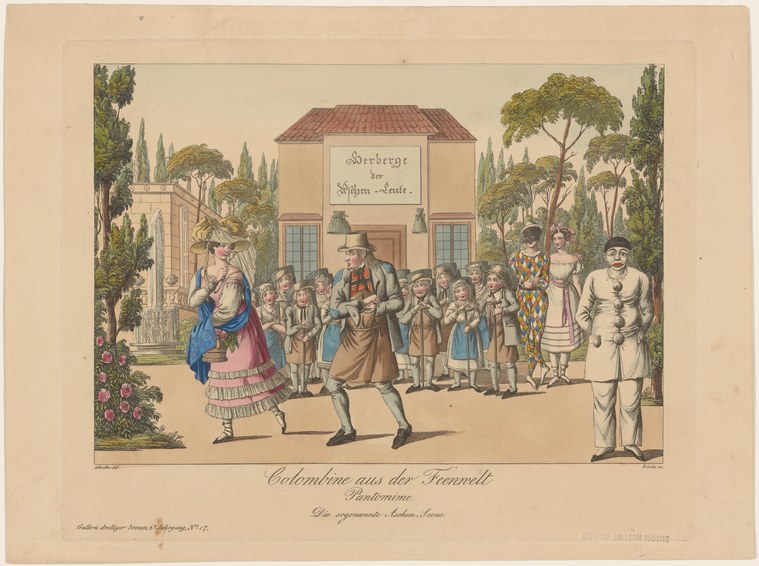
Colombine aus der Feenwelt, Pantomime, die sogenannte Aschen-Scene
Unknown artist
- Collection:
- Prints depicting dance
- Source:
- New York Public Library
- Rights:
- Public domain — free to use, share and adapt.
- Recorded as:
- Public Domain
This print documents a performance tradition—German-language pantomime and harlequinade—that is poorly represented in dance historical literature outside specialist theater history. The exaggerated, emotionally legible poses reveal how pre-Romantic theater trained performers to communicate through the body, a lineage that fed into later theatrical dance. For historians of theatrical gesture and for those studying how commedia dell'arte conventions evolved into European pantomime, this image is a rare visual record of actual stage practice.
What you are looking at
A theatrical scene set before a neoclassical pavilion labeled "Feberge" or similar, with cypress trees flanking the composition in a formal garden setting. A woman in a richly colored dress (blue bodice, pink skirt with deep flounces) stands at left center, posed in an exaggerated attitude with one leg lifted and arms positioned theatrically. To her right, a man in pale breeches and coat assumes a mirroring pose. Between and around them stand numerous figures in period dress—women in long gowns and men in coats and breeches—watching the action. The scene is hand-colored in muted tones: ochre sky, green foliage, flesh tones, and the pale buildings. The composition is shallow and stage-like, with all figures arrayed across a narrow stage space facing the viewer.
The dancing
The two central figures are frozen in mirror-image theatrical attitudes: the woman's raised leg, extended arms, and arched torso suggest a moment of exaggerated mock-dramatic distress or supplication; the man mirrors this posture, creating a parallel abstraction rather than any naturalistic dance embrace. Their bodies are elongated and stylized, with the weight apparently on one leg and the other raised high. The surrounding figures—twenty or more—stand in loose groups, dressed as spectators or courtiers, creating a framing audience. None appear to be actively dancing; all attention is directed toward the central pair.
The dance depicted
This is a scene from a pantomime, likely *Colombine aus der Feenwelt* (Colombine from the Fairy World), a work from the late 18th-century European theatrical tradition. The title refers to the "Aschen-Scene" (Ash Scene), suggesting a narrative moment involving the character Colombine (the maidservant or lover figure from commedia dell'arte stock types adapted into pantomime). The stylized, exaggerated poses and the theatrical framing indicate this is pantomime in the harlequinade tradition—gestural, emotional storytelling rather than balletic dance steps. The pose is designed for maximum visibility and emotional expression to a distant audience.
How it was made
This is a hand-colored engraving or possibly lithograph, likely from the late 18th or early 19th century based on the printing style and the caption in German script. The technique allowed for wide circulation of theatrical scenes—these were popular souvenirs and promotional images for traveling and permanent theater companies. The careful hand coloring (applied after printing) and the precise composition mark this as a professional theatrical documentation, not a sketch. The shallow stage space and frontal viewing angle are consistent with how theater prints represented the stage spectacle to audiences who had not seen the performance.
About this work
This is a theatrical print documenting a scene from a German-language pantomime production, likely from the 1770s–1790s. The work captures a moment of exaggerated pantomimic gesture—the central pose designed to communicate emotion and narrative to a theater audience—framed by costumed spectators or courtiers. It belongs in a dance collection not because the figures are executing recognizable dance steps, but because pantomime was a vital performance genre that blended gestural communication, theatrical convention, and bodily expressiveness in ways that influenced both balletic and popular dance practice. The image is evidence of how late 18th-century theater used the body to tell stories without words.
How to look at it
Notice the bilateral symmetry of the two central figures: they are not dancing together in a balletic sense, but posing in mirror attitudes—a pantomimic convention for creating emotional or comic effect through exaggeration and parallelism. The woman's pose (high leg, arched back, extended arms) is one of distress, supplication, or theatrical dismay; the man's mirroring suggests mockery, response, or emotional echo. The surrounding crowd frames and witnesses this moment, with no one else moving—typical of pantomime, where the story often pauses for a single figure or pair to command full attention. The hand coloring emphasizes the richness and visibility of costume, crucial to pantomime performers who relied on visual clarity at distance.
The period
This print dates to the era when pantomime and harlequinade were dominant entertainment across German-speaking Europe, the 1770s–1800s. These were not ballets but popular theatrical spectacles, usually performed by actors trained in commedia dell'arte stock characters (Harlequin, Colombine, Pantaloon, etc.). The tradition was distinct from ballet proper, which was developing in Paris and court settings; pantomime belonged to popular, traveling, and commercial theater. The style of dress, the garden setting, and the fairy-tale reference suggest this was a sentimental or comedic version of the tradition, not the purely farcical harlequinade. The German-language caption indicates this was circulating within German-speaking regions as a theatrical souvenir.
Where it lives
The print is held in the New York Public Library's collection of dance-related prints. It is catalogued as an undated theatrical print in German, suggesting it was collected as part of a broader gathering of theater and dance documentation without full provenance research.
Questions about this work
Is this a ballet?
No. This is pantomime, a different performance tradition that predates and runs parallel to ballet. Pantomime used exaggerated gesture, facial expression, and recognizable stock characters to tell stories without words or formal ballet technique. The poses here are designed for emotional and narrative clarity rather than balletic line or virtuosity.
What is the Aschen-Scene?
The title translates as the Ash Scene, likely a narrative moment in this pantomime involving the character Colombine. Without access to the original script or performance documentation, the exact plot content cannot be determined, but theatrical prints from this era typically documented recognizable moments that audiences would remember and want to own as souvenirs.
Who were these performers?
The print does not identify the performers. Theatrical prints of this era rarely named actors; the focus was on the character type (Colombine) and the theatrical moment, not the individual performer. Pantomime companies were often traveling troupes or residents of popular theaters in German cities.
Why are they posed like that?
The mirrored, exaggerated poses are pantomimic conventions—a visual shorthand for emotion or relationship that could be read clearly from a distance in a crowded theater. The high leg, arched back, and extended arms convey distress, defiance, or theatrical emotion without the need for words or realistic movement.
More dance artwork





