49 works in this view — arrow keys or swipe to move between them.
Dance in Art
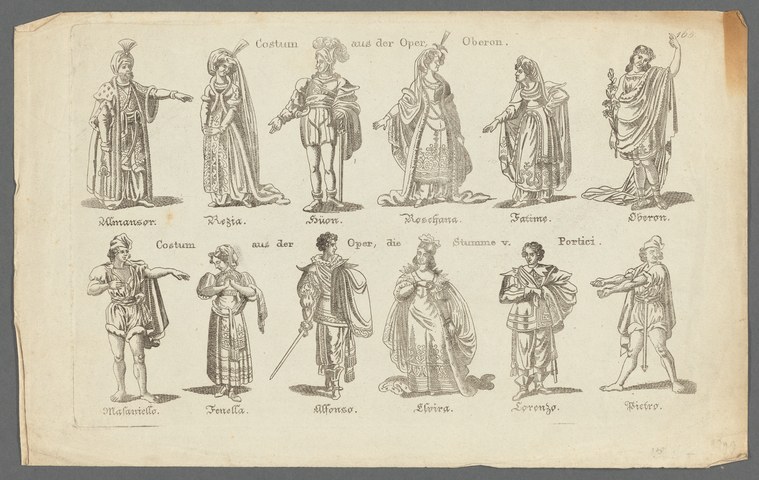
Costum aus der Oper, Oberon ; Costum aus der Oper, die Stumme v[on] Portici
Unknown artist
- Collection:
- Prints depicting dance
- Source:
- New York Public Library
- Rights:
- Public domain — free to use, share and adapt.
- Recorded as:
- Public Domain
For dance historians, this sheet is evidence of the material and visual frame of Romantic-era theatrical dance. The silhouettes shown—particularly the high-waisted, voluminous skirts and relatively rigid upper bodies—directly shaped how dancers could move and how movement was perceived. The regular presentation of character types (military, heroic, noble, servant) also indexes the genre conventions and social hierarchies embedded in operatic dance of the era.
What you are looking at
This is a double-register engraving displaying operatic costume designs arranged in two horizontal rows of six figures each. The top register is titled 'Costum aus der Oper, Oberon' (Costume from the Opera Oberon) and the bottom 'Costum aus der Oper, die Stumme v. Portici' (Costume from the Opera The Silent Woman of Portici). Each figure stands isolated against a blank ground, posed to display their costume in full. The figures wear elaborate period dress ranging from classical draped garments and plumed headdresses to ornate military uniforms and flowing robes. The engraving style is precise and linear, with careful cross-hatching to model form and fabric weight. All figures are rendered at roughly equal scale and arranged in a regular grid, emphasizing the didactic purpose of the sheet: to present a costume inventory for reference by artists, theatre makers, or scholars.
The dancing
The twelve figures are uniformly presented in standing poses, most facing front or three-quarter view with arms disposed to show the line of the costume rather than to suggest active movement or weight transfer. Several figures gesture with open palms or extended arms in a manner consistent with operatic declamation—a formal presentational mode rather than dance-specific frame. The poses are static and hieratic, designed to showcase the costume's silhouette and detail rather than to capture motion or partnering. No figures touch or relate spatially to one another; each occupies an independent field.
The dance depicted
This is not primarily a depiction of dance but a costume reference document for operatic performance. The two operas named—Weber's *Oberon* (1826) and Auber's *La muette de Portici* (The Silent Woman of Portici, also known as *Masaniello*, 1828)—are dramatic works with elaborate staged spectacle, and both include choreographed ensemble numbers and danced action as part of their theatrical apparatus. The formal presentational poses suggest operatic convention rather than specific dance technique. The silhouettes and drapery, however, would constrain and enable movement: the high waistlines, wide skirts, and rigid bodices visible in the female figures were the actual conditions under which early 19th-century theatrical dancers moved. This sheet documents the material environment of dance without depicting dance itself.
How it was made
This is an engraving, identifiable by the uniform parallel hatching, the crisp linear definition, and the tonal range achieved through line density rather than wash or color. Engraving was the standard medium for circulating costume designs and theatre documentation in the early 19th century, and its clarity and reproducibility made it ideal for reference materials consulted by theatre professionals across cities and companies. The print would have been distributed individually or as part of a larger portfolio of costume sheets, allowing costume makers, dancers, and stage managers to consult current fashion and character-specific dress. The technique permits fine detail in ornament and drapery folds, essential information for the costumer.
About this work
This engraving is a working document from the world of early Romantic opera, presenting costume designs for two canonical works of the late 1820s. It belongs to a large class of theatrical ephemera—cost-conscious, widely circulated, and now rare—that mediated between the court of the designer and the theatre workshop. The sheet itself neither performs nor analyzes dance, but it captures the silhouettes, weight, and material constraints within which early 19th-century theatrical dancers actually moved. Its interest to dance history lies not in depicting dance technique but in documenting the physical reality of the dancer's body in its historical costume: the high empire waistline, the volume and weight of the skirt, the rigidity of the bodice, and the formal carriage these imposed. Without understanding these constraints, we cannot read the movement of the period.
How to look at it
Examine the costumes as *constraints* on the body rather than as decoration. Note the high empire waistline on the female figures, which would position the dancer's center of gravity differently than modern dress. Look at the weight and volume of the skirts: they would create visible resistance to motion and would require a different carriage and port de bras than lighter, shorter skirts. The male figures in classical and military dress show relatively mobile legs, but their torsos are encased in rigid bodices or armor. The formal stance of every figure—neither weight-shifted nor gestural in a way that suggests actual movement—reflects the presentational convention of the costume plate, which was not meant to show how the wearer moved but how the costume looked at rest.
The artist
The artist is not recorded. Costume design sheets of this type were often produced by theatre workshops or engravers serving opera houses directly and circulated without signature. Attribution would require comparison with other documented theatre engravings of the period and knowledge of which houses or publishing concerns issued designs for these specific operas.
The period
The 1820s were a critical moment in European operatic and theatrical dance. Both *Oberon* and *La muette de Portici* were major international successes, performed across European stages and driving fashion in stage costume and movement vocabulary. This was the era of the Romantic ballet's emergence: the vocabulary of pointe work, ethereal female silhouettes, and supernatural subjects was crystallizing in Paris and spreading rapidly. Operatic dance at this moment stood between the older tradition of pantomime and declamation and the newer, more virtuosic ballet technique. The costumes shown here—classical, Ottoman, military, and allegorical—reflect the Orientalism and historical exoticism that characterized both serious opera and ballet spectacle of the period.
Where it lives
The sheet is held in the New York Public Library's Prints collection and is catalogued under dance imagery. The collection preserves a large archive of theatrical prints and costume designs from across Europe and America, many without detailed accession information, reflecting the mass-produced and widely circulated nature of theatrical ephemera.
Questions about this work
Did dancers wear these exact costumes in performances of Oberon and La muette de Portici?
This sheet likely represents standard designs used by multiple companies, but variations would have been inevitable. Theatre workshops adapted designs to available materials, the body size of the company's dancers, and local taste. The sheet represents the ideal or template, not the only realization.
Why are the figures posed so stiffly if this is operatic dress?
The costume plate was a reference document, not a performance record. The figures are posed to display the costume's silhouette, drapery, and detail to the costumer and stage maker. The formal stance was the convention of the genre—it had nothing to do with how the wearer actually moved on stage.
Can I tell from this what dances were performed in these operas?
Not directly. The sheet documents costume and character type but not the specific movements or choreography. What it does show is the material envelope—the weight, volume, and articulation—within which dancers had to work.
Who would have used a sheet like this?
Costume makers, stage managers, choreographers, and dancers preparing for performance, as well as theatre directors planning productions. Such sheets circulated among theatres and were often copied or adapted by local craftspeople. They were also sold to the theatre-going public as souvenirs.
More dance artwork





