49 works in this view — arrow keys or swipe to move between them.
Dance in Art
Five theatrical scenes
Unknown artist
- Collection:
- Prints depicting dance
- Source:
- New York Public Library
- Rights:
- Public domain — free to use, share and adapt.
- Recorded as:
- Public Domain
Dance historians and performers benefit from studying the scenic contexts and visual aesthetics of the periods in which particular styles developed. These engravings reveal what theatrical space looked like to audiences of the Romantic era, and how designers and printmakers imagined the relationship between the human figure and the natural or architectural world. Understanding the visual setting—the romantic ruins, the ordered gardens, the wooded depths—clarifies what audiences expected from theatrical spectacle and from the movement of performers within it.
What you are looking at
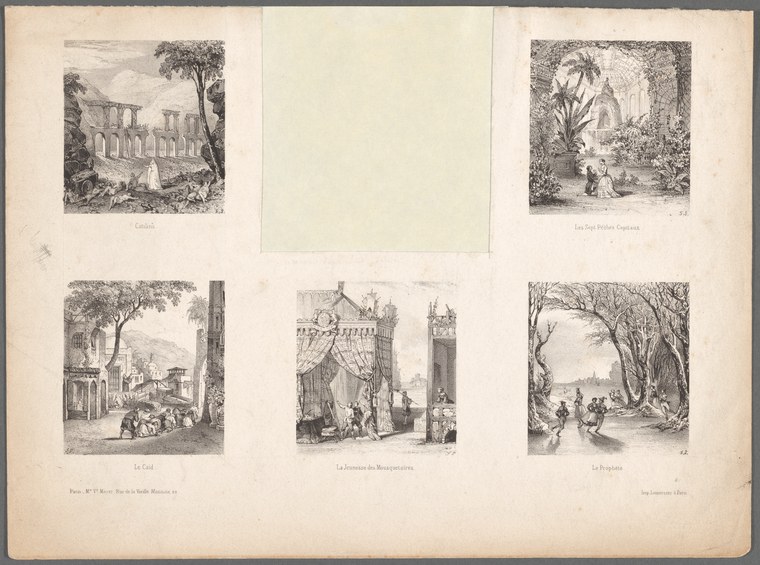
A portfolio of five theatrical scenes rendered as small engravings, each depicting a different location or dramatic moment. The top left shows classical ruins—a multi-storied stone structure with arches—set amid dense vegetation and framed by a large tree. Top right depicts a garden scene with a figure in light drapery and another seated or reclining figure beneath an archway overgrown with vines. The middle left presents an urban or village street with figures gathered beneath a colonnade or covered passage. The center image shows an interior or semi-interior space with draped fabric suggesting a tent or pavilion, where a group of figures stands before what appears to be a tower or fortified structure. Bottom right shows a wooded avenue lined with large spreading trees, with several figures visible among them. All five scenes employ fine line-work characteristic of engraving, with careful attention to light, shade, and atmospheric perspective. The compositions suggest romantic or neoclassical theatrical settings, the kind that would serve as backdrops for staged drama or dance.
The dancing
Across all five scenes, figures are rendered small in scale relative to architectural and natural elements, a convention that emphasizes the landscape and setting over detailed study of the body. Where visible, postures appear relaxed and natural rather than formalized—standing, walking, conversing, or reclining. Dress appears contemporary to the print's era (likely late 18th or early 19th century), with women in long gowns and men in fitted breeches. No figure is shown in the lifted, turned-out frame of formal dance; rather, the bodies occupy space as they would in everyday theatrical narrative. The groupings are scattered and informal, oriented toward the architecture and landscape rather than toward each other in formation.
The dance depicted
These images do not appear to depict dance itself but rather theatrical settings and genre scenes that would have served as backdrops or context for theatrical or operatic performance. The title "Five theatrical scenes" suggests these are stock settings—ruins, gardens, fortified posts, streets, groves—the kind of imagined or idealized locations that formed the visual vocabulary of Romantic-era theatre. If dancing occurred in these spaces, it would have been set against these scenic elements, but the prints show the spaces empty of active performance. The informality of the posed figures and the emphasis on romantic landscape and architecture suggest these belong to the visual culture of theatre design rather than dance documentation.
How it was made
These are engravings, identified by their fine parallel line-work (hatching and cross-hatching) for creating tone and shadow, and their crisp, regular margins. Engraving was expensive and time-consuming, and prints of this quality indicate a professional printmaker working for a publishing house with resources to produce theatrical designs, costume prints, or architectural and landscape studies. The small scale and neat composition of five images on a single sheet suggests this was produced as a portfolio or proof sheet, possibly for a published collection of theatrical scenes or for a master's or artist's reference collection. Engravings of this type circulated widely in the late 18th and early 19th centuries as affordable (relative to paintings) images for educated middle-class collectors.
About this work
This is a portfolio of five engraved theatrical scenes, likely from the late 18th or early 19th century, showing idealized locations—classical ruins, gardens, streets, pavilions, and groves—that would have formed the scenographic vocabulary of contemporary theatre and opera. The prints do not document dance in action but rather the architectural and natural settings within which theatrical and dance performance would have been staged. As a product of the engraver's art, these images would have circulated among theatregoers, scene painters, and educated collectors, shaping the visual imagination of Romantic-era performance. The work belongs in a dance archive because it documents the visual culture in which dance was performed—the imagined worlds, the handling of light and shadow, and the integration of the dancing body into architecture and landscape.
How to look at it
Observe the careful use of light and shadow to create depth and atmosphere: the dense hatching in the foreground, the more open lines in the distant elements. Notice how the figures are positioned as accessories to the landscape rather than as the focal point—a compositional choice that emphasizes setting over action. The fineness of the line-work requires close viewing to appreciate the detail of architectural elements and foliage. This is a printer's art, not a painter's; the effect depends on the regularity and precision of the engraved line, and on the quality of the impression (how sharply the plate was inked and wiped).
The period
This portfolio dates to the era of Romantic theatre and the development of Romantic ballet. By the late 18th and early 19th centuries, theatrical design had moved away from the flat, symbolic scenery of the Baroque toward more illusionistic, emotionally evocative settings. Landscape—picturesque ruins, wild groves, moonlit gardens—became a vehicle for establishing mood and narrative context. Engravings of scenic designs circulated widely and influenced both theatre production and the graphic imagination of the reading public. At the same time, ballet was developing the narrative vocabulary of Romantic ballet, in which the spatial and atmospheric qualities of a setting (an enchanted garden, a battlefield, a woodland glade) would dramatically frame and enhance the emotional content of the dancing.
Where it lives
Held at the New York Public Library as part of a collection of prints depicting dance. The holding is classified as "dance," suggesting the library's curators recognized these scenic images as documenting the visual culture of theatrical dance, even though the images do not show active dance movement.
Questions about this work
Why are these prints in a dance collection if they don't show people dancing?
Dance does not exist only when bodies are moving. Dancers performed within and against the visual and spatial contexts these prints document—the architecture, the landscape, the quality of light. To understand how dancers were seen and what audiences expected from theatrical performance, we need to know what these spaces looked like. These engravings are primary sources for the visual culture in which dance happened.
What period do these prints represent?
The style and subject matter suggest the late 18th or early 19th century, the age of Romantic theatre and the early development of Romantic ballet. But the exact date is not recorded. The engraving technique and the imagery of ruins, gardens, and picturesque landscapes are consistent with Romantic aesthetics.
Who made these prints and who printed them?
The artist and printmaker are not recorded in the catalogue. The quality of the engraving and the composition of the sheet suggest these were produced by a professional studio, possibly as part of a published series of theatrical designs or as reference material for scene painters and costume designers.
What would these have been used for?
Theatrical scene designs were circulated as engravings for several purposes: as reference material for scene painters and theatre workshops; as a record of celebrated productions; and as affordable images for educated collectors interested in theatre and aesthetics. These small prints might have been bound into a book or portfolio, or sold as loose sheets.
More dance artwork





