49 works in this view — arrow keys or swipe to move between them.
Dance in Art
Native American dancing in prints
Unknown artist
- Collection:
- Prints depicting dance
- Source:
- New York Public Library
- Rights:
- Public domain — free to use, share and adapt.
- Recorded as:
- Public Domain
For a dance historian, this image matters as evidence of what 19th-century American illustrators and publishers believed Native American ceremony and activity looked like, and what they chose to circulate as representative. Whether accurate or imagined, it shaped how millions of Americans visualized Native peoples and their practices, including any ceremonial or ritual movement. The image also raises questions about the ethics and accuracy of ethnographic illustration in this period.
What you are looking at
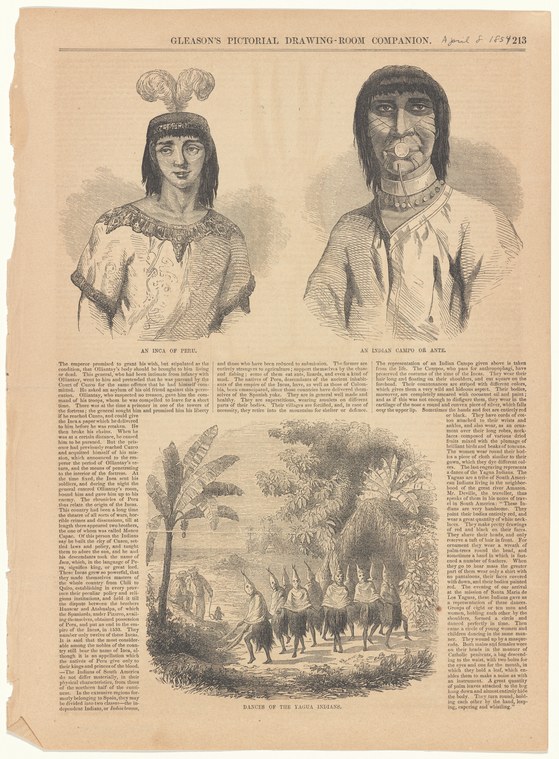
This engraved page from Gleason's Pictorial Drawing-Room Companion presents three ethnographic studies of Native American figures and a landscape scene. At top left, a woman wears a long fringed dress with elaborate beaded shoulder decoration and a tall feathered headdress; her posture is frontal and static. At top right, a man stands in profile wearing minimal dress—a breechcloth and beaded necklace—with geometric face paint or tattoos marked across his features. The lower half shows a wider landscape: a procession of figures on horseback and on foot moving through a savanna-like terrain with scattered trees and palms, with what appears to be a ceremonial gathering or buffalo hunt in progress. The engraving style is characteristic of mid-19th-century American periodical illustration, with fine cross-hatching for tonal depth and classical compositional framing.
The dancing
The two portrait figures are presented as static anthropological specimens rather than captured in motion. The woman's body faces the viewer with arms at her sides or gently positioned; the man's body turns to show profile, his stance upright but still. The lower scene shows multiple figures dispersed across a landscape in various postures—some mounted, some walking, some kneeling or bending—suggesting active movement and work rather than formalized dance steps. Without closer detail, the specific postures and arm frames are difficult to distinguish.
The dance depicted
The image appears to document Native American life and activity rather than formal dance performance. The lower scene suggests hunting, travel, or a ceremonial gathering, and the standing figures may indicate practices related to these activities. If dancing is depicted in the lower landscape scene, it is embedded in a broader narrative of daily or ceremonial life rather than isolated as a dance performance for artistic contemplation. The engraving's documentary intent complicates identification of any specific dance style or movement vocabulary.
How it was made
This is a wood engraving or steel engraving published in a periodical (Gleason's Pictorial Drawing-Room Companion, dated April 2, 1859 according to the page header). The medium allowed for fine detail and mass reproduction, making ethnographic imagery accessible to a mid-19th-century American reading public. The technique of engraving produces the characteristic linear hatching and formal composition visible here. As a periodical page, this work reached thousands of households and shaped popular understanding of Native American appearance and activity, whether accurate or imagined.
About this work
This is a page of ethnographic illustration from a major American periodical of the 1850s, presenting Native American figures and a landscape scene of what may be ceremonial or hunting activity. It sits at the intersection of journalism, anthropology, and artistic practice in an era when illustrated periodicals were primary sources of visual information about peoples beyond European-American experience. The work documents both how Native Americans were visually represented in mainstream American culture and what activities—including possible ceremonial movement—were deemed worthy of illustration for a broad audience.
How to look at it
Attend to the contrast between the static portrait busts (presenting Native Americans as anthropological subjects in a timeless present) and the active landscape scene (suggesting movement, work, and ceremony in progress). Notice the detail of dress, ornament, and body marking in the portraits—the feathered headdress, beaded necklace, geometric face paint—which convey 'otherness' through visual accumulation. In the landscape, look for the dispersal of figures across space and their varied postures: this spatial and postural variety may indicate ceremony, hunting, or travel, but the engraving does not isolate or clarify any specific movement practice.
The artist
The engraver is not identified in the catalogue record. Gleason's Pictorial Drawing-Room Companion employed staff illustrators and engravers whose work appeared unsigned. The page's style and technique are consistent with professional American periodical engraving of the 1850s.
The period
This image dates to the height of American periodical illustration in the mid-19th century, when wood and steel engravings brought imagery of 'exotic' peoples into middle-class American homes. This was also the era of Indian removal policies, western expansion, and intense popular curiosity about Native American life—often mediated through illustrated periodicals and sensationalized narratives. Ethnographic illustration of this kind typically reflected the illustrator's imagination and the publication's commercial interests as much as direct observation.
Where it lives
This page is held by the New York Public Library as part of its prints collection. It is a single page from the periodical Gleason's Pictorial Drawing-Room Companion, published April 2, 1859. The archive mark visible on the page indicates cataloging by the NYPL.
Questions about this work
Is this documenting actual Native American dance?
The image may include ceremonial or ritual movement, but it is presented as ethnographic documentation of Native American life and activity rather than as isolated dance performance. The lower landscape scene shows figures in various postures that suggest movement and work. Without more specific historical context, it is difficult to identify a particular dance form or confirm whether the illustrator observed actual ceremony.
How reliable is this image as a source on Native American dress and appearance?
Mid-19th-century ethnographic engravings in American periodicals blended observation, imagination, and the commercial interests of publishers. While details of dress and ornament may reflect actual practice, the overall presentation—especially the static, frontal portrait format—reflects the period's approach to ethnographic illustration rather than a neutral record. The image is valuable as evidence of how Native Americans were visually represented to American audiences in 1859, not necessarily as an accurate record.
What is Gleason's Pictorial Drawing-Room Companion?
Gleason's was a major American illustrated periodical published from 1851 to 1859, featuring engraved images of current events, exotic locations and peoples, and sensational narratives. It was a precursor to later illustrated newspapers and reached a broad middle-class audience. Pages like this one were among its most popular content.
More dance artwork





