49 works in this view — arrow keys or swipe to move between them.
Dance in Art
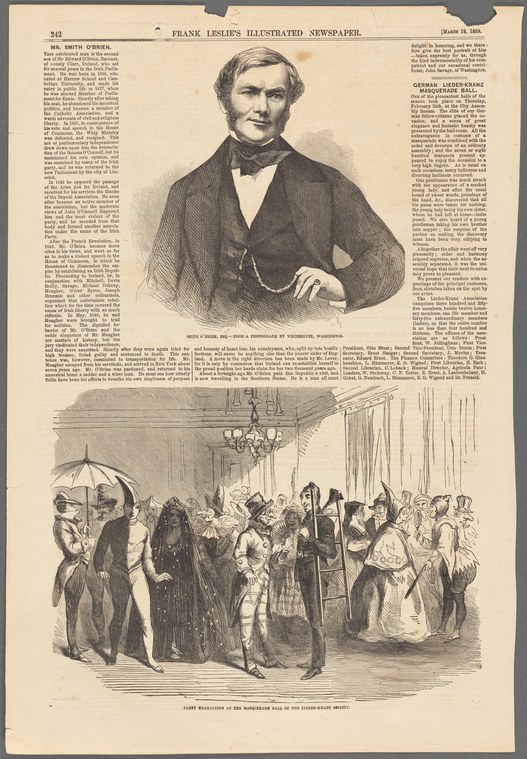
Smith O'Brien, Esq.; Fancy characters at the masquerade ball of the Lieder-Kranz Society; Frank Leslie's Illustrated Newspaper, March 19, 1859
Unknown artist
- Collection:
- Prints depicting dance
- Source:
- New York Public Library
- Rights:
- Public domain — free to use, share and adapt.
- Recorded as:
- Public Domain
This work illustrates the boundary between dance as social practice and dance as spectacle in the nineteenth century, and how illustrated newspapers shaped public understanding of elite entertainments. It shows that masquerade balls—events with strong connections to dance history—were marketed and understood primarily as visual spectacles of costume and character rather than as occasions to showcase choreography or technique.
What you are looking at
A masquerade ball held indoors in an elegant room with high ceilings and a chandelier. The gathering is crowded with costumed guests in fancy dress, many carrying umbrellas and parasols as props or costume elements. The setting appears to be a formal ballroom with draped walls. Guests wear a variety of elaborate costumes representing different characters and nationalities—some appear to be in military dress, others in oriental or exotic garb. The composition is dense with figures mingling, conversing, and moving through the space. Above the main scene is a portrait of a well-dressed gentleman in mid-nineteenth-century attire, identified in the caption as Smith O'Brien, Esq., suggesting this is a report on a social event of note.
The dancing
The figures throughout the ballroom scene are upright and static, posed in conversation rather than actively dancing. Bodies are clustered in groups, standing or moving slowly through the space. There is no visible partner hold, frame, or coordinated movement. The gestures are social—hands gesturing in conversation, figures turning to address one another. This is a social gathering captured in standing, mingling poses rather than in the act of dancing movement.
The dance depicted
This is not a depiction of actual dance in progress but rather a masquerade ball—a formal social event of the mid-nineteenth-century elite. While the masquerade was an occasion where dance might occur, the image shows the crowd and spectacle of the event itself rather than any active dancing. The costume and pageantry suggest this was a fashionable entertainment where the visual display of elaborate dress and assumed characters took precedence. No specific dance style is identifiable from the poses or movement captured.
How it was made
This is a wood engraving published in Frank Leslie's Illustrated Newspaper, a weekly periodical known for current events reporting with dramatic illustrations. The technique allowed for rapid reproduction and mass circulation to a broad readership, making this a form of illustrated journalism. The engraving shows the graphic conventions of the period—fine cross-hatching for texture, strong line work defining form, and the compositional density typical of newspaper illustration meant to convey excitement and social importance to a general audience.
About this work
This is an illustrated news report of the Lieder-Kranz Society masquerade ball, published in March 1859. It documents a significant social event in the life of New York's German-American community, represented here through the figure of Smith O'Brien, Esq. (likely a prominent attendee or patron). Rather than depicting dance as a performed art, the work captures the spectacle and sociability of a fashionable ball, showing how the middle and upper classes of the era used costume, pageantry, and elaborate dress to perform identity and entertain one another. The image is valuable not as a record of dance technique or style, but as evidence of how dance events were understood and reported in popular culture—as occasions for visual display and social gathering rather than as performances to be analyzed for their movement.
How to look at it
Observe the distribution of figures across the ballroom—how the artist conveyed crowd and movement through overlapping forms and varying density rather than through actual choreographed motion. Note the variety of costumes and the emphasis on visual character and dress. The portrait at the top and the caption anchor this to news reporting rather than imaginative art—this is documentary illustration, attempting to record what occurred rather than to interpret or beautify it. The absence of any clear moment of dance, despite the ballroom setting, is itself significant: it tells us that by 1859, a masquerade ball was valued and reported primarily as social spectacle.
The artist
The illustration is uncredited. Frank Leslie's Illustrated Newspaper (founded 1855) employed a large stable of engravers and illustrators working from sketches and descriptions to produce weekly visual news reports. The newspaper was known for dramatic, densely composed scenes that captured the social life of American cities, particularly New York.
The period
The mid-nineteenth century saw the rise of illustrated newspapers as a dominant form of mass media, allowing editors to compete for readership through visual sensation and topicality. The 1850s and 1860s were also a period when masquerade balls and fancy-dress entertainments were fashionable among the American elite and ethnic communities seeking to assert cultural status. The Lieder-Kranz ("song wreath") was a German-American social and musical organization, and events like this ball would have been important for community visibility and social networking.
Where it lives
Published in Frank Leslie's Illustrated Newspaper, March 19, 1859. This is a work of mass-circulation popular journalism, part of the newspaper's record of weekly social events in New York City. It would have reached thousands of subscribers in its original form, and the engraving likely came from the newspaper's archives or was preserved in bound collections of the periodical.
Questions about this work
Is anyone actually dancing in this image?
No. The figures are posed in conversation and mingling rather than in active dance. While the masquerade ball was an event where dance might take place, this illustration focuses on the crowd, costumes, and social gathering rather than on capturing any moment of choreographed movement or partner dancing.
Why would a masquerade ball be newsworthy?
In the nineteenth century, masquerade balls and fancy-dress entertainments hosted by prominent individuals or organizations were important social events covered by newspapers as markers of community status and cultural life. The Lieder-Kranz was a significant German-American organization, and the publication of this event with a prominent portrait of an attendee indicated the society's importance to the newspaper's readership.
What was the Lieder-Kranz Society?
The Lieder-Kranz ("song wreath") was a German-American social, musical, and cultural organization founded in the mid-nineteenth century. Such societies provided community, entertainment, and a venue for German immigrants and their descendants to preserve and celebrate their cultural identity in America.
More dance artwork





