49 works in this view — arrow keys or swipe to move between them.
Dance in Art
Les artistes contemporaines
Unknown artist
- Collection:
- Prints depicting dance
- Source:
- New York Public Library
- Rights:
- Public domain — free to use, share and adapt.
- Recorded as:
- Public Domain
The work shows how women artists and performers were marketed and memorialized in the late nineteenth century: as beautiful, refined objects of display rather than as active practitioners of their craft. The gap between the title's claim of contemporary artistic significance and the image's refusal to show any art or performance is itself historically meaningful.
What you are looking at
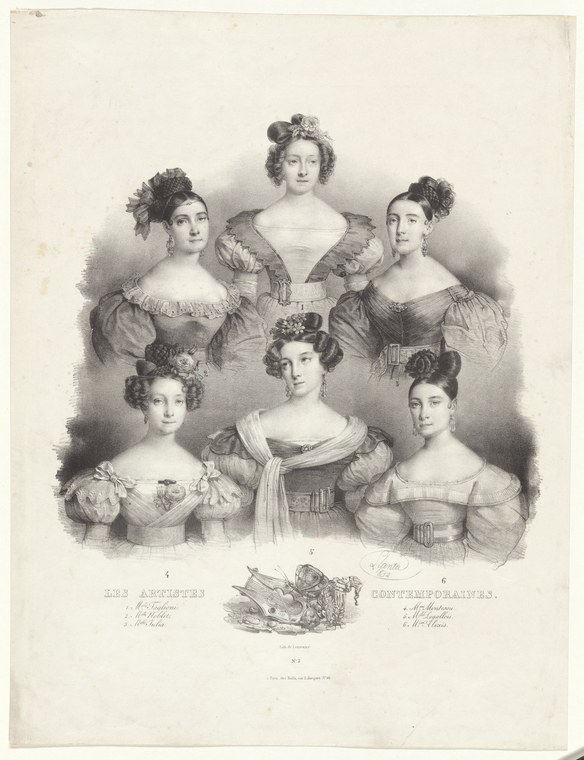
Six young women are arranged in a formal group portrait against a plain background, their figures modeled with soft tonal gradation in the manner of steel engraving. Three stand in the back row, three sit or recline in front. All wear fashionable day dress of the 1890s—high-necked gowns with puffed shoulders, fitted waists, and elaborate drapery—with their hair arranged in the Gibson Girl style of that era, some crowned with feathers or ornamental combs. The women's poses are studied and composed rather than candid: they gaze toward the viewer or into the middle distance with the self-consciousness of performers or public figures. The title *Les artistes contemporaines* (Contemporary Women Artists) is inscribed below in the plate, flanked by decorative flourishes. There is no suggestion of active dance; this is a celebratory group portrait of named individuals presented as notable figures of their time.
The dancing
No dancing is depicted. The women are arranged in a formal static composition typical of Victorian portraiture—shoulders squared, spines erect, hands folded or resting. Their poses suggest elegance and refinement rather than movement or exertion. The variety of their positions (standing, seated, reclining) creates visual interest within an otherwise formal genre. Their bearing and dress signal high social status and cultivation rather than physical performance.
The dance depicted
This work does not depict dance. It is a commemorative portrait of six named women identified as contemporary artists—possibly singers, actors, painters, or musicians of the 1890s—presented in a gallery of their likenesses. While the women may have been performers or artists of various kinds, the print itself records them in stillness, not in motion or performance.
How it was made
This is a steel engraving, a technique that allows fine tonal modeling and wide circulation. The soft shading and subtle gradation of the background and faces are characteristic of steel-plate engraving at the highest level of finish. The plate was printed and distributed to a broad audience—the New York Public Library's holding of the work suggests it was commercially available and collectable in the United States. The monochromatic print implies circulation through illustrated periodicals, art publications, or as a standalone portrait print.
About this work
This is a group portrait engraving of six women identified as *Les artistes contemporaines*, almost certainly French artists or performers of the 1890s. The work celebrates named individuals of its moment through portraiture rather than through representation of their work or practice. It sits on the boundary of our collection: while it documents cultural figures whose artistry may have included performance, the image itself is an act of commemoration and social positioning, not a record of dance or movement. It belongs here as evidence of how dance and performance were discussed and circulated in the popular press of the period—these women were famous enough to warrant a group engraving, yet the engraving tells us almost nothing about what they actually did.
How to look at it
Study the formal composition: the careful arrangement of the six figures to create visual balance and hierarchy, the way the faces are individuated despite the uniform dress and styling, and the complete absence of narrative or action. Note the contrast between the inscribed claim of artistic achievement and the image's presentation of the women as objects of display. The soft modeling and high finish of the engraving would have made this a prestigious and collectible object in its time—the quality of the print was itself a statement of the women's importance.
The artist
The artist is not recorded. The style and finish of the engraving, and the nature of the project—a commemorative group portrait of named contemporary women—suggest a commercial atelier or publishing house, possibly Parisian, producing high-quality reproductive prints for a middle-class and aspirational audience. The inscription format and the apparent publication by a Parisian house (indicated by the French title) suggest this was a successful commercial print.
The period
The 1890s saw a boom in illustrated journalism and the mass reproduction of celebrity portraiture. The Gibson Girl aesthetic visible here—the high collars, puffed sleeves, and elaborately styled hair—was the dominant ideal of feminine beauty and cultivation. Women performers, artists, and social figures were increasingly documented in group and individual portraits that circulated as prints, postcards, and illustrations. The ability to name and celebrate six women as *artistes contemporaines* reflects a moment when women's participation in public cultural life, while still constrained and contested, was notable enough to commemorate.
Where it lives
The work is held by the New York Public Library in its collection of prints depicting dance (or related performance and movement culture). Its inclusion in a dance-focused collection may reflect broader nineteenth-century practices of grouping portraiture, performance, and visual culture together, or may indicate that at least some of these women were known as dancers or theatrical performers.
Questions about this work
Does this print show a dance?
No. It is a formal portrait group of six named women presented as contemporary artists or performers. There is no action, movement, or performance depicted. The women are arranged in elegant stillness for the purpose of commemoration and display.
Who were these women?
The catalogue record does not identify them individually, and the image itself does not make their identities or professions clear. The inscription *Les artistes contemporaines* suggests they were known publicly as artists or performers in the 1890s, but whether they were singers, actors, painters, musicians, or dancers cannot be determined from the print alone.
Why is this in a dance collection?
It may have been acquired as part of a broader collection of nineteenth-century prints relating to performance, entertainment, and public cultural life. Some or all of the women depicted may have been known as dancers or theatrical performers, but that is not evident from the image itself.
What technique is this?
This is a steel engraving, a reproductive technique that produced fine tonal gradation and could be printed in large numbers. The high finish and soft modeling suggest this was a prestigious, expensive print intended for a cultivated audience.
More dance artwork





