49 works in this view — arrow keys or swipe to move between them.
Dance in Art
Nancy Dawson
Unknown artist
- Collection:
- Prints depicting dance
- Source:
- New York Public Library
- Rights:
- Public domain — free to use, share and adapt.
- Recorded as:
- Public Domain
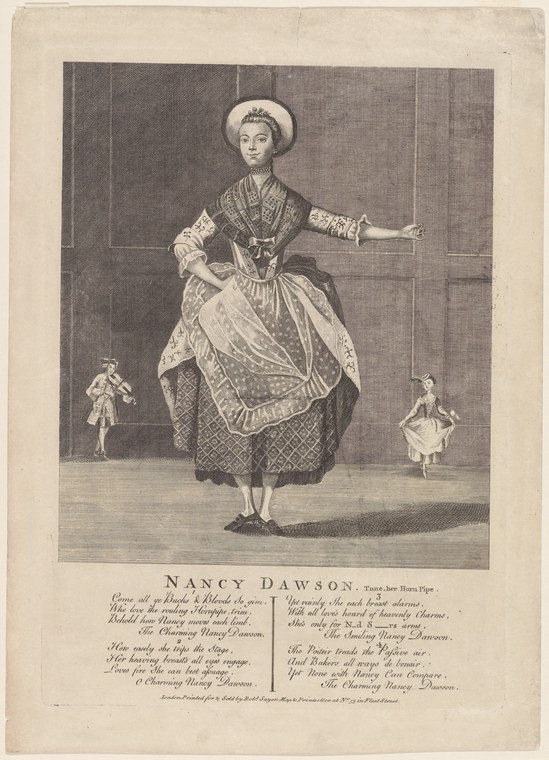
Nancy Dawson was one of the first female dancers to achieve independent celebrity in English theatre, and this image is direct evidence of the theatrical presence and marketing of that celebrity. The engraving reveals the pose and carriage valued in stage dance at the moment when ballet and the comic stage were still closely intertwined, before the Romantic era separated them.
What you are looking at
A woman in mid-eighteenth-century dress stands center stage in a composed theatrical pose. She wears a wide-skirted gown with ornate patterned fabric, a fitted bodice with decorative bows, and a broad-brimmed bonnet tied beneath her chin. Her right arm extends outward in an elegant gesture while her left rests near her body; her posture is upright and dignified. Two small male figures, rendered in miniature scale, flank her at ground level—one to the left, one to the right—in attitudes of observation or attendance. The background is a plain architectural interior with vertical paneling, suggesting a stage set. The composition is formal and symmetrical, typical of theatrical portraiture.
The dancing
The central figure's frame is distinctly balletic: an upright carriage with elongated neck, squared shoulders, and a frontal orientation toward the viewer. Her right arm traces an open line across the body at approximately shoulder height, with the hand held delicately. Her left arm hangs naturally. The stance appears to be a turnout position, with the weight centered and the skirt arranged to display its volume and pattern. The two subsidiary figures, rendered toy-like, are static poses rather than dancers.
The dance depicted
Nancy Dawson was a celebrated dancer of the 1760s–70s, known for hornpipe dancing and comic stage roles. This image shows her in theatrical dress rather than active movement, suggesting a moment of display or address to the audience. The pose—arm extended in greeting or flourish, body frontal and stable—is consistent with the theatrical vocabulary of galant and neoclassical stage movement, where the body holds a composed attitude for the viewer's admiration. The miniature attendant figures are costume convention of the period and not dancing partners.
How it was made
This is an engraving, identifiable by the regular hatching, fine line-work, and tonal modeling achieved through parallel lines. The technique allowed for multiple impressions and wide circulation; the presence of printed text below the image confirms this as a commercial print. The engraver has used the medium to render fine detail in the fabric pattern and lace, and to control light through differential density of line, creating a sculptural quality to the figure. Such prints were sold individually as souvenirs of popular performers and as theatrical documentation.
About this work
This is a celebrity portrait engraving of Nancy Dawson, one of the most popular dancers of Georgian England, shown in a moment of theatrical presentation rather than active dance. The work documents the aesthetic values of mid-eighteenth-century stage dance: verticality, frontality, delicate arm carriage, and the display of expensive dress. Dawson's fame rested largely on her comic timing and her signature hornpipe and jig performances, but this image captures her in the more formal, courtly mode of theatrical address that was equally part of the repertory. The print itself—with its text, its format for commercial sale, and its reproduction method—was a vehicle for star-making and gave audiences at home a view of a performer they might have seen only from the gallery of a theatre.
How to look at it
Observe the deliberate frontality and the careful arrangement of the skirt, which occupies most of the image. The extended arm is not caught mid-motion but held in a stable, finished position—this is a formal salute or presentation of self, not a dynamic gesture. The tiny attendant figures are a reminder that this is a portrait of a person in her theatrical capacity, not a record of an actual dance step. The detail of the patterned fabric suggests that costume was a significant part of Dawson's appeal and professional image.
The artist
The artist is not recorded. The print was published in London in the mid-to-late eighteenth century. The style and technique are consistent with the work of commercial theatrical engravers of that period, many of whom remain anonymous despite producing thousands of images of performers and theatrical scenes.
The period
This print dates to the age of David Garrick and the ascendancy of English theatrical dancing. In the 1760s–70s, the English stage was home to a thriving culture of comic dance—hornpipe, jig, and pantomime—that was equally prestigious with the formal French-influenced court dances. Engraved portraits of performers were a major industry and a primary way that theatre was consumed by the public beyond the playhouse. The style of address and the calm, posed attitude reflect neoclassical aesthetic values; this is not Romantic or dramatic gesture, but a composed display of the body as an object for the viewer's regard.
Where it lives
The print is held in the New York Public Library's collection of prints depicting dance. It appears to be a single-sheet engraving intended for sale or distribution; the printed text and format are standard for London theatrical prints of this period.
Dance in this work
Questions about this work
Who was Nancy Dawson?
Nancy Dawson was one of the most celebrated English dancers of the mid-eighteenth century, active from the 1750s through the 1770s. She was particularly famous for her comic performances, hornpipe dancing, and appearances in pantomime. She achieved unusual prominence and independence as a female performer and was a fixture of London's Theatre Royal, Drury Lane.
Is she actually dancing in this image?
No. This is a theatrical portrait showing her in a posed, composed attitude—a formal presentation of the body rather than a captured moment of movement. This kind of pose was standard for celebrity portraits of performers and conveyed dignity and theatrical presence rather than documenting actual choreography.
What is a hornpipe?
A hornpipe is a solo stage dance popular in English theatre, typically performed to spirited music in duple or triple meter. It features intricate footwork, turning, and rhythmic clarity. It was danced in soft shoes on the ball of the foot and was a vehicle for displaying virtuosity and comic character.
What are the small figures beside her?
These are miniature attendant figures typical of theatrical prints of the period. They may represent servants or companions within the theatrical fiction, but they are aesthetic convention rather than a record of the actual stage setup. Their smallness emphasizes the prominence of the principal performer.
More dance artwork





