49 works in this view — arrow keys or swipe to move between them.
Dance in Art
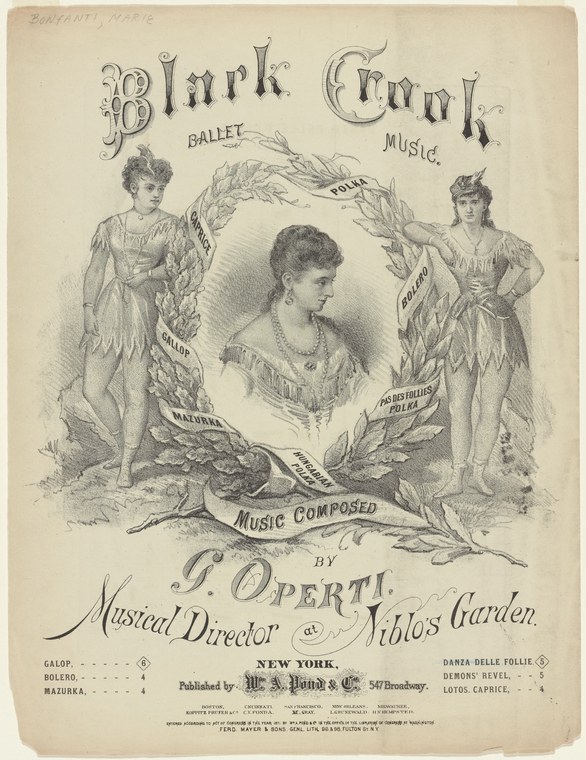
Black Crook ballet music; music composed by G. Operti, musical director at Niblo's Garden
Unknown artist
- Collection:
- Prints depicting dance
- Source:
- New York Public Library
- Rights:
- Public domain — free to use, share and adapt.
- Recorded as:
- Public Domain
This print documents the commercial infrastructure of ballet in mid-nineteenth-century New York and shows how dance music was packaged and circulated to the public as a cultural product. The named dances suggest the repertoire of spectacle and character variation that made up theatrical ballet of the period, even though the engraving itself does not show choreography in action.
What you are looking at
This is a title page or promotional engraving for ballet music composed by G. Operti, musical director at Niblo's Garden in New York. The composition centers on a portrait bust of a woman with an upswept hairstyle and bare shoulders, framed by laurel wreaths. To either side stand two female figures in classical drapery—one holding a lyre, the other a palm frond—posed as allegorical muses or attendants. The figures are rendered in the linear style typical of mid-nineteenth-century theatrical engraving, with fine hatching to model form and drapery. Decorative botanical elements and banners inscribed with dance titles (visible text includes "Galop," "Bolero," "Raindeer" [sic], and others) fill the surrounding space. The overall aesthetic is one of refined theatrical elegance, emphasizing the composer's cultural standing and the music's association with ballet and spectacle.
The dancing
The two allegorical figures flank the central portrait symmetrically, each standing in a classical contrapposto pose with one leg bearing weight and the torso turned slightly toward the viewer. Their arms are lifted and extended in a graceful manner characteristic of neoclassical art—one holds a lyre, the other a palm, both attributes of Apollo and Victory. The poses suggest the refined, upright carriage of trained classical dancers, though they are rendered as static figurative allegories rather than mid-movement choreography. The women wear thin classical chitons with minimal drapery, establishing a genealogy from ancient Greek art.
The dance depicted
This engraving documents the music composed for ballet spectacle at Niblo's Garden, a major New York theater, but does not depict an actual dance in progress. Instead it presents the paratextual apparatus of theatrical promotion—the composer's name, the venue, and allegorical figures signifying artistic refinement and the classical tradition. The named dances (Galop, Bolero, Raindeer) suggest the ballet contained character dances and national or exotic variations typical of mid-nineteenth-century romantic and pantomime ballet. The piece is advertising material rather than a record of choreography.
How it was made
This is a steel or copper engraving, a reproductive print technique widely used for theatrical and musical promotion in the nineteenth century. The fine lines, precise hatching, and ability to capture delicate detail mark it as intaglio work, likely engraved from a drawing. This medium allowed for mass reproduction and broad circulation—such title pages were bound into published musical scores and used as promotional sheets. The technique's formality and expense signal the work's intended audience: cultivated music buyers and theater patrons.
About this work
This engraving is a title page for ballet music composed by G. Operti for performances at Niblo's Garden in New York in an unrecorded date in the mid-nineteenth century. It does not depict dance itself but rather the cultural apparatus surrounding theatrical ballet—the composer, the venue, and the classical allegorical tradition that gave ballet legitimacy and prestige. As such it documents the status of ballet music as published, circulating commodity and the relationship between visual art, music, and dance in commercial theater of the period.
The work belongs in a dance gallery because it records a moment when ballet was a major draw at a significant American theater, and because its visual rhetoric—the classical muses, the refined draftsmanship, the association with named forms (galop, bolero)—shaped how audiences understood ballet as an art form tied to antiquity, European sophistication, and cosmopolitan entertainment.
How to look at it
Attend to the decorative and promotional function of the composition: the symmetrical flanking figures serve not to depict choreography but to elevate the composer's name through association with classical art and refined taste. The named dances scattered through the design (visible on banners and labels) are the actual traces of what was performed—read these as a list of the ballet's structure and variety rather than as depictions. The neoclassical aesthetic of the allegorical figures positions ballet as heir to ancient Greek art, a claim that was central to ballet's cultural legitimacy in the nineteenth century.
The artist
G. Operti is identified only as musical director at Niblo's Garden. The engraver is not recorded on the print. Niblo's Garden was a major New York theater venue (opened 1823), and the house maintained a resident orchestra and composer. Operti's role suggests he was responsible for commissioning, arranging, or composing music for the theater's ballet spectacles, a common practice in nineteenth-century theatrical management.
The period
This engraving dates to the height of theatrical ballet's popularity in America, after the visits of European dancers like Fanny Essler (1840–42) had established ballet as a fashionable spectacle. Niblo's Garden competed with other New York theaters (Park Theatre, Bowery Theatre) to present elaborate pantomime-ballets featuring named national or exotic dances (galops, boleros, etc.). Published musical scores for these works, with engraved title pages, became consumer products for domestic music-making and also served as advertisements for the theater's current attractions. The allegorical title page followed conventions established in European music publishing and signaled artistic ambition.
Where it lives
This engraving is held by the New York Public Library in its collection of prints depicting dance. It is a published theatrical ephemeron—a title page, likely from a printed score or distributed as promotional material for Niblo's Garden.
Questions about this work
Did Operti choreograph this ballet himself?
The print identifies him only as musical director and composer. It does not state who choreographed the ballet. In mid-nineteenth-century American theater, the composer and choreographer were usually different people, though they worked closely.
What was Niblo's Garden?
Niblo's Garden was a major New York theater that opened in 1823 on Broadway. It was one of the city's premier venues for pantomime-ballet and spectacle during the 1830s–1860s, competing with the Park Theatre and Bowery Theatre.
What do the named dances mean?
These were character dances or variations that formed part of the full ballet spectacle. A galop is a rapid couple dance; a bolero is a Spanish dance. Their presence on the title page tells us the ballet included variety, exotic color, and national dances—standard features of romantic-era ballet.
Is this the only record of the ballet?
As far as we know. Theater reviews in nineteenth-century newspapers may mention the work, but this engraving may be our only surviving visual documentation of the ballet's music and structure.
More dance artwork





