49 works in this view — arrow keys or swipe to move between them.
Dance in Art
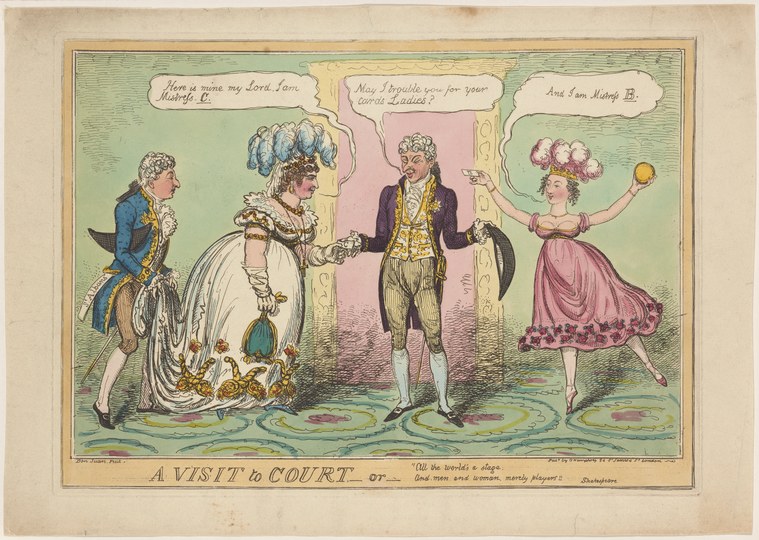
A visit to court, or "All the world's a stage, and men and woman merely players," Shakespeare
Unknown artist
- Collection:
- Prints depicting dance
- Source:
- New York Public Library
- Rights:
- Public domain — free to use, share and adapt.
- Recorded as:
- Public Domain
The work is historically significant as evidence of how 18th-century artists and audiences understood court and ballroom life as theatrical performance rather than authentic social interaction. It documents the aesthetic conventions of satire directed at aristocratic pretension—conventions that shaped how dance and dancers were represented in visual culture of the period. For dance historians, it offers insight into how the ballroom and its denizens were perceived and parodied by printmakers who catered to a broad, literate public amused by mockery of the wealthy.
What you are looking at
Four figures in fashionable 18th-century dress occupy a stage-like space with a pink architectural backdrop. A man in blue coat and breeches stands left, gesturing toward a woman in an elaborate white gown with panniers and jeweled ornaments, who holds a small dog. Centre stands a portly gentleman in yellow waistcoat and dark coat, one arm extended in presentation. To the right, a woman in pink silk with high-piled powdered hair and a small spherical object (possibly a fan or ornament) in her raised hand completes the group. The composition is framed with a golden border and includes speech bubbles with period dialogue. The print uses hand-coloring in soft greens, pinks, and flesh tones, with fine linear hatching establishing shadow and form.
The dancing
The bodies are posed in social tableau rather than balletic or terpsichorean alignment. No closed holds, partnered frames, or coordinated footwork are evident. Postures are gestural and discursive—the central male figure gestures outward in introduction or commentary, while the figures around him adopt display poses typical of social interaction rather than dance technique. The woman on the right appears to be in a slight contrapposto, one leg bearing weight, but this reads as fashionable stance rather than dance position. There is no evidence of synchronized movement or technical execution.
The dance depicted
The image does not depict actual dancing, despite the title's invocation of theatrical performance. The Shakespeare quotation—'All the world's a stage, and men and woman merely players'—signals that this is a satirical scene of social performance and courtly artifice rather than a representation of a specific dance form. The figures enact social roles at court with the exaggeration and stillness of actors in a comedic sketch. If dance is present, it is as metaphor for the performative nature of courtly behaviour itself, not as a depictable technique.
How it was made
This is a hand-coloured engraving or etching, evident from the fine linear hatching and the characteristics of line-work that cannot be achieved in lithography or other processes. The quality of the line, the hatching technique, and the way the image has been toned in soft colour washes are consistent with late 18th-century satirical print production. Such prints were affordable and widely distributed, reaching a broad audience beyond the aristocracy—typical circulation for social satire of the period. The hand-coloring allowed for individuation of costume and status while maintaining the precision of the engraved line.
About this work
This is a hand-coloured satirical engraving depicting a scene of social performance at a fashionable 18th-century court, using the language of theatrical presentation to mock the affectation and role-playing inherent in aristocratic life. The work is titled 'A Visit to Court' and includes a quotation from Shakespeare about life as performance, making explicit its commentary on social artifice. Although it shows figures in an ostensibly danceable setting—a formal interior with fashionable dress—the composition and the nature of the gestures indicate social satire rather than documentary record of dance practice. The print belongs in a dance archive because it captures a moment when courtly life itself was understood as spectacle and performance, and because it documents the visual culture in which social dance (particularly courtly forms like the minuet) was a central marker of status and refinement.
How to look at it
Attend to the poses rather than the movement: each figure holds a static, exaggerated posture designed to convey type and intention rather than a captured moment of motion. The artist has chosen to freeze social performance mid-gesture, allowing the dialogue to complete the satirical meaning. Notice the costume detail—the jewels, the panniers, the carefully dressed hair—which signals status and pretension. The architectural setting, the formal arrangement, and the theatrical lighting all reinforce that this is a scene being *performed* rather than a ballroom in natural use. The contrast between the formal beauty of the clothing and the awkwardness or pretentiousness of the poses is where the satire resides.
The period
This print was created in the late 18th century, a period of intense satirical print production in Britain targeting aristocratic manners and social climbers. The 1780s and 1790s saw a flourishing of hand-coloured satirical engravings by artists such as Gillray, Rowlandson, and their contemporaries and imitators—works that were sold individually or in series and circulated widely. Social dance, particularly the minuet and country dance, remained central to courtly and upper-middle-class life, but satire increasingly targeted the emptiness and hypocrisy of such display. The Shakespeare epigraph reflects broader Enlightenment and proto-Romantic interest in the performative nature of society itself.
Where it lives
The work is held in the New York Public Library's collection of prints depicting dance. It is a single-sheet hand-coloured engraving or etching, typical of the commercial satirical print market of the late 18th century.
Questions about this work
Is anyone actually dancing in this image?
No. The figures are posed in social attitudes rather than executing a dance. The title and the Shakespeare quotation indicate that the print is using dance and the ballroom as metaphors for social performance and artifice. The work is satire directed at courtly pretension, not a record of dance practice.
What does the Shakespeare quotation mean?
'All the world's a stage, and men and woman merely players' comes from *As You Like It* and was already a cliché by the late 18th century. Here it signals that courtly life is theatre—that the people visiting court are performing roles rather than being authentic. The quotation is the key to reading the image as satire rather than as a factual scene of courtship or social dance.
Why is this in a dance collection?
Because it documents how the ballroom and courtly performance were understood in the period when social dance was a central practice among the aristocracy and gentry. It shows what the visual culture around dance looked like, even though it is not itself depicting technique or choreography. Satire of court life is inseparable from satire of courtly dance.
What can we tell about fashion from this print?
The woman on the left wears a fashionable high-waisted gown with panniers (side hoops) and elaborate jeweled ornament; her hair is high-piled and powdered. The men wear tailored coats, breeches, and buckled shoes. The styling and the hand-coloring technique allow the artist to signal wealth and status through costume detail, which is essential to the satire—the clothes are beautiful but the figures wearing them are made ridiculous.
More dance artwork





