49 works in this view — arrow keys or swipe to move between them.
Dance in Art
Petipa
Unknown artist
- Collection:
- Prints depicting dance
- Source:
- New York Public Library
- Rights:
- Public domain — free to use, share and adapt.
- Recorded as:
- Public Domain
This is a primary document of how one of ballet history's most important figures was publicly represented and circulated during his lifetime. For dancers and historians, the image records the appearance and bearing of the choreographer who shaped the technique and narrative vocabulary of classical ballet, and the journal context reveals how Paris and European theaters engaged with Russian Imperial Ballet authority. The portrait also illustrates the status ballet had achieved by mid-century: a celebrated choreographer warranted a featured spread in an international theatrical publication.
What you are looking at
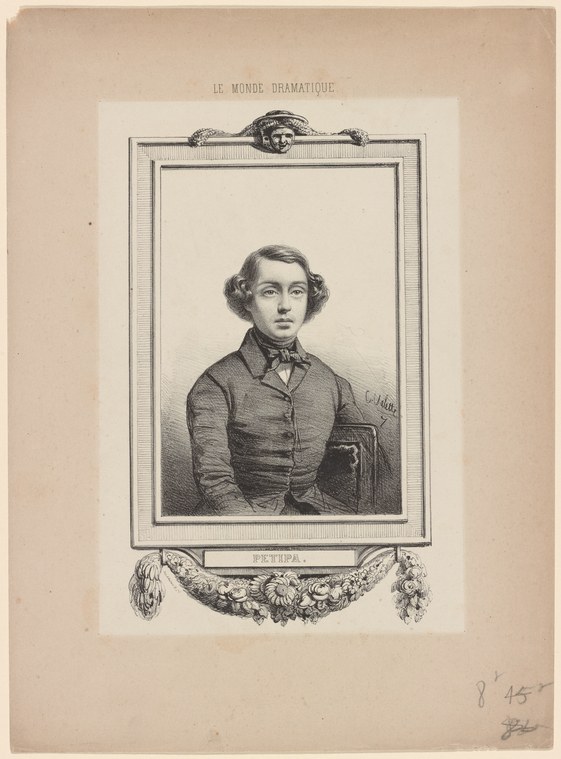
A three-quarter-length portrait of a young man, rendered in engraving or lithographic crayon, sits within an elaborate double-lined rectangular frame topped with a classical carved ornament. The sitter faces the viewer with a composed, somewhat grave expression, his head tilted slightly and turned toward the light. He wears a dark fitted jacket or tunic over a white shirt with a dark bow tie or cravat, his posture upright and formal. His hair is dark and styled close to the head in the fashion of the mid-nineteenth century. He holds what appears to be a bound manuscript or book against his body with his left hand. The background is uniformly light, directing all attention to his face and figure. Below the portrait frame hangs a delicate garland of flowers and leaves, a motif typical of commemorative prints from the Romantic era. The text "LE MONDE DRAMATIQUE" appears at the top of the page, indicating this is a theatrical publication.
The dancing
A single standing figure shown in formal dress of the nineteenth century. The posture is erect and dignified, with shoulders squared and weight evenly distributed. The left arm holds a book or manuscript across the body; the right arm is relaxed at the side. The head is turned slightly toward the light, and the gaze is directed outward and downward with a contemplative expression. There is no indication of active movement or dance pose; the figure is stationary and presentational, as befits a commemorative portrait.
The dance depicted
The catalogue identifies this as 'Petipa,' almost certainly referring to Marius Petipa (1818–1910), the preeminent ballet master of the Imperial Theatre in St. Petersburg. However, this engraving does not depict Petipa dancing or in motion. It is a portrait print from a theatrical journal, made to commemorate or introduce him to readers. Petipa was one of the most influential figures in classical ballet history, choreographer of La Bayadère, Swan Lake (revised version), and The Sleeping Beauty, but this image captures him as a gentleman and artist rather than as a performer. The manuscript he holds hints at his work as a choreographer and writer, not a dancer in performance.
How it was made
This is a black-and-white engraving or crayon lithograph, inferred from the fine parallel lines used to model tone, the delicate hatching in the shadows, and the precision of the frame and decorative elements. The technique was well suited to mass reproduction in journals and periodicals. The work appeared in Le Monde Dramatique, a French theatrical publication of the nineteenth century, indicating circulation among theater professionals, critics, and educated readers interested in dance and drama. The formal presentation—the ornamental frame and floral garland—places it in the tradition of commemorative prints issued to mark the arrival or prominence of celebrated performers and choreographers.
About this work
This is a commemorative portrait engraving of Marius Petipa, the Russian Imperial Ballet's master choreographer, published in the French theatrical journal Le Monde Dramatique. Rather than depicting Petipa in performance, it presents him as a distinguished artist and author, holding a manuscript and meeting the viewer's gaze with measured formality. The print belongs to a tradition of theatrical journalism that used portraiture to introduce and celebrate celebrated figures of the stage to an international audience of theater professionals and enthusiasts. Petipa's influence on classical ballet choreography and technique cannot be overstated, and this portrait captures him at the height of his authority in the nineteenth-century ballet world.
How to look at it
Examine the formality of Petipa's pose and expression: he is presented not as an entertainer in motion but as a thinker and artist. Note the manuscript he holds—it signals his role as a creator and choreographer, not a performer. The decorative frame and garland place him in the tradition of honored figures in the arts. The engraving technique, with its fine lines and careful modeling, conveys both authority and accessibility, suited to reproduction and distribution in a journal read by professionals and theater enthusiasts.
The artist
The artist of this engraving is not recorded in the catalogue. However, the style and quality of execution suggest it was produced by a skilled theater portraitist working for Le Monde Dramatique, a publication known for commissioning prominent engravings of celebrated performers and creators. The decorative precision and the formal presentation indicate professional theatrical journalism rather than amateur or polemical work.
The period
The print dates to the era of Romanticism and the early classical ballet tradition, when Petipa was consolidating his position as ballet master. By the 1850s–1860s, when this portrait was likely made, Petipa had already choreographed many of his most celebrated works and was recognized as an authority on ballet technique and composition across Europe. In France, Romantic ballet had given way to new forms, but Russian Imperial Ballet, under Petipa's direction, was establishing itself as a rival and eventually superior force in European dance. The circulation of Petipa's portrait in a French journal testifies to the international reach of Russian ballet during this period and the prestige attached to his name.
Where it lives
This engraving comes from the New York Public Library's collection of prints depicting dance. It was published in or as part of Le Monde Dramatique, a French theatrical journal of the nineteenth century. The work is a reproductive print made for circulation and is characteristic of theatrical journalism of the period.
Questions about this work
Is this an image of Petipa dancing?
No. This is a commemorative portrait of Marius Petipa as a distinguished artist and choreographer, not a depiction of him performing. He is shown in formal dress holding a manuscript, reflecting his role as creator and author of ballets rather than as a dancer in action.
When was Marius Petipa active?
Petipa worked as a dancer, choreographer, and ballet master primarily in Russia from the 1840s until his retirement in 1903. He was appointed to the Imperial Theatre in St. Petersburg and became the most influential choreographer of classical ballet, creating or revising works including Swan Lake, The Sleeping Beauty, and La Bayadère.
Why was this portrait published in a French journal?
By the mid-nineteenth century, Russian Imperial Ballet and Petipa's work were known and celebrated internationally. French journals of theater and arts regularly featured portraits of celebrated European and Russian performers and creators to inform and engage their readership of theater professionals and enthusiasts.
More dance artwork





