49 works in this view — arrow keys or swipe to move between them.
Dance in Art
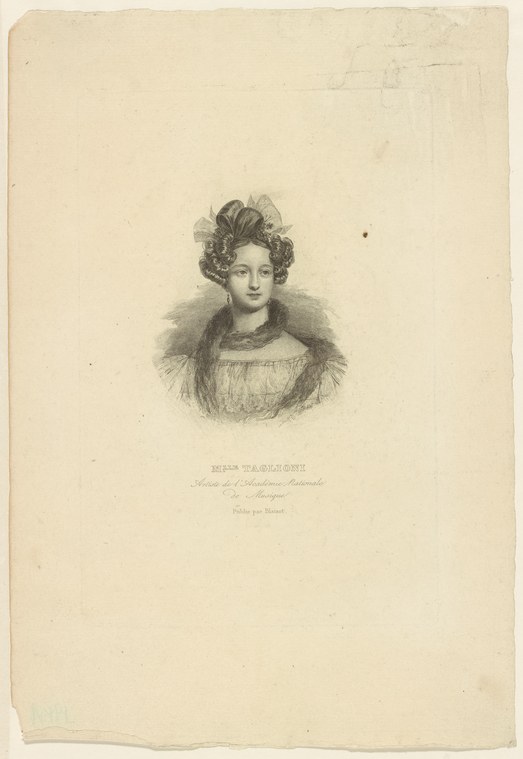
Mlle. Taglioni, artiste de l'Académie Nationale de Musique
Unknown artist
- Collection:
- Prints depicting dance
- Source:
- New York Public Library
- Rights:
- Public domain — free to use, share and adapt.
- Recorded as:
- Public Domain
Taglioni was the defining ballerina of the Romantic era and one of the most celebrated performers of her age, yet few images capture her dancing itself. This portrait is valuable as a record of how she was seen and presented to the public—as a refined, elegant woman of beauty and distinction, confirming her status beyond the stage. It illustrates the celebrity machinery of 19th-century ballet and the role of lithographic portraiture in constructing the public image of dancers.
What you are looking at
A bust-length portrait of a young woman in early 19th-century dress, rendered in fine pencil or chalk on cream paper. She is shown from roughly the shoulders up, her head turned slightly to the viewer's right, with an open, direct gaze. Her dark hair is dressed high and elaborately, gathered at the crown with ringlets framing her face in the Regency style. She wears a low-cut, off-shoulder chemise or evening dress with a gauze shawl or fichu draped across her shoulders and upper back, softly shaded to suggest volume and delicate fabric. The drawing is precise and flattering, with particular attention to the play of light on her face and the texture of her hair and drapery. The composition is intimate and refined, closer to a society portrait than a theatrical document.
The dancing
The sitter is stationary, posed rather than in motion. Her posture is upright and composed, with shoulders relaxed and drawn back—the carriage of a trained performer accustomed to being observed. Her expression is gentle and direct, with no indication of active movement or the dynamic tension of a dancer mid-step. There are no visible arms or hands to read, and the body is presented as a still, portrait object rather than as an instrument of dance.
The dance depicted
The inscription identifies this as Marie Taglioni, the most celebrated ballerina of the Romantic era and a defining figure in the history of theatrical ballet. Taglioni was the prima ballerina of the Paris Opéra and the muse of Romantic ballet, known for roles in La Sylphide (1832) and other major works of the 1830s–1840s. This image, however, is a society portrait rather than a dance documentation. It shows her as a public figure and celebrity—a woman of rank and refinement—rather than capturing her in the act of dancing or in costume for a specific role.
How it was made
The work is a lithographic print, as evidenced by the fine, consistent tonal work, the characteristic handling of chalk or crayon on the stone, and the soft, luminous quality of the image. The technique allowed for wide circulation of celebrity portraits and contributed to Taglioni's international fame; her image could be reproduced and distributed far more easily than an oil painting. The print shows high technical skill in modeling form and texture, suggesting this was commissioned work for a substantial market.
About this work
This is a commemorative portrait lithograph of Marie Taglioni, the most famous dancer of the Romantic ballet era, produced during or shortly after the height of her career in the 1830s–1840s. It documents her not as a dancer in motion but as a cultural celebrity and woman of consequence in early 19th-century society. The work belongs in a gallery of dance imagery because it captures the public face and iconic status of one of the medium's most transformative figures—the embodiment of the Romantic ideal and a symbol of ballet's reach into elite European culture. It reveals how dancers of this period were marketed, remembered, and consumed by their audiences: as much through portraiture and society imagery as through depictions of performance itself.
How to look at it
Attend to the refinement of the presentation: the careful arrangement of hair and drapery, the soft modeling of light, the directness of her gaze. These choices tell us that Taglioni's value to her public lay not only in her dancing but in her presence, her beauty, and her association with elegance and cultivation. The portrait is designed to convey status and desirability—qualities that made her a figure of fascination beyond the stage. Notice also the absence of any dance costume or reference to performance; this is the woman off-stage, presented as a society figure.
The artist
The artist is not recorded. The print is unsigned in the visible portion of the image, though the inscription 'Lith. par Moncet' appears in the lower margin, suggesting it was lithographed by someone named Moncet (possibly the printer rather than the original portraitist). The work is competent society portraiture, consistent with the commercial production of celebrity likenesses that flourished in Paris during the 1830s–1840s.
The period
This portrait dates to the era of Romantic ballet (c. 1830–1850), when ballet shifted from Classical restraint and spectacle toward an emphasis on ethereal, otherworldly female dancers. Taglioni epitomized this new aesthetic and became the first great international dance celebrity, her fame circulated through prints, engravings, and popular imagery across Europe. The technique of lithography—developed commercially only in the 1820s—made her image available to a broad public and contributed to her legendary status. Society portraiture in this period was also a form of social documentation, recording the appearance and refinement of notable women.
Where it lives
The print is held in the New York Public Library's collection of dance-related prints. It belongs to a broader tradition of theatrical and celebrity portraiture produced in 19th-century Paris and distributed across Europe.
Questions about this work
Who was Marie Taglioni?
Marie Taglioni (1804–1884) was a Swedish-Italian ballerina and the most celebrated dancer of the Romantic era. She created the title role in La Sylphide (1832), one of the foundational works of ballet, and became an international celebrity known for her technique, grace, and embodiment of the Romantic ideal of the ethereal, otherworldly female dancer.
Why is this a portrait rather than a dance image?
This is a society portrait because it served a different purpose than stage documentation. During the 19th century, celebrated performers like Taglioni were also public figures and celebrities whose images were sold as prints to admirers and collectors. This portrait was designed for circulation in the market for celebrity likenesses, not for recording the choreography or technique of a specific role.
What does the inscription mean?
The inscription reads 'Mlle. Taglioni / Artiste de l'Académie Nationale de Musique / de Paris / Lith. par Moncet.' This identifies her as a performer at the Paris Opéra (the Académie Nationale de Musique) and credits Moncet as the lithographer who transferred the image to stone for printing.
More dance artwork





