49 works in this view — arrow keys or swipe to move between them.
Dance in Art
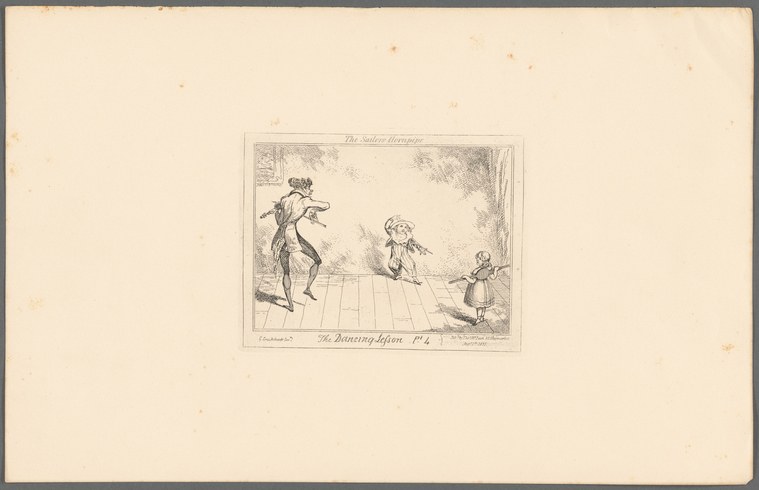
The dancing lesson, pt. 4. The sailors hornpipe
Unknown artist
- Collection:
- Prints depicting dance
- Source:
- New York Public Library
- Rights:
- Public domain — free to use, share and adapt.
- Recorded as:
- Public Domain
The sailor's hornpipe is documented in dance history largely through written description and later theatrical versions; visual evidence of how it was actually danced in ordinary contexts is scarce. This print records the characteristic angular, trunk-forward carriage and stiff-legged deportment that distinguished it from other solo dances of the period, and shows it as an act of teaching—social knowledge transmitted from one body to another. The series format suggests these prints served as both entertainment and practical instruction, revealing how print culture disseminated popular dance knowledge.
What you are looking at
An informal domestic interior shows four figures on a wooden floor, apparently during an instructional moment. At left, a man in fashionable dress—coat, breeches, and hat—stands in an exaggerated posture with one leg extended and arms splayed, his body twisted as if demonstrating a step or style of movement. To his right, a younger boy or apprentice mirrors his stance in miniature, legs apart and arms raised. Two female figures observe from the right side of the composition; one stands watching, while another sits or reclines. The setting is plainly furnished, with panelled walls and a corner visible behind. The etching is finely detailed, with careful cross-hatching to suggest fabric texture and spatial depth. The mood is one of performance and instruction—the left figure is clearly "showing" rather than dancing with a partner.
The dancing
The primary male figure dominates through an extreme and comic exaggeration of stance: his left leg is thrust out at an acute angle, his torso twists, and his arms are spread wide. The smaller male figure replicates this posture on a reduced scale, suggesting imitation or mockery. Both stand freely without a partner frame. The two female figures are passive observers—one standing upright, one seated—and play no active role in the demonstration. The gestural language is theatrical and deliberately ungainly, far from the controlled lines of ballroom technique.
The dance depicted
This is a sailor's hornpipe, as stated in the inscription, a spirited solo dance traditionally performed by sailors and common in popular entertainment from the 17th through 19th centuries. The hornpipe is characterized by a stiff, angular carriage of the upper body combined with intricate legwork—often performed in place rather than traveling. The exaggerated posture of the left figure—with legs splayed and torso rigid—captures the sailor's hornpipe convention of maintaining a nearly motionless trunk while the legs work beneath. The smaller figure suggests this is a lesson or demonstration, likely a dance master or older sailor teaching the step to a youth. The informality of the setting and the presence of female observers suggests a domestic or tavern context rather than theatrical performance.
How it was made
This is a finely executed etching or engraving, identifiable by the delicate parallel lines (cross-hatching) used to build tone and texture throughout. The technique allows precise rendering of fabric folds, facial expression, and the subtle play of light across the wooden floor. The composition is economical and framed by a ruled border, suggesting this is one plate from a printed series—the inscription indicates this is part 4 of a larger instructional or satirical sequence on dancing lessons. Such prints circulated widely in the 18th century as affordable, reproducible documents of popular culture and instructional technique.
About this work
This etching depicts a sailor's hornpipe lesson, capturing the moment a dance master or experienced sailor demonstrates the characteristic stiff-legged, upper-body-static posture of the form to a young pupil in a domestic setting. The sailor's hornpipe was a widespread popular dance, particularly among sailors and in taverns, and remained a staple of English entertainment from at least the 17th century onward. The print is one part of a series on dancing lessons, likely didactic or gently satirical in intent, and offers rare documentary evidence of how this vigorous solo was actually performed and taught in the period. The artist chose to freeze the moment of instruction rather than performance itself, emphasizing the deliberate, almost contorted posture that defines the style.
How to look at it
Attend to the posture of the left-hand figure: the rigid, nearly immobile torso, the splayed legs, and the awkward arm position. This is not graceful or vertical; it is deliberately cramped and angular. Notice also how the artist chose a moment of demonstration rather than motion—the figures are frozen in positions they hold, not caught mid-leap. The smaller figure's mimicry drives home that this is a step to be learned and repeated, not an improvisation. The wooden floor and domestic furnishings are plain and ordinary, grounding this as a real social practice rather than theatrical spectacle.
The artist
The artist is not recorded. The style and technique are consistent with 18th-century English or Continental print production, and the subject matter—a sequence of dancing lessons—was popular in printmaking of that period. The fine detail and compositional control suggest a trained hand, possibly a professional engraver or etcher working from another's design or from direct observation.
The period
The sailor's hornpipe reached the height of its popularity in the 18th and early 19th centuries, particularly in England. It was a fixture of tavern culture, street entertainment, and—increasingly—of theatrical performance. The same period saw an explosion of instructional and satirical prints on dancing, partly as an extension of the fashion for dance masters and the codification of ballroom forms like the minuet and cotillion. Series of prints on dancing lessons, whether instructional or comic, were commercial products aimed at a broad audience interested in fashionable accomplishment or amused by its excesses.
Where it lives
This print is part of the NYPL's collection "Prints depicting dance." It is one part (part 4) of a series titled "The dancing lesson," suggesting it was issued as a sequence, likely for sale to a general audience in the 18th century.
Dance in this work
Questions about this work
What is a sailor's hornpipe?
A solo jig danced historically by sailors and popular in taverns and entertainment. It is characterized by stiff posture, little upper-body movement, and rapid footwork, typically performed in place. The dance appears in English written sources from at least the 17th century and remained common through the 19th.
How do we know this is a hornpipe and not another dance?
The inscription on the print explicitly states "The sailors hornpipe." The posture shown—stiff torso, splayed legs, anchored position—is consistent with contemporary descriptions of the form and distinguishes it from other solo dances such as the jig or reel, which involve more traveling and upper-body movement.
Why show a lesson rather than a performance?
This is part of a series on dancing lessons, suggesting the prints were didactic or novelty items meant for a broad market. By showing the moment of instruction, the artist emphasizes that this is a learnable step, a skill transmitted through imitation—and perhaps invites gentle satire of the formality and exaggeration involved in teaching it.
Who was the artist?
The artist is unknown. The work shows the skill and style of 18th-century professional printmaking, but no signature or attribution is recorded in the catalogue.
More dance artwork





