49 works in this view — arrow keys or swipe to move between them.
Dance in Art
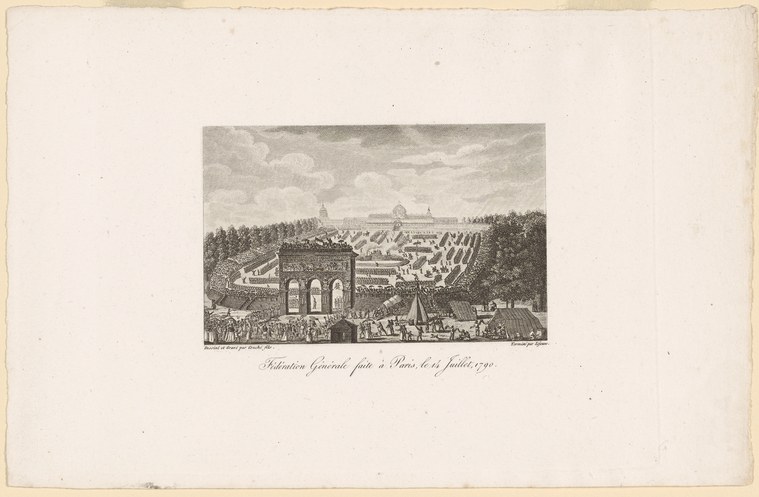
Fédération Générale faite à Paris, le 14 Juillet, 1790
Unknown artist
- Collection:
- Prints depicting dance
- Source:
- New York Public Library
- Rights:
- Public domain — free to use, share and adapt.
- Recorded as:
- Public Domain
This engraving records a critical moment when European civic culture invented the mass political festival and used coordinated collective movement—processional, ceremonial—as a language of revolutionary legitimacy. It shows how the aesthetics of dance and ceremony shifted from aristocratic order to democratic assembly, establishing visual conventions that would shape political spectacle for centuries. For historians of festival, ritual, and embodied politics, this image is essential documentation of how a revolutionary state choreographed its own representation.
What you are looking at
This engraving depicts a vast outdoor celebration in Paris on 14 July 1790, commemorating the first anniversary of the storming of the Bastille. The composition is structured as a bird's-eye view of the Champ de Mars, with crowds of figures filling the foreground and middle ground in loose processional arrangement. A large temporary pavilion or reviewing stand occupies the left side, and formal gardens or planted rows recede into the distance. The sky is rendered in classical stippled technique, with clouds breaking to suggest a clear day. The entire scene conveys mass participation and civic spectacle: hundreds of small figures are scattered across the composition, many appearing to move or gesture, though individual dancers cannot be clearly isolated. The scale emphasizes the collective nature of the event rather than the refinement of individual movement.
The dancing
The figures in the foreground and middle ground are rendered as small silhouettes at this scale, making detailed analysis of hold or frame impossible. Some appear to be standing in loose groups; others seem to be in motion or processional line. The clothing is legible only at the broadest level—civilian dress of the period with no special theatrical costume. The sheer number of participants and the outdoor setting suggest mass participation rather than trained performers, though the organized composition hints at some structure or choreography to the gathering.
The dance depicted
This is not a depiction of theatrical dance but rather a civic celebration and popular festival. The 1790 Fédération Générale brought together National Guard units, dignitaries, and ordinary citizens in a ritualized public assembly marked by processions, music, and collective movement. While formal 'dance' in the theatrical sense was likely not the primary activity, the gathering would have included processional movement, possibly some ceremonial formations, and the kind of social mixing and street entertainment typical of revolutionary festivals. The image documents a moment of political theater and collective participation rather than choreographed dance.
How it was made
This is a copper-plate engraving, evident from the fine parallel-line hatching throughout the composition, the clarity of architectural detail, and the overall tonal range achieved through line density alone. Engravings of this period were expensive to produce and distribute; this would have been a significant commemorative publication, likely issued to circulate an image of the event to a broad educated public across France and Europe. The bird's-eye perspective and architectural precision suggest the work may have been based on a drawing by an artist present at the event or working from descriptions and plans. The technique allowed for fine detail but limited the rendering of movement to suggestion rather than specificity.
About this work
This engraving records the Fédération Générale of 14 July 1790, the first official state celebration of the French Revolution's anniversary, held at the Champ de Mars in Paris. It belongs in a gallery of dance art not because it depicts ballroom or theatrical dance, but because it captures a pivotal moment when the revolutionary state claimed the power to orchestrate collective movement and ceremonial assembly on an unprecedented scale. The image sits at the intersection of political theatre, civic ritual, and popular festival—registers in which 'dance' meant formation, procession, and the embodied presence of the revolutionary body politic rather than trained choreography.
For art and dance historians, the work documents how European culture transformed the representation of bodies in motion: from the symmetrical couple or court line to the surging crowd, from individual virtuosity to collective participation. The engraving was one of thousands produced to commemorate 1790, making it a mass medium for circulating an image of revolutionary spectacle.
How to look at it
Attend to the composition's scale and perspective: the artist chose an elevated viewpoint that flattens hierarchy and emphasizes the vastness of the crowd. This is a painting of spectacle as collective phenomenon, not individual action. Look at how the pavilion and reviewing stand dominate the left side—this is not a spontaneous celebration but a carefully structured state ceremony. The formal geometry of the gardens in the background reinforces the sense of order imposed on the crowd. The figures themselves are rendered too small to read individual gesture or dance form, but that very technique—dissolving the person into the crowd—was the point: the revolutionary subject was the people, not the dancer.
The period
The Fédération Générale of 1790 occurred at a moment of extraordinary optimism in the French Revolution. By 1790, the National Assembly had abolished feudalism, declared rights, seized church lands, and drafted a constitution. The July festival was designed to unite the nation—National Guard units from every department were invited to Paris to swear allegiance to the new constitutional order in a massive outdoor ceremony. This was revolutionary pageantry at its height: the state attempting to regiment and display the people as a unified political body.
In the history of dance and spectacle, the Fédération Générale marked a watershed. Before 1789, processional and ceremonial movement belonged chiefly to the court and the church. By 1790, the revolution had appropriated these forms of collective movement and claimed them as expressions of popular sovereignty. Later French revolutionary festivals—the Fête de la Fédération in 1792, the Fête de l'Être Suprême in 1794—extended this grammar of mass movement and civic choreography. The style of this engraving reflects contemporary taste for architectural precision and documentary clarity, but also the period's anxiety to record and preserve revolutionary innovation.
Where it lives
Held by the New York Public Library in the prints collection under the catalog designation 'Prints depicting dance.' This engraving is likely one of thousands circulated in France and across Europe in 1790–91 to commemorate the anniversary celebration.
Dance in this work
Questions about this work
Is this actually a dance?
Not in the theatrical sense. The Fédération Générale was a civic assembly and political ceremony involving processions, mass swearing of oaths, and ceremonial movement, but not choreographed or performed dance. However, it is crucial to the history of how European culture understood bodily movement in public: it shows the moment when coordinated collective movement became a language of political legitimacy and democratic participation.
What was the event?
The Fédération Générale of 14 July 1790 was held at the Champ de Mars in Paris to commemorate the first anniversary of the storming of the Bastille (14 July 1789). National Guard units from across France gathered to swear loyalty to the newly drafted constitution. It was designed as a grand civic ceremony uniting the revolutionary nation.
Who made this engraving?
The artist is not recorded. The engraving was likely produced and circulated as a mass commemorative print to celebrate the event and spread an image of revolutionary spectacle. Hundreds of such prints were issued in 1790–91.
Why is crowd movement important to dance history?
Before the revolution, European concert and court dance focused on trained individual bodies or couples. The revolutionary festivals of 1790–94 pioneered the aesthetic of mass movement and collective formation as political theatre. This shift influenced how later European societies thought about dance, festival, and the embodied expression of group identity.
More dance artwork





